#include <stdint.h>#include <string.h>#include <sys/_keproc.h>#include <sys/_procheap.h>#include <sys/_heap.h>#include <sys/mman.h>
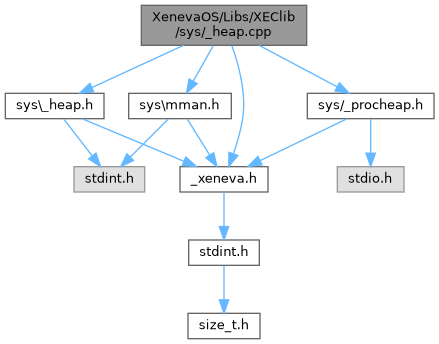
Include dependency graph for _heap.cpp:
Classes | |
| struct | malloc_chunk |
| struct | malloc_tree_chunk |
| struct | malloc_segment |
| struct | malloc_state |
| struct | malloc_params |
Macros | |
| #define | LACKS_UNISTD_H |
| #define | LACKS_FCNTL_H |
| #define | LACKS_SYS_PARAM_H |
| #define | stderr 0 |
| #define | HAVE_MORECORE 1 |
| #define | MORECORE xe_request_page |
| #define | MORECORE_CONTIGUOUS 1 |
| #define | MORECORE_CANNOT_TRIM 0 |
| #define | USE_DL_PREFIX |
| #define | LACKS_TIME_H |
| #define | USE_LOCKS 0 |
| #define | MALLOC_FAILURE_ACTION |
| #define | CALL_MMAP(size) xe_request_page(size) |
| #define | CALL_MUNMAP(ptr, size) xe_free_page(ptr, size) |
| #define | HAVE_MMAP 1 |
| #define | HAVE_MREMAP 0 |
| #define | NO_MALLINFO 1 |
| #define | NO_MALLOC_STATS 1 |
| #define | DEFAULT_GRANULARITY 64 |
| #define | DLMALLOC_VERSION 20806 |
| #define | DLMALLOC_EXPORT extern |
| #define | MORECORE_CONTIGUOUS 0 |
| #define | HAVE_MMAP 0 |
| #define | HAVE_MREMAP 0 |
| #define | LACKS_UNISTD_H 1 |
| #define | LACKS_SYS_TYPES_H 1 |
| #define | LACKS_SYS_MMAN_H 1 |
| #define | LACKS_FCNTL_H 1 |
| #define | LACKS_TIME_H 1 |
| #define | ABORT for(;;); |
| #define | LACKS_STDLIB_H 1 |
| #define | LACKS_STRING_H 1 |
| #define | LACKS_WINDOWS_H 1 |
| #define | LACKS_ERRNO_H 1 |
| #define | NO_MALLOC_STATS 1 |
| #define | EINVAL 22 |
| #define | ENOMEM 12 |
| #define | ENOTSUP 95 |
| #define | errno _kernel_errno |
| #define | errno 0 |
| #define | MORECORE_FAILURE ((void*)(-1)) |
| #define | MAX_SIZE_T (~(size_t)0) |
| #define | USE_SPIN_LOCKS 0 |
| #define | ONLY_MSPACES 0 |
| #define | MSPACES 0 |
| #define | MALLOC_ALIGNMENT ((size_t)(2 * sizeof(void *))) |
| #define | FOOTERS 0 |
| #define | ABORT_ON_ASSERT_FAILURE 1 |
| #define | PROCEED_ON_ERROR 0 |
| #define | INSECURE 0 |
| #define | MALLOC_INSPECT_ALL 0 |
| #define | MMAP_CLEARS 1 |
| #define | MORECORE_DEFAULT sbrk |
| #define | DEFAULT_TRIM_THRESHOLD MAX_SIZE_T |
| #define | DEFAULT_MMAP_THRESHOLD ((size_t)256U * (size_t)1024U) |
| #define | MAX_RELEASE_CHECK_RATE 4095 |
| #define | USE_BUILTIN_FFS 0 |
| #define | USE_DEV_RANDOM 0 |
| #define | MALLINFO_FIELD_TYPE size_t |
| #define | NO_SEGMENT_TRAVERSAL 0 |
| #define | M_TRIM_THRESHOLD (-1) |
| #define | M_GRANULARITY (-2) |
| #define | M_MMAP_THRESHOLD (-3) |
| #define | NOINLINE |
| #define | FORCEINLINE |
| #define | assert(x) |
| #define | DEBUG 0 |
| #define | LOCK_AT_FORK 0 |
| #define | malloc_getpagesize ((size_t)4096U) |
| #define | SIZE_T_SIZE (sizeof(size_t)) |
| #define | SIZE_T_BITSIZE (sizeof(size_t) << 3) |
| #define | SIZE_T_ZERO ((size_t)0) |
| #define | SIZE_T_ONE ((size_t)1) |
| #define | SIZE_T_TWO ((size_t)2) |
| #define | SIZE_T_FOUR ((size_t)4) |
| #define | TWO_SIZE_T_SIZES (SIZE_T_SIZE<<1) |
| #define | FOUR_SIZE_T_SIZES (SIZE_T_SIZE<<2) |
| #define | SIX_SIZE_T_SIZES (FOUR_SIZE_T_SIZES+TWO_SIZE_T_SIZES) |
| #define | HALF_MAX_SIZE_T (MAX_SIZE_T / 2U) |
| #define | CHUNK_ALIGN_MASK (MALLOC_ALIGNMENT - SIZE_T_ONE) |
| #define | is_aligned(A) (((size_t)((A)) & (CHUNK_ALIGN_MASK)) == 0) |
| #define | align_offset(A) |
| #define | MFAIL ((void*)(MAX_SIZE_T)) |
| #define | CMFAIL ((char*)(MFAIL)) /* defined for convenience */ |
| #define | MUNMAP_DEFAULT(a, s) munmap((a), (s)) |
| #define | MMAP_PROT (PROT_READ|PROT_WRITE) |
| #define | MMAP_FLAGS (MAP_PRIVATE) |
| #define | MMAP_DEFAULT(s) |
| #define | DIRECT_MMAP_DEFAULT(s) MMAP_DEFAULT(s) |
| #define | CALL_MORECORE(S) MORECORE(S) |
| #define | USE_MMAP_BIT (SIZE_T_ONE) |
| #define | CALL_MMAP(s) MMAP_DEFAULT(s) |
| #define | CALL_MUNMAP(a, s) MUNMAP_DEFAULT((a), (s)) |
| #define | CALL_DIRECT_MMAP(s) DIRECT_MMAP_DEFAULT(s) |
| #define | CALL_MREMAP(addr, osz, nsz, mv) MFAIL |
| #define | USE_NONCONTIGUOUS_BIT (4U) |
| #define | EXTERN_BIT (8U) |
| #define | USE_LOCK_BIT (0U) |
| #define | INITIAL_LOCK(l) (0) |
| #define | DESTROY_LOCK(l) (0) |
| #define | ACQUIRE_MALLOC_GLOBAL_LOCK() |
| #define | RELEASE_MALLOC_GLOBAL_LOCK() |
| #define | MCHUNK_SIZE (sizeof(mchunk)) |
| #define | CHUNK_OVERHEAD (SIZE_T_SIZE) |
| #define | MMAP_CHUNK_OVERHEAD (TWO_SIZE_T_SIZES) |
| #define | MMAP_FOOT_PAD (FOUR_SIZE_T_SIZES) |
| #define | MIN_CHUNK_SIZE ((MCHUNK_SIZE + CHUNK_ALIGN_MASK) & ~CHUNK_ALIGN_MASK) |
| #define | chunk2mem(p) ((void*)((char*)(p) + TWO_SIZE_T_SIZES)) |
| #define | mem2chunk(mem) ((mchunkptr)((char*)(mem) - TWO_SIZE_T_SIZES)) |
| #define | align_as_chunk(A) (mchunkptr)((A) + align_offset(chunk2mem(A))) |
| #define | MAX_REQUEST ((-MIN_CHUNK_SIZE) << 2) |
| #define | MIN_REQUEST (MIN_CHUNK_SIZE - CHUNK_OVERHEAD - SIZE_T_ONE) |
| #define | pad_request(req) (((req) + CHUNK_OVERHEAD + CHUNK_ALIGN_MASK) & ~CHUNK_ALIGN_MASK) |
| #define | request2size(req) (((req) < MIN_REQUEST)? MIN_CHUNK_SIZE : pad_request(req)) |
| #define | PINUSE_BIT (SIZE_T_ONE) |
| #define | CINUSE_BIT (SIZE_T_TWO) |
| #define | FLAG4_BIT (SIZE_T_FOUR) |
| #define | INUSE_BITS (PINUSE_BIT|CINUSE_BIT) |
| #define | FLAG_BITS (PINUSE_BIT|CINUSE_BIT|FLAG4_BIT) |
| #define | FENCEPOST_HEAD (INUSE_BITS|SIZE_T_SIZE) |
| #define | cinuse(p) ((p)->head & CINUSE_BIT) |
| #define | pinuse(p) ((p)->head & PINUSE_BIT) |
| #define | flag4inuse(p) ((p)->head & FLAG4_BIT) |
| #define | is_inuse(p) (((p)->head & INUSE_BITS) != PINUSE_BIT) |
| #define | is_mmapped(p) (((p)->head & INUSE_BITS) == 0) |
| #define | chunksize(p) ((p)->head & ~(FLAG_BITS)) |
| #define | clear_pinuse(p) ((p)->head &= ~PINUSE_BIT) |
| #define | set_flag4(p) ((p)->head |= FLAG4_BIT) |
| #define | clear_flag4(p) ((p)->head &= ~FLAG4_BIT) |
| #define | chunk_plus_offset(p, s) ((mchunkptr)(((char*)(p)) + (s))) |
| #define | chunk_minus_offset(p, s) ((mchunkptr)(((char*)(p)) - (s))) |
| #define | next_chunk(p) ((mchunkptr)( ((char*)(p)) + ((p)->head & ~FLAG_BITS))) |
| #define | prev_chunk(p) ((mchunkptr)( ((char*)(p)) - ((p)->prev_foot) )) |
| #define | next_pinuse(p) ((next_chunk(p)->head) & PINUSE_BIT) |
| #define | get_foot(p, s) (((mchunkptr)((char*)(p) + (s)))->prev_foot) |
| #define | set_foot(p, s) (((mchunkptr)((char*)(p) + (s)))->prev_foot = (s)) |
| #define | set_size_and_pinuse_of_free_chunk(p, s) ((p)->head = (s|PINUSE_BIT), set_foot(p, s)) |
| #define | set_free_with_pinuse(p, s, n) (clear_pinuse(n), set_size_and_pinuse_of_free_chunk(p, s)) |
| #define | overhead_for(p) (is_mmapped(p)? MMAP_CHUNK_OVERHEAD : CHUNK_OVERHEAD) |
| #define | calloc_must_clear(p) (!is_mmapped(p)) |
| #define | leftmost_child(t) ((t)->child[0] != 0? (t)->child[0] : (t)->child[1]) |
| #define | is_mmapped_segment(S) ((S)->sflags & USE_MMAP_BIT) |
| #define | is_extern_segment(S) ((S)->sflags & EXTERN_BIT) |
| #define | NSMALLBINS (32U) |
| #define | NTREEBINS (32U) |
| #define | SMALLBIN_SHIFT (3U) |
| #define | SMALLBIN_WIDTH (SIZE_T_ONE << SMALLBIN_SHIFT) |
| #define | TREEBIN_SHIFT (8U) |
| #define | MIN_LARGE_SIZE (SIZE_T_ONE << TREEBIN_SHIFT) |
| #define | MAX_SMALL_SIZE (MIN_LARGE_SIZE - SIZE_T_ONE) |
| #define | MAX_SMALL_REQUEST (MAX_SMALL_SIZE - CHUNK_ALIGN_MASK - CHUNK_OVERHEAD) |
| #define | ensure_initialization() (void)(mparams.magic != 0 || init_mparams()) |
| #define | gm (&_gm_) |
| #define | is_global(M) ((M) == &_gm_) |
| #define | is_initialized(M) ((M)->top != 0) |
| #define | use_lock(M) ((M)->mflags & USE_LOCK_BIT) |
| #define | enable_lock(M) ((M)->mflags |= USE_LOCK_BIT) |
| #define | disable_lock(M) |
| #define | use_mmap(M) ((M)->mflags & USE_MMAP_BIT) |
| #define | enable_mmap(M) ((M)->mflags |= USE_MMAP_BIT) |
| #define | disable_mmap(M) ((M)->mflags &= ~USE_MMAP_BIT) |
| #define | use_noncontiguous(M) ((M)->mflags & USE_NONCONTIGUOUS_BIT) |
| #define | disable_contiguous(M) ((M)->mflags |= USE_NONCONTIGUOUS_BIT) |
| #define | set_lock(M, L) |
| #define | page_align(S) (((S) + (mparams.page_size - SIZE_T_ONE)) & ~(mparams.page_size - SIZE_T_ONE)) |
| #define | granularity_align(S) |
| #define | mmap_align(S) page_align(S) |
| #define | SYS_ALLOC_PADDING (TOP_FOOT_SIZE + MALLOC_ALIGNMENT) |
| #define | is_page_aligned(S) (((size_t)(S) & (mparams.page_size - SIZE_T_ONE)) == 0) |
| #define | is_granularity_aligned(S) (((size_t)(S) & (mparams.granularity - SIZE_T_ONE)) == 0) |
| #define | segment_holds(S, A) ((char*)(A) >= S->base && (char*)(A) < S->base + S->size) |
| #define | should_trim(M, s) (1) |
| #define | TOP_FOOT_SIZE (align_offset(chunk2mem(0))+pad_request(sizeof(struct malloc_segment))+MIN_CHUNK_SIZE) |
| #define | PREACTION(M) (0) |
| #define | POSTACTION(M) |
| #define | CORRUPTION_ERROR_ACTION(m) ABORT |
| #define | USAGE_ERROR_ACTION(m, p) ABORT |
| #define | check_free_chunk(M, P) |
| #define | check_inuse_chunk(M, P) |
| #define | check_malloced_chunk(M, P, N) |
| #define | check_mmapped_chunk(M, P) |
| #define | check_malloc_state(M) |
| #define | check_top_chunk(M, P) |
| #define | is_small(s) (((s) >> SMALLBIN_SHIFT) < NSMALLBINS) |
| #define | small_index(s) (bindex_t)((s) >> SMALLBIN_SHIFT) |
| #define | small_index2size(i) ((i) << SMALLBIN_SHIFT) |
| #define | MIN_SMALL_INDEX (small_index(MIN_CHUNK_SIZE)) |
| #define | smallbin_at(M, i) ((sbinptr)((char*)&((M)->smallbins[(i)<<1]))) |
| #define | treebin_at(M, i) (&((M)->treebins[i])) |
| #define | compute_tree_index(S, I) |
| #define | bit_for_tree_index(i) (i == NTREEBINS-1)? (SIZE_T_BITSIZE-1) : (((i) >> 1) + TREEBIN_SHIFT - 2) |
| #define | leftshift_for_tree_index(i) |
| #define | minsize_for_tree_index(i) |
| #define | idx2bit(i) ((binmap_t)(1) << (i)) |
| #define | mark_smallmap(M, i) ((M)->smallmap |= idx2bit(i)) |
| #define | clear_smallmap(M, i) ((M)->smallmap &= ~idx2bit(i)) |
| #define | smallmap_is_marked(M, i) ((M)->smallmap & idx2bit(i)) |
| #define | mark_treemap(M, i) ((M)->treemap |= idx2bit(i)) |
| #define | clear_treemap(M, i) ((M)->treemap &= ~idx2bit(i)) |
| #define | treemap_is_marked(M, i) ((M)->treemap & idx2bit(i)) |
| #define | least_bit(x) ((x) & -(x)) |
| #define | left_bits(x) ((x<<1) | -(x<<1)) |
| #define | same_or_left_bits(x) ((x) | -(x)) |
| #define | compute_bit2idx(X, I) |
| #define | ok_address(M, a) ((char*)(a) >= (M)->least_addr) |
| #define | ok_next(p, n) ((char*)(p) < (char*)(n)) |
| #define | ok_inuse(p) is_inuse(p) |
| #define | ok_pinuse(p) pinuse(p) |
| #define | ok_magic(M) (1) |
| #define | RTCHECK(e) (e) |
| #define | mark_inuse_foot(M, p, s) |
| #define | set_inuse(M, p, s) |
| #define | set_inuse_and_pinuse(M, p, s) |
| #define | set_size_and_pinuse_of_inuse_chunk(M, p, s) ((p)->head = (s|PINUSE_BIT|CINUSE_BIT)) |
| #define | insert_small_chunk(M, P, S) |
| #define | unlink_small_chunk(M, P, S) |
| #define | unlink_first_small_chunk(M, B, P, I) |
| #define | replace_dv(M, P, S) |
| #define | insert_large_chunk(M, X, S) |
| #define | unlink_large_chunk(M, X) |
| #define | insert_chunk(M, P, S) |
| #define | unlink_chunk(M, P, S) |
| #define | internal_malloc(m, b) dlmalloc(b) |
| #define | internal_free(m, mem) dlfree(mem) |
| #define | fm gm |
Typedefs | |
| typedef unsigned long | DWORD |
| typedef void * | HANDLE |
| typedef void * | PVOID |
| typedef long | LONG |
| typedef struct malloc_chunk | mchunk |
| typedef struct malloc_chunk * | mchunkptr |
| typedef struct malloc_chunk * | sbinptr |
| typedef unsigned int | bindex_t |
| typedef unsigned int | binmap_t |
| typedef unsigned int | flag_t |
| typedef struct malloc_tree_chunk | tchunk |
| typedef struct malloc_tree_chunk * | tchunkptr |
| typedef struct malloc_tree_chunk * | tbinptr |
| typedef struct malloc_segment | msegment |
| typedef struct malloc_segment * | msegmentptr |
| typedef struct malloc_state * | mstate |
Macro Definition Documentation
◆ ABORT
| #define ABORT for(;;); |
◆ ABORT_ON_ASSERT_FAILURE
| #define ABORT_ON_ASSERT_FAILURE 1 |
◆ ACQUIRE_MALLOC_GLOBAL_LOCK
| #define ACQUIRE_MALLOC_GLOBAL_LOCK | ( | ) |
◆ align_as_chunk
| #define align_as_chunk | ( | A | ) | (mchunkptr)((A) + align_offset(chunk2mem(A))) |
◆ align_offset
| #define align_offset | ( | A | ) |
Value:
((((size_t)(A) & CHUNK_ALIGN_MASK) == 0)? 0 :\
◆ assert
| #define assert | ( | x | ) |
◆ bit_for_tree_index
| #define bit_for_tree_index | ( | i | ) | (i == NTREEBINS-1)? (SIZE_T_BITSIZE-1) : (((i) >> 1) + TREEBIN_SHIFT - 2) |
◆ CALL_DIRECT_MMAP
| #define CALL_DIRECT_MMAP | ( | s | ) | DIRECT_MMAP_DEFAULT(s) |
◆ CALL_MMAP [1/2]
| #define CALL_MMAP | ( | s | ) | MMAP_DEFAULT(s) |
◆ CALL_MMAP [2/2]
| #define CALL_MMAP | ( | size | ) | xe_request_page(size) |
◆ CALL_MORECORE
| #define CALL_MORECORE | ( | S | ) | MORECORE(S) |
Define CALL_MORECORE
◆ CALL_MREMAP
| #define CALL_MREMAP | ( | addr, | |
| osz, | |||
| nsz, | |||
| mv | |||
| ) | MFAIL |
Define CALL_MREMAP
◆ CALL_MUNMAP [1/2]
| #define CALL_MUNMAP | ( | a, | |
| s | |||
| ) | MUNMAP_DEFAULT((a), (s)) |
◆ CALL_MUNMAP [2/2]
| #define CALL_MUNMAP | ( | ptr, | |
| size | |||
| ) | xe_free_page(ptr, size) |
◆ calloc_must_clear
| #define calloc_must_clear | ( | p | ) | (!is_mmapped(p)) |
◆ check_free_chunk
| #define check_free_chunk | ( | M, | |
| P | |||
| ) |
◆ check_inuse_chunk
| #define check_inuse_chunk | ( | M, | |
| P | |||
| ) |
◆ check_malloc_state
| #define check_malloc_state | ( | M | ) |
◆ check_malloced_chunk
| #define check_malloced_chunk | ( | M, | |
| P, | |||
| N | |||
| ) |
◆ check_mmapped_chunk
| #define check_mmapped_chunk | ( | M, | |
| P | |||
| ) |
◆ check_top_chunk
| #define check_top_chunk | ( | M, | |
| P | |||
| ) |
◆ chunk2mem
| #define chunk2mem | ( | p | ) | ((void*)((char*)(p) + TWO_SIZE_T_SIZES)) |
◆ CHUNK_ALIGN_MASK
| #define CHUNK_ALIGN_MASK (MALLOC_ALIGNMENT - SIZE_T_ONE) |
◆ chunk_minus_offset
| #define chunk_minus_offset | ( | p, | |
| s | |||
| ) | ((mchunkptr)(((char*)(p)) - (s))) |
◆ CHUNK_OVERHEAD
| #define CHUNK_OVERHEAD (SIZE_T_SIZE) |
◆ chunk_plus_offset
| #define chunk_plus_offset | ( | p, | |
| s | |||
| ) | ((mchunkptr)(((char*)(p)) + (s))) |
◆ chunksize
| #define chunksize | ( | p | ) | ((p)->head & ~(FLAG_BITS)) |
◆ cinuse
| #define cinuse | ( | p | ) | ((p)->head & CINUSE_BIT) |
◆ CINUSE_BIT
| #define CINUSE_BIT (SIZE_T_TWO) |
◆ clear_flag4
| #define clear_flag4 | ( | p | ) | ((p)->head &= ~FLAG4_BIT) |
◆ clear_pinuse
| #define clear_pinuse | ( | p | ) | ((p)->head &= ~PINUSE_BIT) |
◆ clear_smallmap
| #define clear_smallmap | ( | M, | |
| i | |||
| ) | ((M)->smallmap &= ~idx2bit(i)) |
◆ clear_treemap
| #define clear_treemap | ( | M, | |
| i | |||
| ) | ((M)->treemap &= ~idx2bit(i)) |
◆ CMFAIL
| #define CMFAIL ((char*)(MFAIL)) /* defined for convenience */ |
◆ compute_bit2idx
| #define compute_bit2idx | ( | X, | |
| I | |||
| ) |
Value:
{\
unsigned int Y = X - 1;\
unsigned int K = Y >> (16-4) & 16;\
unsigned int N = K; Y >>= K;\
N += K = Y >> (8-3) & 8; Y >>= K;\
N += K = Y >> (4-2) & 4; Y >>= K;\
N += K = Y >> (2-1) & 2; Y >>= K;\
N += K = Y >> (1-0) & 1; Y >>= K;\
I = (bindex_t)(N + Y);\
}
◆ compute_tree_index
| #define compute_tree_index | ( | S, | |
| I | |||
| ) |
Value:
{\
size_t X = S >> TREEBIN_SHIFT;\
if (X == 0)\
I = 0;\
else if (X > 0xFFFF)\
I = NTREEBINS-1;\
else {\
unsigned int Y = (unsigned int)X;\
unsigned int N = ((Y - 0x100) >> 16) & 8;\
unsigned int K = (((Y <<= N) - 0x1000) >> 16) & 4;\
N += K;\
N += K = (((Y <<= K) - 0x4000) >> 16) & 2;\
K = 14 - N + ((Y <<= K) >> 15);\
I = (K << 1) + ((S >> (K + (TREEBIN_SHIFT-1)) & 1));\
}\
}
◆ CORRUPTION_ERROR_ACTION
| #define CORRUPTION_ERROR_ACTION | ( | m | ) | ABORT |
◆ DEBUG
| #define DEBUG 0 |
◆ DEFAULT_GRANULARITY
| #define DEFAULT_GRANULARITY 64 |
◆ DEFAULT_MMAP_THRESHOLD
◆ DEFAULT_TRIM_THRESHOLD
| #define DEFAULT_TRIM_THRESHOLD MAX_SIZE_T |
◆ DESTROY_LOCK
| #define DESTROY_LOCK | ( | l | ) | (0) |
◆ DIRECT_MMAP_DEFAULT
| #define DIRECT_MMAP_DEFAULT | ( | s | ) | MMAP_DEFAULT(s) |
◆ disable_contiguous
| #define disable_contiguous | ( | M | ) | ((M)->mflags |= USE_NONCONTIGUOUS_BIT) |
◆ disable_lock
| #define disable_lock | ( | M | ) |
◆ disable_mmap
| #define disable_mmap | ( | M | ) | ((M)->mflags &= ~USE_MMAP_BIT) |
◆ DLMALLOC_EXPORT
| #define DLMALLOC_EXPORT extern |
◆ DLMALLOC_VERSION
| #define DLMALLOC_VERSION 20806 |
◆ EINVAL
| #define EINVAL 22 |
◆ enable_lock
| #define enable_lock | ( | M | ) | ((M)->mflags |= USE_LOCK_BIT) |
◆ enable_mmap
| #define enable_mmap | ( | M | ) | ((M)->mflags |= USE_MMAP_BIT) |
◆ ENOMEM
| #define ENOMEM 12 |
◆ ENOTSUP
| #define ENOTSUP 95 |
◆ ensure_initialization
| #define ensure_initialization | ( | ) | (void)(mparams.magic != 0 || init_mparams()) |
◆ errno [1/2]
| #define errno _kernel_errno |
◆ errno [2/2]
| #define errno 0 |
◆ EXTERN_BIT
| #define EXTERN_BIT (8U) |
◆ FENCEPOST_HEAD
| #define FENCEPOST_HEAD (INUSE_BITS|SIZE_T_SIZE) |
◆ FLAG4_BIT
| #define FLAG4_BIT (SIZE_T_FOUR) |
◆ flag4inuse
| #define flag4inuse | ( | p | ) | ((p)->head & FLAG4_BIT) |
◆ FLAG_BITS
| #define FLAG_BITS (PINUSE_BIT|CINUSE_BIT|FLAG4_BIT) |
◆ fm
| #define fm gm |
◆ FOOTERS
| #define FOOTERS 0 |
◆ FORCEINLINE
| #define FORCEINLINE |
◆ FOUR_SIZE_T_SIZES
| #define FOUR_SIZE_T_SIZES (SIZE_T_SIZE<<2) |
◆ get_foot
| #define get_foot | ( | p, | |
| s | |||
| ) | (((mchunkptr)((char*)(p) + (s)))->prev_foot) |
◆ gm
| #define gm (&_gm_) |
◆ granularity_align
| #define granularity_align | ( | S | ) |
Value:
(((S) + (mparams.granularity - SIZE_T_ONE))\
& ~(mparams.granularity - SIZE_T_ONE))
◆ HALF_MAX_SIZE_T
| #define HALF_MAX_SIZE_T (MAX_SIZE_T / 2U) |
◆ HAVE_MMAP [1/2]
| #define HAVE_MMAP 1 |
◆ HAVE_MMAP [2/2]
| #define HAVE_MMAP 0 |
◆ HAVE_MORECORE
| #define HAVE_MORECORE 1 |
◆ HAVE_MREMAP [1/2]
| #define HAVE_MREMAP 0 |
◆ HAVE_MREMAP [2/2]
| #define HAVE_MREMAP 0 |
◆ idx2bit
| #define idx2bit | ( | i | ) | ((binmap_t)(1) << (i)) |
◆ INITIAL_LOCK
| #define INITIAL_LOCK | ( | l | ) | (0) |
◆ INSECURE
| #define INSECURE 0 |
◆ insert_chunk
| #define insert_chunk | ( | M, | |
| P, | |||
| S | |||
| ) |
Value:
Definition dlmalloc.c:2466
◆ insert_large_chunk
| #define insert_large_chunk | ( | M, | |
| X, | |||
| S | |||
| ) |
◆ insert_small_chunk
| #define insert_small_chunk | ( | M, | |
| P, | |||
| S | |||
| ) |
Value:
{\
bindex_t I = small_index(S);\
mchunkptr B = smallbin_at(M, I);\
mchunkptr F = B;\
assert(S >= MIN_CHUNK_SIZE);\
if (!smallmap_is_marked(M, I))\
mark_smallmap(M, I);\
F = B->fd;\
else {\
CORRUPTION_ERROR_ACTION(M);\
}\
B->fd = P;\
F->bk = P;\
P->fd = F;\
P->bk = B;\
}
Definition dlmalloc.c:2264
◆ internal_free
| #define internal_free | ( | m, | |
| mem | |||
| ) | dlfree(mem) |
◆ internal_malloc
| #define internal_malloc | ( | m, | |
| b | |||
| ) | dlmalloc(b) |
◆ INUSE_BITS
| #define INUSE_BITS (PINUSE_BIT|CINUSE_BIT) |
◆ is_aligned
| #define is_aligned | ( | A | ) | (((size_t)((A)) & (CHUNK_ALIGN_MASK)) == 0) |
◆ is_extern_segment
| #define is_extern_segment | ( | S | ) | ((S)->sflags & EXTERN_BIT) |
◆ is_global
| #define is_global | ( | M | ) | ((M) == &_gm_) |
◆ is_granularity_aligned
| #define is_granularity_aligned | ( | S | ) | (((size_t)(S) & (mparams.granularity - SIZE_T_ONE)) == 0) |
◆ is_initialized
| #define is_initialized | ( | M | ) | ((M)->top != 0) |
◆ is_inuse
| #define is_inuse | ( | p | ) | (((p)->head & INUSE_BITS) != PINUSE_BIT) |
◆ is_mmapped
| #define is_mmapped | ( | p | ) | (((p)->head & INUSE_BITS) == 0) |
◆ is_mmapped_segment
| #define is_mmapped_segment | ( | S | ) | ((S)->sflags & USE_MMAP_BIT) |
◆ is_page_aligned
| #define is_page_aligned | ( | S | ) | (((size_t)(S) & (mparams.page_size - SIZE_T_ONE)) == 0) |
◆ is_small
| #define is_small | ( | s | ) | (((s) >> SMALLBIN_SHIFT) < NSMALLBINS) |
◆ LACKS_ERRNO_H
| #define LACKS_ERRNO_H 1 |
◆ LACKS_FCNTL_H [1/2]
| #define LACKS_FCNTL_H |
◆ LACKS_FCNTL_H [2/2]
| #define LACKS_FCNTL_H 1 |
◆ LACKS_STDLIB_H
| #define LACKS_STDLIB_H 1 |
◆ LACKS_STRING_H
| #define LACKS_STRING_H 1 |
◆ LACKS_SYS_MMAN_H
| #define LACKS_SYS_MMAN_H 1 |
◆ LACKS_SYS_PARAM_H
| #define LACKS_SYS_PARAM_H |
◆ LACKS_SYS_TYPES_H
| #define LACKS_SYS_TYPES_H 1 |
◆ LACKS_TIME_H [1/2]
| #define LACKS_TIME_H |
◆ LACKS_TIME_H [2/2]
| #define LACKS_TIME_H 1 |
◆ LACKS_UNISTD_H [1/2]
| #define LACKS_UNISTD_H |
◆ LACKS_UNISTD_H [2/2]
| #define LACKS_UNISTD_H 1 |
◆ LACKS_WINDOWS_H
| #define LACKS_WINDOWS_H 1 |
◆ least_bit
| #define least_bit | ( | x | ) | ((x) & -(x)) |
◆ left_bits
| #define left_bits | ( | x | ) | ((x<<1) | -(x<<1)) |
◆ leftmost_child
◆ leftshift_for_tree_index
| #define leftshift_for_tree_index | ( | i | ) |
Value:
((i == NTREEBINS-1)? 0 : \
◆ LOCK_AT_FORK
| #define LOCK_AT_FORK 0 |
◆ M_GRANULARITY
| #define M_GRANULARITY (-2) |
◆ M_MMAP_THRESHOLD
| #define M_MMAP_THRESHOLD (-3) |
◆ M_TRIM_THRESHOLD
| #define M_TRIM_THRESHOLD (-1) |
◆ MALLINFO_FIELD_TYPE
| #define MALLINFO_FIELD_TYPE size_t |
◆ MALLOC_ALIGNMENT
| #define MALLOC_ALIGNMENT ((size_t)(2 * sizeof(void *))) |
◆ MALLOC_FAILURE_ACTION
| #define MALLOC_FAILURE_ACTION |
◆ malloc_getpagesize
| #define malloc_getpagesize ((size_t)4096U) |
◆ MALLOC_INSPECT_ALL
| #define MALLOC_INSPECT_ALL 0 |
◆ mark_inuse_foot
| #define mark_inuse_foot | ( | M, | |
| p, | |||
| s | |||
| ) |
◆ mark_smallmap
| #define mark_smallmap | ( | M, | |
| i | |||
| ) | ((M)->smallmap |= idx2bit(i)) |
◆ mark_treemap
| #define mark_treemap | ( | M, | |
| i | |||
| ) | ((M)->treemap |= idx2bit(i)) |
◆ MAX_RELEASE_CHECK_RATE
| #define MAX_RELEASE_CHECK_RATE 4095 |
◆ MAX_REQUEST
| #define MAX_REQUEST ((-MIN_CHUNK_SIZE) << 2) |
◆ MAX_SIZE_T
| #define MAX_SIZE_T (~(size_t)0) |
◆ MAX_SMALL_REQUEST
| #define MAX_SMALL_REQUEST (MAX_SMALL_SIZE - CHUNK_ALIGN_MASK - CHUNK_OVERHEAD) |
◆ MAX_SMALL_SIZE
| #define MAX_SMALL_SIZE (MIN_LARGE_SIZE - SIZE_T_ONE) |
◆ MCHUNK_SIZE
| #define MCHUNK_SIZE (sizeof(mchunk)) |
◆ mem2chunk
| #define mem2chunk | ( | mem | ) | ((mchunkptr)((char*)(mem) - TWO_SIZE_T_SIZES)) |
◆ MFAIL
| #define MFAIL ((void*)(MAX_SIZE_T)) |
◆ MIN_CHUNK_SIZE
| #define MIN_CHUNK_SIZE ((MCHUNK_SIZE + CHUNK_ALIGN_MASK) & ~CHUNK_ALIGN_MASK) |
◆ MIN_LARGE_SIZE
| #define MIN_LARGE_SIZE (SIZE_T_ONE << TREEBIN_SHIFT) |
◆ MIN_REQUEST
| #define MIN_REQUEST (MIN_CHUNK_SIZE - CHUNK_OVERHEAD - SIZE_T_ONE) |
◆ MIN_SMALL_INDEX
| #define MIN_SMALL_INDEX (small_index(MIN_CHUNK_SIZE)) |
◆ minsize_for_tree_index
| #define minsize_for_tree_index | ( | i | ) |
Value:
((SIZE_T_ONE << (((i) >> 1) + TREEBIN_SHIFT)) | \
◆ mmap_align
| #define mmap_align | ( | S | ) | page_align(S) |
◆ MMAP_CHUNK_OVERHEAD
| #define MMAP_CHUNK_OVERHEAD (TWO_SIZE_T_SIZES) |
◆ MMAP_CLEARS
| #define MMAP_CLEARS 1 |
◆ MMAP_DEFAULT
| #define MMAP_DEFAULT | ( | s | ) |
Value:
((dev_zero_fd < 0) ? \
mmap(0, (s), MMAP_PROT, MMAP_FLAGS, dev_zero_fd, 0)) : \
mmap(0, (s), MMAP_PROT, MMAP_FLAGS, dev_zero_fd, 0))
◆ MMAP_FLAGS
| #define MMAP_FLAGS (MAP_PRIVATE) |
◆ MMAP_FOOT_PAD
| #define MMAP_FOOT_PAD (FOUR_SIZE_T_SIZES) |
◆ MMAP_PROT
| #define MMAP_PROT (PROT_READ|PROT_WRITE) |
◆ MORECORE
| #define MORECORE xe_request_page |
◆ MORECORE_CANNOT_TRIM
| #define MORECORE_CANNOT_TRIM 0 |
◆ MORECORE_CONTIGUOUS [1/2]
| #define MORECORE_CONTIGUOUS 1 |
◆ MORECORE_CONTIGUOUS [2/2]
| #define MORECORE_CONTIGUOUS 0 |
◆ MORECORE_DEFAULT
| #define MORECORE_DEFAULT sbrk |
◆ MORECORE_FAILURE
| #define MORECORE_FAILURE ((void*)(-1)) |
◆ MSPACES
| #define MSPACES 0 |
◆ MUNMAP_DEFAULT
| #define MUNMAP_DEFAULT | ( | a, | |
| s | |||
| ) | munmap((a), (s)) |
◆ next_chunk
◆ next_pinuse
| #define next_pinuse | ( | p | ) | ((next_chunk(p)->head) & PINUSE_BIT) |
◆ NO_MALLINFO
| #define NO_MALLINFO 1 |
◆ NO_MALLOC_STATS [1/2]
| #define NO_MALLOC_STATS 1 |
◆ NO_MALLOC_STATS [2/2]
| #define NO_MALLOC_STATS 1 |
◆ NO_SEGMENT_TRAVERSAL
| #define NO_SEGMENT_TRAVERSAL 0 |
◆ NOINLINE
| #define NOINLINE |
◆ NSMALLBINS
| #define NSMALLBINS (32U) |
◆ NTREEBINS
| #define NTREEBINS (32U) |
◆ ok_address
| #define ok_address | ( | M, | |
| a | |||
| ) | ((char*)(a) >= (M)->least_addr) |
◆ ok_inuse
| #define ok_inuse | ( | p | ) | is_inuse(p) |
◆ ok_magic
| #define ok_magic | ( | M | ) | (1) |
◆ ok_next
| #define ok_next | ( | p, | |
| n | |||
| ) | ((char*)(p) < (char*)(n)) |
◆ ok_pinuse
| #define ok_pinuse | ( | p | ) | pinuse(p) |
◆ ONLY_MSPACES
| #define ONLY_MSPACES 0 |
◆ overhead_for
| #define overhead_for | ( | p | ) | (is_mmapped(p)? MMAP_CHUNK_OVERHEAD : CHUNK_OVERHEAD) |
◆ pad_request
| #define pad_request | ( | req | ) | (((req) + CHUNK_OVERHEAD + CHUNK_ALIGN_MASK) & ~CHUNK_ALIGN_MASK) |
◆ page_align
| #define page_align | ( | S | ) | (((S) + (mparams.page_size - SIZE_T_ONE)) & ~(mparams.page_size - SIZE_T_ONE)) |
◆ pinuse
| #define pinuse | ( | p | ) | ((p)->head & PINUSE_BIT) |
◆ PINUSE_BIT
| #define PINUSE_BIT (SIZE_T_ONE) |
◆ POSTACTION
| #define POSTACTION | ( | M | ) |
◆ PREACTION
| #define PREACTION | ( | M | ) | (0) |
◆ prev_chunk
| #define prev_chunk | ( | p | ) | ((mchunkptr)( ((char*)(p)) - ((p)->prev_foot) )) |
◆ PROCEED_ON_ERROR
| #define PROCEED_ON_ERROR 0 |
◆ RELEASE_MALLOC_GLOBAL_LOCK
| #define RELEASE_MALLOC_GLOBAL_LOCK | ( | ) |
◆ replace_dv
| #define replace_dv | ( | M, | |
| P, | |||
| S | |||
| ) |
◆ request2size
| #define request2size | ( | req | ) | (((req) < MIN_REQUEST)? MIN_CHUNK_SIZE : pad_request(req)) |
◆ RTCHECK
| #define RTCHECK | ( | e | ) | (e) |
◆ same_or_left_bits
| #define same_or_left_bits | ( | x | ) | ((x) | -(x)) |
◆ segment_holds
| #define segment_holds | ( | S, | |
| A | |||
| ) | ((char*)(A) >= S->base && (char*)(A) < S->base + S->size) |
◆ set_flag4
| #define set_flag4 | ( | p | ) | ((p)->head |= FLAG4_BIT) |
◆ set_foot
| #define set_foot | ( | p, | |
| s | |||
| ) | (((mchunkptr)((char*)(p) + (s)))->prev_foot = (s)) |
◆ set_free_with_pinuse
| #define set_free_with_pinuse | ( | p, | |
| s, | |||
| n | |||
| ) | (clear_pinuse(n), set_size_and_pinuse_of_free_chunk(p, s)) |
◆ set_inuse
| #define set_inuse | ( | M, | |
| p, | |||
| s | |||
| ) |
Value:
((p)->head = (((p)->head & PINUSE_BIT)|s|CINUSE_BIT),\
◆ set_inuse_and_pinuse
| #define set_inuse_and_pinuse | ( | M, | |
| p, | |||
| s | |||
| ) |
Value:
((p)->head = (s|PINUSE_BIT|CINUSE_BIT),\
◆ set_lock
| #define set_lock | ( | M, | |
| L | |||
| ) |
Value:
◆ set_size_and_pinuse_of_free_chunk
| #define set_size_and_pinuse_of_free_chunk | ( | p, | |
| s | |||
| ) | ((p)->head = (s|PINUSE_BIT), set_foot(p, s)) |
◆ set_size_and_pinuse_of_inuse_chunk
| #define set_size_and_pinuse_of_inuse_chunk | ( | M, | |
| p, | |||
| s | |||
| ) | ((p)->head = (s|PINUSE_BIT|CINUSE_BIT)) |
◆ should_trim
| #define should_trim | ( | M, | |
| s | |||
| ) | (1) |
◆ SIX_SIZE_T_SIZES
| #define SIX_SIZE_T_SIZES (FOUR_SIZE_T_SIZES+TWO_SIZE_T_SIZES) |
◆ SIZE_T_BITSIZE
| #define SIZE_T_BITSIZE (sizeof(size_t) << 3) |
◆ SIZE_T_FOUR
| #define SIZE_T_FOUR ((size_t)4) |
◆ SIZE_T_ONE
| #define SIZE_T_ONE ((size_t)1) |
◆ SIZE_T_SIZE
| #define SIZE_T_SIZE (sizeof(size_t)) |
◆ SIZE_T_TWO
| #define SIZE_T_TWO ((size_t)2) |
◆ SIZE_T_ZERO
| #define SIZE_T_ZERO ((size_t)0) |
◆ small_index
| #define small_index | ( | s | ) | (bindex_t)((s) >> SMALLBIN_SHIFT) |
◆ small_index2size
| #define small_index2size | ( | i | ) | ((i) << SMALLBIN_SHIFT) |
◆ smallbin_at
| #define smallbin_at | ( | M, | |
| i | |||
| ) | ((sbinptr)((char*)&((M)->smallbins[(i)<<1]))) |
◆ SMALLBIN_SHIFT
| #define SMALLBIN_SHIFT (3U) |
◆ SMALLBIN_WIDTH
| #define SMALLBIN_WIDTH (SIZE_T_ONE << SMALLBIN_SHIFT) |
◆ smallmap_is_marked
| #define smallmap_is_marked | ( | M, | |
| i | |||
| ) | ((M)->smallmap & idx2bit(i)) |
◆ stderr
| #define stderr 0 |
◆ SYS_ALLOC_PADDING
| #define SYS_ALLOC_PADDING (TOP_FOOT_SIZE + MALLOC_ALIGNMENT) |
◆ TOP_FOOT_SIZE
| #define TOP_FOOT_SIZE (align_offset(chunk2mem(0))+pad_request(sizeof(struct malloc_segment))+MIN_CHUNK_SIZE) |
◆ treebin_at
| #define treebin_at | ( | M, | |
| i | |||
| ) | (&((M)->treebins[i])) |
◆ TREEBIN_SHIFT
| #define TREEBIN_SHIFT (8U) |
◆ treemap_is_marked
| #define treemap_is_marked | ( | M, | |
| i | |||
| ) | ((M)->treemap & idx2bit(i)) |
◆ TWO_SIZE_T_SIZES
| #define TWO_SIZE_T_SIZES (SIZE_T_SIZE<<1) |
◆ unlink_chunk
| #define unlink_chunk | ( | M, | |
| P, | |||
| S | |||
| ) |
Value:
◆ unlink_first_small_chunk
| #define unlink_first_small_chunk | ( | M, | |
| B, | |||
| P, | |||
| I | |||
| ) |
Value:
{\
assert(P != B);\
assert(P != F);\
assert(chunksize(P) == small_index2size(I));\
if (B == F) {\
clear_smallmap(M, I);\
}\
F->bk = B;\
B->fd = F;\
}\
else {\
CORRUPTION_ERROR_ACTION(M);\
}\
}
◆ unlink_large_chunk
| #define unlink_large_chunk | ( | M, | |
| X | |||
| ) |
◆ unlink_small_chunk
| #define unlink_small_chunk | ( | M, | |
| P, | |||
| S | |||
| ) |
Value:
{\
bindex_t I = small_index(S);\
assert(P != B);\
assert(P != F);\
assert(chunksize(P) == small_index2size(I));\
if (B == F) {\
clear_smallmap(M, I);\
}\
(ok_address(M, B) && B->fd == P))) {\
F->bk = B;\
B->fd = F;\
}\
else {\
CORRUPTION_ERROR_ACTION(M);\
}\
}\
else {\
CORRUPTION_ERROR_ACTION(M);\
}\
}
◆ USAGE_ERROR_ACTION
| #define USAGE_ERROR_ACTION | ( | m, | |
| p | |||
| ) | ABORT |
◆ USE_BUILTIN_FFS
| #define USE_BUILTIN_FFS 0 |
◆ USE_DEV_RANDOM
| #define USE_DEV_RANDOM 0 |
◆ USE_DL_PREFIX
| #define USE_DL_PREFIX |
◆ use_lock
| #define use_lock | ( | M | ) | ((M)->mflags & USE_LOCK_BIT) |
◆ USE_LOCK_BIT
| #define USE_LOCK_BIT (0U) |
◆ USE_LOCKS
| #define USE_LOCKS 0 |
◆ use_mmap
| #define use_mmap | ( | M | ) | ((M)->mflags & USE_MMAP_BIT) |
◆ USE_MMAP_BIT
| #define USE_MMAP_BIT (SIZE_T_ONE) |
Define CALL_MMAP/CALL_MUNMAP/CALL_DIRECT_MMAP
◆ use_noncontiguous
| #define use_noncontiguous | ( | M | ) | ((M)->mflags & USE_NONCONTIGUOUS_BIT) |
◆ USE_NONCONTIGUOUS_BIT
| #define USE_NONCONTIGUOUS_BIT (4U) |
◆ USE_SPIN_LOCKS
| #define USE_SPIN_LOCKS 0 |
Typedef Documentation
◆ bindex_t
| typedef unsigned int bindex_t |
◆ binmap_t
| typedef unsigned int binmap_t |
◆ DWORD
| typedef unsigned long DWORD |
◆ flag_t
| typedef unsigned int flag_t |
◆ HANDLE
| typedef void* HANDLE |
◆ LONG
| typedef long LONG |
◆ mchunk
| typedef struct malloc_chunk mchunk |
◆ mchunkptr
| typedef struct malloc_chunk* mchunkptr |
◆ msegment
| typedef struct malloc_segment msegment |
◆ msegmentptr
| typedef struct malloc_segment* msegmentptr |
◆ mstate
| typedef struct malloc_state* mstate |
◆ PVOID
| typedef void* PVOID |
◆ sbinptr
| typedef struct malloc_chunk* sbinptr |
◆ tbinptr
| typedef struct malloc_tree_chunk* tbinptr |
◆ tchunk
| typedef struct malloc_tree_chunk tchunk |
◆ tchunkptr
| typedef struct malloc_tree_chunk* tchunkptr |
Function Documentation
◆ calloc()
| void * calloc | ( | unsigned long long | n_item, |
| unsigned long long | size | ||
| ) |
◆ dlbulk_free() [1/2]
| DLMALLOC_EXPORT size_t dlbulk_free | ( | void ** | , |
| size_t | n_elements | ||
| ) |
◆ dlbulk_free() [2/2]
◆ dlcalloc()
| DLMALLOC_EXPORT void * dlcalloc | ( | size_t | n_elements, |
| size_t | elem_size | ||
| ) |
◆ dlfree()
| DLMALLOC_EXPORT void dlfree | ( | void * | mem | ) |
◆ dlindependent_calloc() [1/2]
◆ dlindependent_calloc() [2/2]
| DLMALLOC_EXPORT void ** dlindependent_calloc | ( | size_t | , |
| size_t | , | ||
| void ** | |||
| ) |
◆ dlindependent_comalloc() [1/2]
◆ dlindependent_comalloc() [2/2]
| DLMALLOC_EXPORT void ** dlindependent_comalloc | ( | size_t | , |
| size_t * | , | ||
| void ** | |||
| ) |
◆ dlmalloc()
| DLMALLOC_EXPORT void * dlmalloc | ( | size_t | bytes | ) |
◆ dlmalloc_footprint()
| DLMALLOC_EXPORT size_t dlmalloc_footprint | ( | void | ) |
◆ dlmalloc_footprint_limit()
| DLMALLOC_EXPORT size_t dlmalloc_footprint_limit | ( | void | ) |
◆ dlmalloc_max_footprint()
| DLMALLOC_EXPORT size_t dlmalloc_max_footprint | ( | void | ) |
◆ dlmalloc_set_footprint_limit()
| DLMALLOC_EXPORT size_t dlmalloc_set_footprint_limit | ( | size_t | bytes | ) |
◆ dlmalloc_stats()
| DLMALLOC_EXPORT void dlmalloc_stats | ( | void | ) |
◆ dlmalloc_trim()
| DLMALLOC_EXPORT int dlmalloc_trim | ( | size_t | pad | ) |
◆ dlmalloc_usable_size()
| size_t dlmalloc_usable_size | ( | void * | mem | ) |
◆ dlmallopt()
| DLMALLOC_EXPORT int dlmallopt | ( | int | param_number, |
| int | value | ||
| ) |
◆ dlmemalign()
| DLMALLOC_EXPORT void * dlmemalign | ( | size_t | alignment, |
| size_t | bytes | ||
| ) |
◆ dlposix_memalign()
| DLMALLOC_EXPORT int dlposix_memalign | ( | void ** | pp, |
| size_t | alignment, | ||
| size_t | bytes | ||
| ) |
◆ dlpvalloc()
| DLMALLOC_EXPORT void * dlpvalloc | ( | size_t | bytes | ) |
◆ dlrealloc()
| DLMALLOC_EXPORT void * dlrealloc | ( | void * | oldmem, |
| size_t | bytes | ||
| ) |
◆ dlrealloc_in_place()
| DLMALLOC_EXPORT void * dlrealloc_in_place | ( | void * | oldmem, |
| size_t | bytes | ||
| ) |
◆ dlvalloc()
| DLMALLOC_EXPORT void * dlvalloc | ( | size_t | bytes | ) |
◆ free()
| void free | ( | void * | ptr | ) |
◆ malloc()
| void * malloc | ( | unsigned int | size | ) |
◆ realloc()
| void * realloc | ( | void * | ptr, |
| unsigned int | new_size | ||
| ) |
◆ xe_free_page()
| void xe_free_page | ( | void * | ptr, |
| int | pages | ||
| ) |
◆ xe_request_page()
| void * xe_request_page | ( | int | pages | ) |