#include "common.h"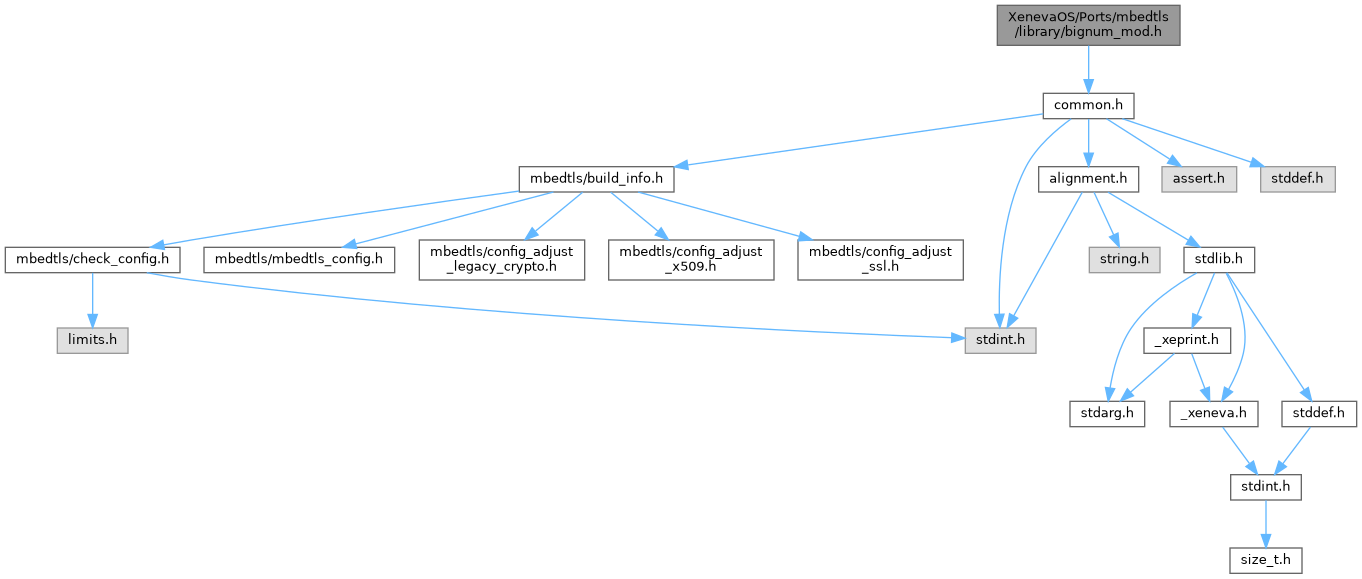
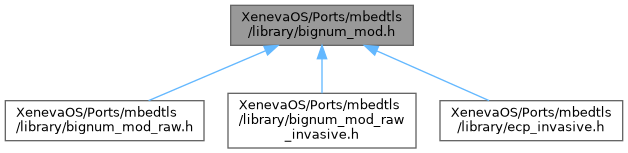
Go to the source code of this file.
Classes | |
| struct | mbedtls_mpi_mod_residue |
| struct | mbedtls_mpi_mont_struct |
| struct | mbedtls_mpi_opt_red_struct |
| struct | mbedtls_mpi_mod_modulus |
| union | mbedtls_mpi_mod_modulus::rep |
Typedefs | |
| typedef int(* | mbedtls_mpi_modp_fn) (mbedtls_mpi_uint *X, size_t X_limbs) |
Enumerations | |
| enum | mbedtls_mpi_mod_rep_selector { MBEDTLS_MPI_MOD_REP_INVALID = 0 , MBEDTLS_MPI_MOD_REP_MONTGOMERY = 2 , MBEDTLS_MPI_MOD_REP_OPT_RED } |
| enum | mbedtls_mpi_mod_ext_rep { MBEDTLS_MPI_MOD_EXT_REP_INVALID = 0 , MBEDTLS_MPI_MOD_EXT_REP_LE = 8 , MBEDTLS_MPI_MOD_EXT_REP_BE } |
Typedef Documentation
◆ mbedtls_mpi_modp_fn
| typedef int(* mbedtls_mpi_modp_fn) (mbedtls_mpi_uint *X, size_t X_limbs) |
Enumeration Type Documentation
◆ mbedtls_mpi_mod_ext_rep
◆ mbedtls_mpi_mod_rep_selector
Modular bignum functions
This module implements operations on integers modulo some fixed modulus.
The functions in this module obey the following conventions unless explicitly indicated otherwise:
- Modulus parameters: the modulus is passed as a pointer to a structure of type mbedtls_mpi_mod_modulus. The structure must be set up with an array of limbs storing the bignum value of the modulus. The modulus must be odd and is assumed to have no leading zeroes. The modulus is usually named
Nand is usually input-only. Functions which take a parameter of typeconstmbedtls_mpi_mod_modulus* must not modify its value. - Bignum parameters: Bignums are passed as pointers to an array of limbs or to a mbedtls_mpi_mod_residue structure. A limb has the type mbedtls_mpi_uint. Residues must be initialized before use, and must be associated with the modulus
N. Unless otherwise specified:- Bignum parameters called
A,B, ... are inputs and are not modified by the function. Functions which take a parameter of typeconstmbedtls_mpi_mod_residue* must not modify its value. - Bignum parameters called
X,Y, ... are outputs or input-output. The initial bignum value of output-only parameters is ignored, but they must be set up and associated with the modulusN. Some functions (typically constant-flow) require that the limbs in an output residue are initialized. - Bignum parameters called
pare inputs used to set up a modulus or residue. These must be pointers to an array of limbs. Tis a temporary storage area. The initial content of such a parameter is ignored and the final content is unspecified.- Some functions use different names, such as
rfor the residue.
- Bignum parameters called
- Bignum sizes: bignum sizes are always expressed in limbs. Both mbedtls_mpi_mod_modulus and mbedtls_mpi_mod_residue have a
limbsmember storing its size. All bignum parameters must have the same number of limbs as the modulus. All bignum sizes must be at least 1 and must be significantly less than SIZE_MAX. The behavior if a size is 0 is undefined. - Bignum representation: the representation of inputs and outputs is specified by the
int_repfield of the modulus. - Parameter ordering: for bignum parameters, outputs come before inputs. The modulus is passed after residues. Temporaries come last.
- Aliasing: in general, output bignums may be aliased to one or more inputs. Modulus values may not be aliased to any other parameter. Outputs may not be aliased to one another. Temporaries may not be aliased to any other parameter.
- Overlap: apart from aliasing of residue pointers (where two residue arguments are equal pointers), overlap is not supported and may result in undefined behavior.
- Error handling: functions generally check compatibility of input sizes. Most functions will not check that input values are in canonical form (i.e. that
A<N), this is only checked during setup of a residue structure. - Modular representatives: all functions expect inputs to be in the range [0,
N- 1] and guarantee outputs in the range [0,N- 1]. Residues are set up with an associated modulus, and operations are only guaranteed to work if the modulus is associated with all residue parameters. If a residue is passed with a modulus other than the one it is associated with, then it may be out of range. If an input is out of range, outputs are fully unspecified, though bignum values out of range should not cause buffer overflows (beware that this is not extensively tested). How residues associated with a modulus are represented.
This also determines which fields of the modulus structure are valid and what their contents are (see mbedtls_mpi_mod_modulus).
| Enumerator | |
|---|---|
| MBEDTLS_MPI_MOD_REP_INVALID | Representation not chosen (makes the modulus structure invalid). |
| MBEDTLS_MPI_MOD_REP_MONTGOMERY | Montgomery representation. |
| MBEDTLS_MPI_MOD_REP_OPT_RED | |
Function Documentation
◆ mbedtls_mpi_mod_add()
| int mbedtls_mpi_mod_add | ( | mbedtls_mpi_mod_residue * | X, |
| const mbedtls_mpi_mod_residue * | A, | ||
| const mbedtls_mpi_mod_residue * | B, | ||
| const mbedtls_mpi_mod_modulus * | N | ||
| ) |
Perform a fixed-size modular addition.
Calculate A + B modulo N.
A, B and X must all be associated with the modulus N and must all have the same number of limbs as N.
X may be aliased to A or B, or even both, but may not overlap either otherwise.
- Note
- This function does not check that
AorBare in canonical form (that is, are <N) - that will have been done by mbedtls_mpi_mod_residue_setup().
- Parameters
-
[out] X The address of the result residue. Must be initialized. Must have the same number of limbs as the modulus N.[in] A The address of the first input residue. [in] B The address of the second input residue. [in] N The address of the modulus. Used to perform a modulo operation on the result of the addition.
- Returns
0if successful.- MBEDTLS_ERR_MPI_BAD_INPUT_DATA if the given MPIs do not have the correct number of limbs.
◆ mbedtls_mpi_mod_inv()
| int mbedtls_mpi_mod_inv | ( | mbedtls_mpi_mod_residue * | X, |
| const mbedtls_mpi_mod_residue * | A, | ||
| const mbedtls_mpi_mod_modulus * | N | ||
| ) |
Perform modular inversion of an MPI with respect to a modulus N.
A and X must be associated with the modulus N and will therefore have the same number of limbs as N.
X may be aliased to A.
- Warning
- Currently only supports prime moduli, but does not check for them.
- Parameters
-
[out] X The modular inverse of Awith respect toN.[in] A The number to calculate the modular inverse of. Must not be 0. [in] N The modulus to use.
- Returns
0if successful.-
MBEDTLS_ERR_MPI_BAD_INPUT_DATA if
AandNdo not have the same number of limbs. -
MBEDTLS_ERR_MPI_BAD_INPUT_DATA if
Ais zero. - MBEDTLS_ERR_MPI_ALLOC_FAILED if couldn't allocate enough memory (needed for conversion to and from Mongtomery form when not in Montgomery form already, and for temporary use by the inversion calculation itself).
◆ mbedtls_mpi_mod_modulus_free()
| void mbedtls_mpi_mod_modulus_free | ( | mbedtls_mpi_mod_modulus * | N | ) |
Free elements of a modulus structure.
This function frees any memory allocated by mbedtls_mpi_mod_modulus_setup().
- Warning
- This function does not free the limb array passed to mbedtls_mpi_mod_modulus_setup() only removes the reference to it, making it safe to free or to use it again.
- Parameters
-
[in,out] N The address of the modulus structure to free.
◆ mbedtls_mpi_mod_modulus_init()
| void mbedtls_mpi_mod_modulus_init | ( | mbedtls_mpi_mod_modulus * | N | ) |
Initialize a modulus structure.
- Parameters
-
[out] N The address of the modulus structure to initialize.
◆ mbedtls_mpi_mod_modulus_setup()
| int mbedtls_mpi_mod_modulus_setup | ( | mbedtls_mpi_mod_modulus * | N, |
| const mbedtls_mpi_uint * | p, | ||
| size_t | p_limbs | ||
| ) |
Setup a modulus structure.
- Parameters
-
[out] N The address of the modulus structure to populate. [in] p The address of the limb array storing the value of N. The memory pointed to bypwill be used byNand must not be modified in any way until after mbedtls_mpi_mod_modulus_free() is called.p_limbs The number of limbs of p.
- Returns
0if successful.
◆ mbedtls_mpi_mod_mul()
| int mbedtls_mpi_mod_mul | ( | mbedtls_mpi_mod_residue * | X, |
| const mbedtls_mpi_mod_residue * | A, | ||
| const mbedtls_mpi_mod_residue * | B, | ||
| const mbedtls_mpi_mod_modulus * | N | ||
| ) |
Multiply two residues, returning the residue modulo the specified modulus.
- Note
- Currently handles the case when
N->int_repis MBEDTLS_MPI_MOD_REP_MONTGOMERY.
The size of the operation is determined by N. A, B and X must all be associated with the modulus N and must all have the same number of limbs as N.
X may be aliased to A or B, or even both, but may not overlap either otherwise. They may not alias N (since they must be in canonical form, they cannot == N).
- Parameters
-
[out] X The address of the result MPI. Must have the same number of limbs as N. On successful completion,Xcontains the result of the multiplicationA * B * R^-1mod N whereR = 2^(biL * N->limbs).[in] A The address of the first MPI. [in] B The address of the second MPI. [in] N The address of the modulus. Used to perform a modulo operation on the result of the multiplication.
- Returns
0if successful.-
MBEDTLS_ERR_MPI_BAD_INPUT_DATA if all the parameters do not have the same number of limbs or
Nis invalid. - MBEDTLS_ERR_MPI_ALLOC_FAILED on memory-allocation failure.
◆ mbedtls_mpi_mod_optred_modulus_setup()
| int mbedtls_mpi_mod_optred_modulus_setup | ( | mbedtls_mpi_mod_modulus * | N, |
| const mbedtls_mpi_uint * | p, | ||
| size_t | p_limbs, | ||
| mbedtls_mpi_modp_fn | modp | ||
| ) |
Setup an optimised-reduction compatible modulus structure.
- Parameters
-
[out] N The address of the modulus structure to populate. [in] p The address of the limb array storing the value of N. The memory pointed to bypwill be used byNand must not be modified in any way until after mbedtls_mpi_mod_modulus_free() is called.p_limbs The number of limbs of p.modp A pointer to the optimised reduction function to use. p.
- Returns
0if successful.
◆ mbedtls_mpi_mod_random()
| int mbedtls_mpi_mod_random | ( | mbedtls_mpi_mod_residue * | X, |
| mbedtls_mpi_uint | min, | ||
| const mbedtls_mpi_mod_modulus * | N, | ||
| int(*)(void *, unsigned char *, size_t) | f_rng, | ||
| void * | p_rng | ||
| ) |
Generate a random number uniformly in a range.
This function generates a random number between min inclusive and N exclusive.
The procedure complies with RFC 6979 §3.3 (deterministic ECDSA) when the RNG is a suitably parametrized instance of HMAC_DRBG and min is 1.
- Note
- There are
N - minpossible outputs. The lower boundmincan be reached, but the upper boundNcannot.
- Parameters
-
X The destination residue. min The minimum value to return. It must be strictly smaller than N. N The modulus. This is the upper bound of the output range, exclusive. f_rng The RNG function to use. This must not be NULL.p_rng The RNG parameter to be passed to f_rng.
- Returns
0if successful.-
MBEDTLS_ERR_MPI_NOT_ACCEPTABLE if the implementation was unable to find a suitable value within a limited number of attempts. This has a negligible probability if
Nis significantly larger thanmin, which is the case for all usual cryptographic applications.
◆ mbedtls_mpi_mod_read()
| int mbedtls_mpi_mod_read | ( | mbedtls_mpi_mod_residue * | r, |
| const mbedtls_mpi_mod_modulus * | N, | ||
| const unsigned char * | buf, | ||
| size_t | buflen, | ||
| mbedtls_mpi_mod_ext_rep | ext_rep | ||
| ) |
Read a residue from a byte buffer.
The residue will be automatically converted to the internal representation based on the value of the N->int_rep field.
The modulus N will be the modulus associated with r. The residue r should only be used in operations where the modulus is N or a modulus equivalent to N (in the sense that all their fields or memory pointed by their fields hold the same value).
- Parameters
-
[out] r The address of the residue. It must have exactly the same number of limbs as the modulus N.[in] N The address of the modulus. [in] buf The input buffer to import from. buflen The length in bytes of buf.ext_rep The endianness of the number in the input buffer.
- Returns
0if successful.-
MBEDTLS_ERR_MPI_BUFFER_TOO_SMALL if
risn't large enough to hold the value inbuf. -
MBEDTLS_ERR_MPI_BAD_INPUT_DATA if
ext_repis invalid or the value in the buffer is not less thanN.
◆ mbedtls_mpi_mod_residue_release()
| void mbedtls_mpi_mod_residue_release | ( | mbedtls_mpi_mod_residue * | r | ) |
Unbind elements of a residue structure.
This function removes the reference to the limb array that was passed to mbedtls_mpi_mod_residue_setup() to make it safe to free or use again.
This function invalidates r and it must not be used until after mbedtls_mpi_mod_residue_setup() is called on it again.
- Parameters
-
[out] r The address of residue to release.
◆ mbedtls_mpi_mod_residue_setup()
| int mbedtls_mpi_mod_residue_setup | ( | mbedtls_mpi_mod_residue * | r, |
| const mbedtls_mpi_mod_modulus * | N, | ||
| mbedtls_mpi_uint * | p, | ||
| size_t | p_limbs | ||
| ) |
Setup a residue structure.
The residue will be set up with the buffer p and modulus N.
The memory pointed to by p will be used by the resulting residue structure. The value at the pointed-to memory will be the initial value of r and must hold a value that is less than the modulus. This value will be used as-is and interpreted according to the value of the N->int_rep field.
The modulus N will be the modulus associated with r. The residue r should only be used in operations where the modulus is N.
- Parameters
-
[out] r The address of the residue to setup. [in] N The address of the modulus related to r.[in] p The address of the limb array containing the value of r. The memory pointed to bypwill be used byrand must not be modified in any way until after mbedtls_mpi_mod_residue_release() is called. The data pointed to bypmust be less than the modulus (the value pointed to byN->p) and already in the representation indicated byN->int_rep.p_limbs The number of limbs of p. Must be the same as the number of limbs in the modulusN.
- Returns
0if successful.-
MBEDTLS_ERR_MPI_BAD_INPUT_DATA if
p_limbsis less than the limbs inNor ifpis not less thanN.
◆ mbedtls_mpi_mod_sub()
| int mbedtls_mpi_mod_sub | ( | mbedtls_mpi_mod_residue * | X, |
| const mbedtls_mpi_mod_residue * | A, | ||
| const mbedtls_mpi_mod_residue * | B, | ||
| const mbedtls_mpi_mod_modulus * | N | ||
| ) |
Perform a fixed-size modular subtraction.
Calculate A - B modulo N.
A, B and X must all have the same number of limbs as N.
X may be aliased to A or B, or even both, but may not overlap either otherwise.
- Note
- This function does not check that
AorBare in canonical form (that is, are <N) - that will have been done by mbedtls_mpi_mod_residue_setup().
- Parameters
-
[out] X The address of the result MPI. Must be initialized. Must have the same number of limbs as the modulus N.[in] A The address of the first MPI. [in] B The address of the second MPI. [in] N The address of the modulus. Used to perform a modulo operation on the result of the subtraction.
- Returns
0if successful.- MBEDTLS_ERR_MPI_BAD_INPUT_DATA if the given MPIs do not have the correct number of limbs.
◆ mbedtls_mpi_mod_write()
| int mbedtls_mpi_mod_write | ( | const mbedtls_mpi_mod_residue * | r, |
| const mbedtls_mpi_mod_modulus * | N, | ||
| unsigned char * | buf, | ||
| size_t | buflen, | ||
| mbedtls_mpi_mod_ext_rep | ext_rep | ||
| ) |
Write a residue into a byte buffer.
The modulus N must be the modulus associated with r (see mbedtls_mpi_mod_residue_setup() and mbedtls_mpi_mod_read()).
The residue will be automatically converted from the internal representation based on the value of N->int_rep field.
- Warning
- If the buffer is smaller than
N->bits, the number of leading zeroes is leaked through timing. Ifris secret, the caller must ensure thatbuflenis at least (N->bits+7)/8.
- Parameters
-
[in] r The address of the residue. It must have the same number of limbs as the modulus N. (ris an input parameter, but its value will be modified during execution and restored before the function returns.)[in] N The address of the modulus associated with r.[out] buf The output buffer to export to. buflen The length in bytes of buf.ext_rep The endianness in which the number should be written into the output buffer.
- Returns
0if successful.-
MBEDTLS_ERR_MPI_BUFFER_TOO_SMALL if
bufisn't large enough to hold the value ofr(without leading zeroes). -
MBEDTLS_ERR_MPI_BAD_INPUT_DATA if
ext_repis invalid. - MBEDTLS_ERR_MPI_ALLOC_FAILED if couldn't allocate enough memory for conversion. Can occur only for moduli with MBEDTLS_MPI_MOD_REP_MONTGOMERY.
