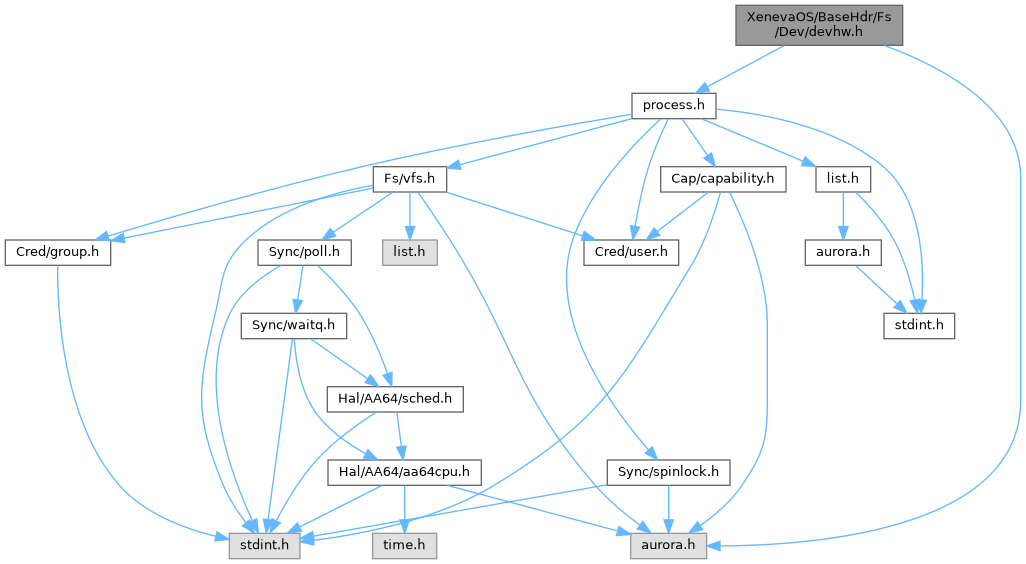
#include <aurora.h>
#include <process.h>
Go to the source code of this file.
|
| void | AuHwdevInitialize (void) |
| | AuHwdevInitialize – register /dev/hwdev (hardware access for user-space drivers, see BaseHdr/hwdev.h)
|
| |
| void | AuInputSrvInitialize (void) |
| | AuInputSrvInitialize – register /dev/inputsrv (see BaseHdr/inputsrv.h)
|
| |
| bool | AuHwdevCallerAllowed (AuProcess *proc) |
| | AuHwdevCallerAllowed – true when proc is in the MISC_DAEMONS group. Checked on every privileged operation: a write-mode open skips the VFS permission check, so node permissions alone are not enough.
|
| |
| bool | AuHwdevClaimsPci (int bus, int dev, int func) |
| | True when a live user-space hwdev capability owns this PCI function.
|
| |
| bool | AuHwdevOwnsDma (AuProcess *proc, uint64_t phys, uint64_t len) |
| | AuHwdevOwnsDma – true when [phys, phys+len) lies inside a DMA buffer that proc allocated through one of its own hw handles. Lets other kernel code accept a user-supplied physical address without trusting it.
|
| |
| bool | AuHwdevHandleIsDevice (AuProcess *proc, int fd, uint16_t vendor, uint16_t device) |
| | Validate that fd is the caller's PCI function with the requested ID.
|
| |
| void * | AuHwdevHandleObject (AuProcess *proc, int fd) |
| | Return the opaque kernel object for one exact caller handle.
|
| |
| bool | AuHwdevHandleOwnsDma (AuProcess *proc, int fd, uint64_t phys, uint64_t len) |
| | Validate a DMA range against one exact hwdev capability.
|
| |
| AuProcess * | AuHwdevCurrentProcess (void) |
| | AuHwdevCurrentProcess – the process running the current thread.
|
| |
◆ AuHwdevCallerAllowed()
AuHwdevCallerAllowed – true when proc is in the MISC_DAEMONS group. Checked on every privileged operation: a write-mode open skips the VFS permission check, so node permissions alone are not enough.
◆ AuHwdevClaimsPci()
| bool AuHwdevClaimsPci |
( |
int |
bus, |
|
|
int |
dev, |
|
|
int |
func |
|
) |
| |
|
extern |
True when a live user-space hwdev capability owns this PCI function.
◆ AuHwdevCurrentProcess()
AuHwdevCurrentProcess – the process running the current thread.
◆ AuHwdevHandleIsDevice()
Validate that fd is the caller's PCI function with the requested ID.
◆ AuHwdevHandleObject()
| void * AuHwdevHandleObject |
( |
AuProcess * |
proc, |
|
|
int |
fd |
|
) |
| |
|
extern |
Return the opaque kernel object for one exact caller handle.
◆ AuHwdevHandleOwnsDma()
Validate a DMA range against one exact hwdev capability.
◆ AuHwdevInitialize()
| void AuHwdevInitialize |
( |
void |
| ) |
|
|
extern |
AuHwdevInitialize – register /dev/hwdev (hardware access for user-space drivers, see BaseHdr/hwdev.h)
◆ AuHwdevOwnsDma()
AuHwdevOwnsDma – true when [phys, phys+len) lies inside a DMA buffer that proc allocated through one of its own hw handles. Lets other kernel code accept a user-supplied physical address without trusting it.
◆ AuInputSrvInitialize()
| void AuInputSrvInitialize |
( |
void |
| ) |
|
|
extern |