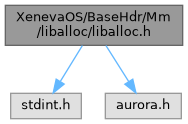
#include <stdint.h>
#include <aurora.h>
Go to the source code of this file.
◆ liballoc_alloc()
| void * liballoc_alloc |
( |
int |
pages | ) |
|
This is the hook into the local system which allocates pages. It accepts an integer parameter which is the number of pages required. The page size was set up in the liballoc_init function.
- Returns
- NULL if the pages were not allocated.
-
A pointer to the allocated memory.
◆ liballoc_free()
| int liballoc_free |
( |
void * |
ptr, |
|
|
int |
pages |
|
) |
| |
This frees previously allocated memory. The void* parameter passed to the function is the exact same value returned from a previous liballoc_alloc call.
The integer value is the number of pages to free.
- Returns
- 0 if the memory was successfully freed.
◆ liballoc_lock()
This function is supposed to lock the memory data structures. It could be as simple as disabling interrupts or acquiring a spinlock. It's up to you to decide.
- Returns
- 0 if the lock was acquired successfully. Anything else is failure.
◆ liballoc_unlock()
This function unlocks what was previously locked by the liballoc_lock function. If it disabled interrupts, it enables interrupts. If it had acquiried a spinlock, it releases the spinlock. etc.
- Returns
- 0 if the lock was successfully released.
◆ port_calloc()
| void * port_calloc |
( |
unsigned long long |
nobj, |
|
|
unsigned long long |
size |
|
) |
| |
◆ port_free()
| void port_free |
( |
void * |
ptr | ) |
|
◆ port_malloc()
| void * port_malloc |
( |
unsigned int |
size | ) |
|
◆ port_realloc()
| void * port_realloc |
( |
void * |
p, |
|
|
unsigned int |
size |
|
) |
| |