#include <pcie.h>#include <string.h>#include <stdint.h>#include <dtb.h>#include <aucon.h>#include <Hal/AA64/qemu.h>#include <Hal/AA64/gic.h>#include <Mm/vmmngr.h>#include <kernelAA64.h>#include <Hal/basicacpi.h>#include <Hal/AA64/aa64lowlevel.h>#include <Drivers/uart.h>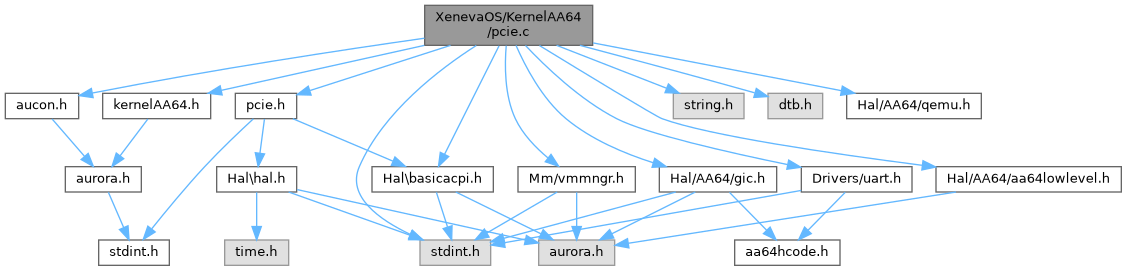
Macros | |
| #define | QEMU_VIRT_ECAM_BASE 0x3f000000 |
| #define | PCI_MEM_BAR_TYPE(x) ((x >> 1) & 0x3) |
| #define | PCI_IS_IO_BAR(x) ((x & 1) != 0) |
| #define | INTERNAL_PCI_REG_BAR0 0x4 |
Enumerations | |
| enum | PCI_MEM_BAR_TYPES { MEMBAR32 , RESERVED , MEMBAR64 } |
Functions | |
| void | AA64PCIeInitialize () |
| AA64PCIeInitialize – intialize pcie subsystem. | |
| bool | AuIsPCIeInitialized () |
| uint64_t | AuPCIEGetDevice (uint16_t seg, int bus, int dev, int func) |
| AuPCIEGetDevice – gets a device address from its bus dev and func. | |
| uint32_t | AuPCIERead (uint64_t device, int reg, int bus, int dev, int func) |
| AuPCIERead – reads a register from pci express. | |
| uint64_t | AuPCIERead64 (uint64_t device, int reg, int size, int bus, int dev, int func) |
| AuPCIERead64 – reads in 64. | |
| void | AuPCIEWrite (uint64_t device, int reg, uint32_t val, int bus, int dev, int func) |
| AuPCIEWrite – writes to a register. | |
| void | AuPCIEWrite64 (uint64_t device, int reg, int size, uint64_t val, int bus, int dev, int func) |
| uint64_t | AuPCIEScanClass (uint8_t classCode, uint8_t subClassCode, int *bus_, int *dev_, int *func_) |
| AuPCIEScanClass – scans and return pcie device with given class code and sub class code. | |
| uint64_t | AuPCIEScanVendorDevice (uint16_t vendor, uint16_t device, int *bus_, int *dev_, int *func_) |
| AuPCIEScanVendorDevice – scans and return pcie device with given vendor id and device id. | |
| uint64_t | AuPCIEScanClassIF (uint8_t classCode, uint8_t subClassCode, uint8_t progIf, int *bus_, int *dev_, int *func_) |
| AuPCIEScanClassIF – scans and return pcie device with given class code and sub class code. | |
| uint64_t | AuPCIEReadBAR (uint64_t device, uint16_t bus, uint16_t dev, uint16_t func, size_t BAR, size_t *barsz) |
| bool | AuPCIEAllocMSI (uint64_t device, size_t vector, int bus, int dev, int func) |
| AuPCIEAllocMSI – Allocate MSI/MSI-X for interrupt. | |
Detailed Description
BSD 2-Clause License
Copyright (c) 2022-2025, Manas Kamal Choudhury All rights reserved.
Redistribution and use in source and binary forms, with or without modification, are permitted provided that the following conditions are met:
- Redistributions of source code must retain the above copyright notice, this list of conditions and the following disclaimer.
- Redistributions in binary form must reproduce the above copyright notice, this list of conditions and the following disclaimer in the documentation and/or other materials provided with the distribution.
THIS SOFTWARE IS PROVIDED BY THE COPYRIGHT HOLDERS AND CONTRIBUTORS "AS IS" AND ANY EXPRESS OR IMPLIED WARRANTIES, INCLUDING, BUT NOT LIMITED TO, THE IMPLIED WARRANTIES OF MERCHANTABILITY AND FITNESS FOR A PARTICULAR PURPOSE ARE DISCLAIMED. IN NO EVENT SHALL THE COPYRIGHT HOLDER OR CONTRIBUTORS BE LIABLE FOR ANY DIRECT, INDIRECT, INCIDENTAL, SPECIAL, EXEMPLARY, OR CONSEQUENTIAL DAMAGES (INCLUDING, BUT NOT LIMITED TO, PROCUREMENT OF SUBSTITUTE GOODS OR SERVICES; LOSS OF USE, DATA, OR PROFITS; OR BUSINESS INTERRUPTION) HOWEVER CAUSED AND ON ANY THEORY OF LIABILITY, WHETHER IN CONTRACT, STRICT LIABILITY, OR TORT (INCLUDING NEGLIGENCE OR OTHERWISE) ARISING IN ANY WAY OUT OF THE USE OF THIS SOFTWARE, EVEN IF ADVISED OF THE POSSIBILITY OF SUCH DAMAGE.
Macro Definition Documentation
◆ INTERNAL_PCI_REG_BAR0
| #define INTERNAL_PCI_REG_BAR0 0x4 |
◆ PCI_IS_IO_BAR
| #define PCI_IS_IO_BAR | ( | x | ) | ((x & 1) != 0) |
◆ PCI_MEM_BAR_TYPE
| #define PCI_MEM_BAR_TYPE | ( | x | ) | ((x >> 1) & 0x3) |
◆ QEMU_VIRT_ECAM_BASE
| #define QEMU_VIRT_ECAM_BASE 0x3f000000 |
Enumeration Type Documentation
◆ PCI_MEM_BAR_TYPES
| enum PCI_MEM_BAR_TYPES |
Function Documentation
◆ AA64PCIeInitialize()
| void AA64PCIeInitialize | ( | ) |
AA64PCIeInitialize – intialize pcie subsystem.
AA64PCIeInitialize – intialize pcie controller.
◆ AuIsPCIeInitialized()
| bool AuIsPCIeInitialized | ( | ) |
◆ AuPCIEAllocMSI()
AuPCIEAllocMSI – Allocate MSI/MSI-X for interrupt.
- Todo:
- – MSIX not implemented yet
- Parameters
-
device – PCIe device address vector – interrupt vector bus – PCIe device bus number dev – PCIe device dev number func – PCIe device function number
◆ AuPCIEGetDevice()
AuPCIEGetDevice – gets a device address from its bus dev and func.
- Parameters
-
seg – device segment bus – bus of the device dev – device number func – function number
- Returns
- return the composited device address
◆ AuPCIERead()
AuPCIERead – reads a register from pci express.
- Parameters
-
device – device address reg – register to read bus – bus number dev – device number func – function number
- Returns
- return the result in DWORD
◆ AuPCIERead64()
AuPCIERead64 – reads in 64.
- Parameters
-
device – device address reg – register size – size to read bus – bus num dev – device number func – func number
- Returns
- return the read result in QWORD
◆ AuPCIEReadBAR()
| uint64_t AuPCIEReadBAR | ( | uint64_t | device, |
| uint16_t | bus, | ||
| uint16_t | dev, | ||
| uint16_t | func, | ||
| size_t | BAR, | ||
| size_t * | barsz | ||
| ) |
◆ AuPCIEScanClass()
| uint64_t AuPCIEScanClass | ( | uint8_t | classCode, |
| uint8_t | subClassCode, | ||
| int * | bus_, | ||
| int * | dev_, | ||
| int * | func_ | ||
| ) |
AuPCIEScanClass – scans and return pcie device with given class code and sub class code.
- Parameters
-
classCode – class code subClassCode – sub class code bus – address, where bus number will be stored dev – address, where device number will be stored func – address, where function number will be stored
◆ AuPCIEScanClassIF()
| uint64_t AuPCIEScanClassIF | ( | uint8_t | classCode, |
| uint8_t | subClassCode, | ||
| uint8_t | progIf, | ||
| int * | bus_, | ||
| int * | dev_, | ||
| int * | func_ | ||
| ) |
AuPCIEScanClassIF – scans and return pcie device with given class code and sub class code.
- Parameters
-
classCode – class code subClassCode – sub class code bus – address, where bus number will be stored dev – address, where device number will be stored func – address, where function number will be stored progIf – Programming interface
- Returns
- pcie device address
◆ AuPCIEScanVendorDevice()
| uint64_t AuPCIEScanVendorDevice | ( | uint16_t | vendor, |
| uint16_t | device, | ||
| int * | bus_, | ||
| int * | dev_, | ||
| int * | func_ | ||
| ) |
AuPCIEScanVendorDevice – scans and return pcie device with given vendor id and device id.
- Parameters
-
vendor – vendor id device – device id bus – address, where bus number will be stored dev – address, where device number will be stored func – address, where function number will be stored
◆ AuPCIEWrite()
AuPCIEWrite – writes to a register.
- Parameters
-
device – device address reg – register size – size to read bus – bus num dev – device number func – func number