#include <DmaRemappingReportingTable.h>
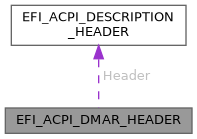
Collaboration diagram for EFI_ACPI_DMAR_HEADER:
Public Attributes | |
| EFI_ACPI_DESCRIPTION_HEADER | Header |
| UINT8 | HostAddressWidth |
| UINT8 | Flags |
| UINT8 | Reserved [10] |
Detailed Description
DMA Remapping Reporting Structure Header as defined in section 8.1 This header will be followed by list of Remapping Structures listed below
- DMA Remapping Hardware Unit Definition (DRHD)
- Reserved Memory Region Reporting (RMRR)
- Root Port ATS Capability Reporting (ATSR)
- Remapping Hardware Static Affinity (RHSA)
- ACPI Name-space Device Declaration (ANDD) These structure types must by reported in numerical order. i.e., All remapping structures of type 0 (DRHD) enumerated before remapping structures of type 1 (RMRR), and so forth.
Member Data Documentation
◆ Flags
| UINT8 EFI_ACPI_DMAR_HEADER::Flags |
- Bit[0]: INTR_REMAP - If Clear, the platform does not support interrupt remapping. If Set, the platform supports interrupt remapping.
- Bit[1]: X2APIC_OPT_OUT - For firmware compatibility reasons, platform firmware may Set this field to request system software to opt out of enabling Extended xAPIC (X2APIC) mode. This field is valid only when the INTR_REMAP field (bit 0) is Set.
- Bit[2]: DMA_CTRL_PLATFORM_OPT_IN_FLAG - Platform firmware is recommended to Set this field to report any platform initiated DMA is restricted to only reserved memory regions (reported in RMRR structures) when transferring control to system software such as on ExitBootServices().
- Bits[7:3] Reserved.
◆ Header
| EFI_ACPI_DESCRIPTION_HEADER EFI_ACPI_DMAR_HEADER::Header |
◆ HostAddressWidth
| UINT8 EFI_ACPI_DMAR_HEADER::HostAddressWidth |
This field indicates the maximum DMA physical addressability supported by this platform. The system address map reported by the BIOS indicates what portions of this addresses are populated. The Host Address Width (HAW) of the platform is computed as (N+1), where N is the value reported in this field. For example, for a platform supporting 40 bits of physical addressability, the value of 100111b is reported in this field.
◆ Reserved
| UINT8 EFI_ACPI_DMAR_HEADER::Reserved[10] |
The documentation for this struct was generated from the following file:
- XenevaOS/Boot/include/IndustryStandard/DmaRemappingReportingTable.h