#include <Http.h>
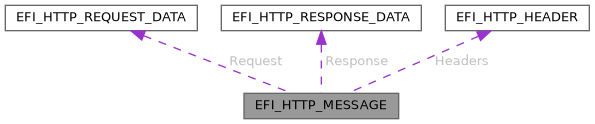
Public Attributes | ||
| union { | ||
| EFI_HTTP_REQUEST_DATA * Request | ||
| EFI_HTTP_RESPONSE_DATA * Response | ||
| } | Data | |
| UINTN | HeaderCount | |
| EFI_HTTP_HEADER * | Headers | |
| UINTN | BodyLength | |
| VOID * | Body | |
Detailed Description
Member Data Documentation
◆ Body
| VOID* EFI_HTTP_MESSAGE::Body |
Body associated with the HTTP request or response. This can be NULL depending on the HttpMethod type.
◆ BodyLength
| UINTN EFI_HTTP_MESSAGE::BodyLength |
Length in bytes of the HTTP body. This can be zero depending on the HttpMethod type.
◆ [union]
| union { ... } EFI_HTTP_MESSAGE::Data |
HTTP message data.
◆ HeaderCount
| UINTN EFI_HTTP_MESSAGE::HeaderCount |
Number of HTTP header structures in Headers list. On request, this count is provided by the caller. On response, this count is provided by the HTTP driver.
◆ Headers
| EFI_HTTP_HEADER* EFI_HTTP_MESSAGE::Headers |
Array containing list of HTTP headers. On request, this array is populated by the caller. On response, this array is allocated and populated by the HTTP driver. It is the responsibility of the caller to free this memory on both request and response.
◆ Request
| EFI_HTTP_REQUEST_DATA* EFI_HTTP_MESSAGE::Request |
When the token is used to send a HTTP request, Request is a pointer to storage that contains such data as URL and HTTP method.
◆ Response
| EFI_HTTP_RESPONSE_DATA* EFI_HTTP_MESSAGE::Response |
When used to await a response, Response points to storage containing HTTP response status code.
The documentation for this struct was generated from the following file:
- XenevaOS/Boot/include/Protocol/Http.h