#include <drm_bridge.h>
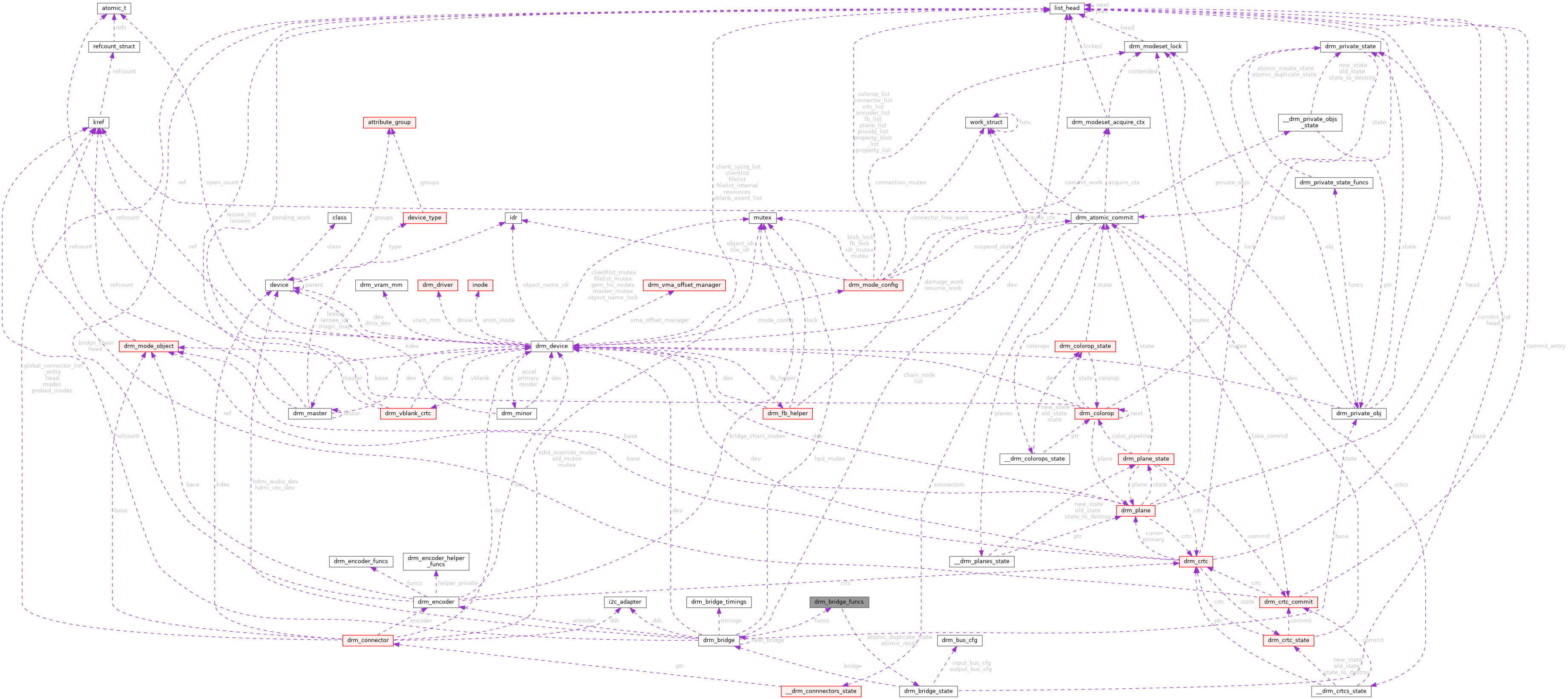
Public Attributes | |
| int(* | attach )(struct drm_bridge *bridge, struct drm_encoder *encoder, enum drm_bridge_attach_flags flags) |
| void(* | destroy )(struct drm_bridge *bridge) |
| void(* | detach )(struct drm_bridge *bridge) |
| enum drm_mode_status(* | mode_valid )(struct drm_bridge *bridge, const struct drm_display_info *info, const struct drm_display_mode *mode) |
| bool(* | mode_fixup )(struct drm_bridge *bridge, const struct drm_display_mode *mode, struct drm_display_mode *adjusted_mode) |
| void(* | disable )(struct drm_bridge *bridge) |
| void(* | post_disable )(struct drm_bridge *bridge) |
| void(* | mode_set )(struct drm_bridge *bridge, const struct drm_display_mode *mode, const struct drm_display_mode *adjusted_mode) |
| void(* | pre_enable )(struct drm_bridge *bridge) |
| void(* | enable )(struct drm_bridge *bridge) |
| void(* | atomic_pre_enable )(struct drm_bridge *bridge, struct drm_atomic_commit *state) |
| void(* | atomic_enable )(struct drm_bridge *bridge, struct drm_atomic_commit *state) |
| void(* | atomic_disable )(struct drm_bridge *bridge, struct drm_atomic_commit *state) |
| void(* | atomic_post_disable )(struct drm_bridge *bridge, struct drm_atomic_commit *state) |
| struct drm_bridge_state *(* | atomic_duplicate_state )(struct drm_bridge *bridge) |
| void(* | atomic_destroy_state )(struct drm_bridge *bridge, struct drm_bridge_state *state) |
| u32 *(* | atomic_get_output_bus_fmts )(struct drm_bridge *bridge, struct drm_bridge_state *bridge_state, struct drm_crtc_state *crtc_state, struct drm_connector_state *conn_state, unsigned int *num_output_fmts) |
| u32 *(* | atomic_get_input_bus_fmts )(struct drm_bridge *bridge, struct drm_bridge_state *bridge_state, struct drm_crtc_state *crtc_state, struct drm_connector_state *conn_state, u32 output_fmt, unsigned int *num_input_fmts) |
| int(* | atomic_check )(struct drm_bridge *bridge, struct drm_bridge_state *bridge_state, struct drm_crtc_state *crtc_state, struct drm_connector_state *conn_state) |
| struct drm_bridge_state *(* | atomic_reset )(struct drm_bridge *bridge) |
| enum drm_connector_status(* | detect )(struct drm_bridge *bridge, struct drm_connector *connector) |
| int(* | get_modes )(struct drm_bridge *bridge, struct drm_connector *connector) |
| const struct drm_edid *(* | edid_read )(struct drm_bridge *bridge, struct drm_connector *connector) |
| void(* | hpd_notify )(struct drm_bridge *bridge, struct drm_connector *connector, enum drm_connector_status status) |
| void(* | hpd_enable )(struct drm_bridge *bridge) |
| void(* | hpd_disable )(struct drm_bridge *bridge) |
| enum drm_mode_status(* | hdmi_tmds_char_rate_valid )(const struct drm_bridge *bridge, const struct drm_display_mode *mode, unsigned long long tmds_rate) |
| int(* | hdmi_clear_avi_infoframe )(struct drm_bridge *bridge) |
| int(* | hdmi_write_avi_infoframe )(struct drm_bridge *bridge, const u8 *buffer, size_t len) |
| int(* | hdmi_clear_hdmi_infoframe )(struct drm_bridge *bridge) |
| int(* | hdmi_write_hdmi_infoframe )(struct drm_bridge *bridge, const u8 *buffer, size_t len) |
| int(* | hdmi_clear_hdr_drm_infoframe )(struct drm_bridge *bridge) |
| int(* | hdmi_write_hdr_drm_infoframe )(struct drm_bridge *bridge, const u8 *buffer, size_t len) |
| int(* | hdmi_clear_spd_infoframe )(struct drm_bridge *bridge) |
| int(* | hdmi_write_spd_infoframe )(struct drm_bridge *bridge, const u8 *buffer, size_t len) |
| int(* | hdmi_clear_audio_infoframe )(struct drm_bridge *bridge) |
| int(* | hdmi_write_audio_infoframe )(struct drm_bridge *bridge, const u8 *buffer, size_t len) |
| int(* | hdmi_audio_startup )(struct drm_bridge *bridge, struct drm_connector *connector) |
| int(* | hdmi_audio_prepare )(struct drm_bridge *bridge, struct drm_connector *connector, struct hdmi_codec_daifmt *fmt, struct hdmi_codec_params *hparms) |
| void(* | hdmi_audio_shutdown )(struct drm_bridge *bridge, struct drm_connector *connector) |
| int(* | hdmi_audio_mute_stream )(struct drm_bridge *bridge, struct drm_connector *connector, bool enable, int direction) |
| int(* | hdmi_cec_init )(struct drm_bridge *bridge, struct drm_connector *connector) |
| int(* | hdmi_cec_enable )(struct drm_bridge *bridge, bool enable) |
| int(* | hdmi_cec_log_addr )(struct drm_bridge *bridge, u8 logical_addr) |
| int(* | hdmi_cec_transmit )(struct drm_bridge *bridge, u8 attempts, u32 signal_free_time, struct cec_msg *msg) |
| int(* | dp_audio_startup )(struct drm_bridge *bridge, struct drm_connector *connector) |
| int(* | dp_audio_prepare )(struct drm_bridge *bridge, struct drm_connector *connector, struct hdmi_codec_daifmt *fmt, struct hdmi_codec_params *hparms) |
| void(* | dp_audio_shutdown )(struct drm_bridge *bridge, struct drm_connector *connector) |
| int(* | dp_audio_mute_stream )(struct drm_bridge *bridge, struct drm_connector *connector, bool enable, int direction) |
| void(* | debugfs_init )(struct drm_bridge *bridge, struct dentry *root) |
Detailed Description
struct drm_bridge_funcs - drm_bridge control functions
Member Data Documentation
◆ atomic_check
| int(* drm_bridge_funcs::atomic_check) (struct drm_bridge *bridge, struct drm_bridge_state *bridge_state, struct drm_crtc_state *crtc_state, struct drm_connector_state *conn_state) |
@atomic_check:
This method is responsible for checking bridge state correctness. It can also check the state of the surrounding components in chain to make sure the whole pipeline can work properly.
&drm_bridge_funcs.atomic_check() hooks are called in reverse order (from the last to the first bridge).
This method is optional. &drm_bridge_funcs.mode_fixup() is not called when &drm_bridge_funcs.atomic_check() is implemented, so only one of them should be provided.
If drivers need to tweak &drm_bridge_state.input_bus_cfg.flags or &drm_bridge_state.output_bus_cfg.flags it should happen in this function. By default the &drm_bridge_state.output_bus_cfg.flags field is set to the next bridge &drm_bridge_state.input_bus_cfg.flags value or &drm_connector.display_info.bus_flags if the bridge is the last element in the chain.
RETURNS: zero if the check passed, a negative error code otherwise.
◆ atomic_destroy_state
| void(* drm_bridge_funcs::atomic_destroy_state) (struct drm_bridge *bridge, struct drm_bridge_state *state) |
@atomic_destroy_state:
Destroy a bridge state object previously allocated by &drm_bridge_funcs.atomic_duplicate_state().
The atomic_destroy_state hook is mandatory if the bridge implements any of the atomic hooks, and should be left unassigned otherwise. For bridges that don't subclass &drm_bridge_state, the drm_atomic_helper_bridge_destroy_state() helper function shall be used to implement this hook.
◆ atomic_disable
| void(* drm_bridge_funcs::atomic_disable) (struct drm_bridge *bridge, struct drm_atomic_commit *state) |
@atomic_disable:
This callback should disable the bridge. It is called right before the preceding element in the display pipe is disabled. If the preceding element is a bridge this means it's called before that bridge's @atomic_disable or @disable vfunc. If the preceding element is a &drm_encoder it's called right before the &drm_encoder_helper_funcs.atomic_disable hook.
The bridge can assume that the display pipe (i.e. clocks and timing signals) feeding it is still running when this callback is called.
The @atomic_disable callback is optional.
◆ atomic_duplicate_state
| struct drm_bridge_state *(* drm_bridge_funcs::atomic_duplicate_state) (struct drm_bridge *bridge) |
@atomic_duplicate_state:
Duplicate the current bridge state object (which is guaranteed to be non-NULL).
The atomic_duplicate_state hook is mandatory if the bridge implements any of the atomic hooks, and should be left unassigned otherwise. For bridges that don't subclass &drm_bridge_state, the drm_atomic_helper_bridge_duplicate_state() helper function shall be used to implement this hook.
RETURNS: A valid drm_bridge_state object or NULL if the allocation fails.
◆ atomic_enable
| void(* drm_bridge_funcs::atomic_enable) (struct drm_bridge *bridge, struct drm_atomic_commit *state) |
@atomic_enable:
This callback should enable the bridge. It is called right after the preceding element in the display pipe is enabled. If the preceding element is a bridge this means it's called after that bridge's @atomic_enable or @enable function. If the preceding element is a &drm_encoder it's called right after the encoder's &drm_encoder_helper_funcs.atomic_enable hook.
The bridge can assume that the display pipe (i.e. clocks and timing signals) feeding it is running when this callback is called. This callback must enable the display link feeding the next bridge in the chain if there is one.
The @atomic_enable callback is optional.
◆ atomic_get_input_bus_fmts
| u32 *(* drm_bridge_funcs::atomic_get_input_bus_fmts) (struct drm_bridge *bridge, struct drm_bridge_state *bridge_state, struct drm_crtc_state *crtc_state, struct drm_connector_state *conn_state, u32 output_fmt, unsigned int *num_input_fmts) |
@atomic_get_input_bus_fmts:
Return the supported bus formats on the input end of a bridge for a specific output bus format.
The returned array must be allocated with kmalloc() and will be freed by the caller. If the allocation fails, NULL should be returned. num_input_fmts must be set to the returned array size. Formats listed in the returned array should be listed in decreasing preference order (the core will try all formats until it finds one that works). When the format is not supported NULL should be returned and num_input_fmts should be set to 0.
This method is called on all elements of the bridge chain as part of the bus format negotiation process that happens in drm_atomic_bridge_chain_select_bus_fmts(). This method is optional. When not implemented, the core will bypass bus format negotiation on this element of the bridge without failing, and the previous element in the chain will be passed MEDIA_BUS_FMT_FIXED as its output bus format.
Bridge drivers that need to support being linked to bridges that are not supporting bus format negotiation should handle the output_fmt == MEDIA_BUS_FMT_FIXED case appropriately, by selecting a sensible default value or extracting this information from somewhere else (FW property, &drm_display_mode, &drm_display_info, ...)
Note: Even if input format selection on the first bridge has no impact on the negotiation process (bus format negotiation stops once we reach the first element of the chain), drivers are expected to return accurate input formats as the input format may be used to configure the CRTC output appropriately.
◆ atomic_get_output_bus_fmts
| u32 *(* drm_bridge_funcs::atomic_get_output_bus_fmts) (struct drm_bridge *bridge, struct drm_bridge_state *bridge_state, struct drm_crtc_state *crtc_state, struct drm_connector_state *conn_state, unsigned int *num_output_fmts) |
@atomic_get_output_bus_fmts:
Return the supported bus formats on the output end of a bridge. The returned array must be allocated with kmalloc() and will be freed by the caller. If the allocation fails, NULL should be returned. num_output_fmts must be set to the returned array size. Formats listed in the returned array should be listed in decreasing preference order (the core will try all formats until it finds one that works).
This method is only called on the last element of the bridge chain as part of the bus format negotiation process that happens in &drm_atomic_bridge_chain_select_bus_fmts(). This method is optional. When not implemented, the core will fall back to &drm_connector.display_info.bus_formats[0] if &drm_connector.display_info.num_bus_formats > 0, or to MEDIA_BUS_FMT_FIXED otherwise.
◆ atomic_post_disable
| void(* drm_bridge_funcs::atomic_post_disable) (struct drm_bridge *bridge, struct drm_atomic_commit *state) |
@atomic_post_disable:
This callback should disable the bridge. It is called right after the preceding element in the display pipe is disabled. If the preceding element is a bridge this means it's called after that bridge's @atomic_post_disable or @post_disable function. If the preceding element is a &drm_encoder it's called right after the encoder's &drm_encoder_helper_funcs.atomic_disable hook.
The bridge must assume that the display pipe (i.e. clocks and timing signals) feeding it is no longer running when this callback is called.
The @atomic_post_disable callback is optional.
◆ atomic_pre_enable
| void(* drm_bridge_funcs::atomic_pre_enable) (struct drm_bridge *bridge, struct drm_atomic_commit *state) |
@atomic_pre_enable:
This callback should enable the bridge. It is called right before the preceding element in the display pipe is enabled. If the preceding element is a bridge this means it's called before that bridge's @atomic_pre_enable or @pre_enable function. If the preceding element is a &drm_encoder it's called right before the encoder's &drm_encoder_helper_funcs.atomic_enable hook.
The display pipe (i.e. clocks and timing signals) feeding this bridge will not yet be running when this callback is called. The bridge must not enable the display link feeding the next bridge in the chain (if there is one) when this callback is called.
The @atomic_pre_enable callback is optional.
◆ atomic_reset
| struct drm_bridge_state *(* drm_bridge_funcs::atomic_reset) (struct drm_bridge *bridge) |
@atomic_reset:
Reset the bridge to a predefined state (or retrieve its current state) and return a &drm_bridge_state object matching this state. This function is called at attach time.
The atomic_reset hook is mandatory if the bridge implements any of the atomic hooks, and should be left unassigned otherwise. For bridges that don't subclass &drm_bridge_state, the drm_atomic_helper_bridge_reset() helper function shall be used to implement this hook.
Note that the atomic_reset() semantics is not exactly matching the reset() semantics found on other components (connector, plane, ...).
- The reset operation happens when the bridge is attached, not when drm_mode_config_reset() is called
- It's meant to be used exclusively on bridges that have been converted to the ATOMIC API
RETURNS: A valid drm_bridge_state object in case of success, an ERR_PTR() giving the reason of the failure otherwise.
◆ attach
| int(* drm_bridge_funcs::attach) (struct drm_bridge *bridge, struct drm_encoder *encoder, enum drm_bridge_attach_flags flags) |
@attach:
This callback is invoked whenever our bridge is being attached to a &drm_encoder. The flags argument tunes the behaviour of the attach operation (see DRM_BRIDGE_ATTACH_*).
The @attach callback is optional.
RETURNS:
Zero on success, error code on failure.
◆ debugfs_init
| void(* drm_bridge_funcs::debugfs_init) (struct drm_bridge *bridge, struct dentry *root) |
@debugfs_init:
Allows bridges to create bridge-specific debugfs files.
◆ destroy
| void(* drm_bridge_funcs::destroy) (struct drm_bridge *bridge) |
@destroy:
This callback is invoked when the bridge is about to be deallocated.
The @destroy callback is optional.
◆ detach
| void(* drm_bridge_funcs::detach) (struct drm_bridge *bridge) |
@detach:
This callback is invoked whenever our bridge is being detached from a &drm_encoder.
The @detach callback is optional.
◆ detect
| enum drm_connector_status(* drm_bridge_funcs::detect) (struct drm_bridge *bridge, struct drm_connector *connector) |
@detect:
Check if anything is attached to the bridge output.
This callback is optional, if not implemented the bridge will be considered as always having a component attached to its output. Bridges that implement this callback shall set the DRM_BRIDGE_OP_DETECT flag in their &drm_bridge->ops.
RETURNS:
drm_connector_status indicating the bridge output status.
◆ disable
| void(* drm_bridge_funcs::disable) (struct drm_bridge *bridge) |
@disable:
This callback should disable the bridge. It is called right before the preceding element in the display pipe is disabled. If the preceding element is a bridge this means it's called before that bridge's @disable vfunc. If the preceding element is a &drm_encoder it's called right before the &drm_encoder_helper_funcs.disable, &drm_encoder_helper_funcs.prepare or &drm_encoder_helper_funcs.dpms hook.
The bridge can assume that the display pipe (i.e. clocks and timing signals) feeding it is still running when this callback is called.
The @disable callback is optional.
NOTE:
This is deprecated, do not use! New drivers shall use &drm_bridge_funcs.atomic_disable.
◆ dp_audio_mute_stream
| int(* drm_bridge_funcs::dp_audio_mute_stream) (struct drm_bridge *bridge, struct drm_connector *connector, bool enable, int direction) |
@dp_audio_mute_stream:
Mute/unmute DisplayPort audio stream.
This callback is optional, it can be implemented by bridges that set the @DRM_BRIDGE_OP_DP_AUDIO flag in their &drm_bridge->ops.
Returns: 0 on success, a negative error code otherwise
◆ dp_audio_prepare
| int(* drm_bridge_funcs::dp_audio_prepare) (struct drm_bridge *bridge, struct drm_connector *connector, struct hdmi_codec_daifmt *fmt, struct hdmi_codec_params *hparms) |
@dp_audio_prepare: Configures DisplayPort audio stream. Can be called multiple times for each setup.
This callback is optional but it must be implemented by bridges that set the @DRM_BRIDGE_OP_DP_AUDIO flag in their &drm_bridge->ops.
Returns: 0 on success, a negative error code otherwise
◆ dp_audio_shutdown
| void(* drm_bridge_funcs::dp_audio_shutdown) (struct drm_bridge *bridge, struct drm_connector *connector) |
@dp_audio_shutdown:
Shut down the DisplayPort audio stream.
This callback is optional but it must be implemented by bridges that set the @DRM_BRIDGE_OP_DP_AUDIO flag in their &drm_bridge->ops.
Returns: 0 on success, a negative error code otherwise
◆ dp_audio_startup
| int(* drm_bridge_funcs::dp_audio_startup) (struct drm_bridge *bridge, struct drm_connector *connector) |
@dp_audio_startup:
Called when ASoC starts a DisplayPort audio stream setup.
This callback is optional, it can be implemented by bridges that set the @DRM_BRIDGE_OP_DP_AUDIO flag in their &drm_bridge->ops.
Returns: 0 on success, a negative error code otherwise
◆ edid_read
| const struct drm_edid *(* drm_bridge_funcs::edid_read) (struct drm_bridge *bridge, struct drm_connector *connector) |
@edid_read:
Read the EDID data of the connected display.
The @edid_read callback is the preferred way of reporting mode information for a display connected to the bridge output. Bridges that support reading EDID shall implement this callback and leave the @get_modes callback unimplemented.
The caller of this operation shall first verify the output connection status and refrain from reading EDID from a disconnected output.
This callback is optional. Bridges that implement it shall set the DRM_BRIDGE_OP_EDID flag in their &drm_bridge->ops.
The connector parameter shall be used for the sole purpose of EDID retrieval, and shall not be stored internally by bridge drivers for future usage.
RETURNS:
An edid structure newly allocated with drm_edid_alloc() or returned from drm_edid_read() family of functions on success, or NULL otherwise. The caller is responsible for freeing the returned edid structure with drm_edid_free().
◆ enable
| void(* drm_bridge_funcs::enable) (struct drm_bridge *bridge) |
@enable:
This callback should enable the bridge. It is called right after the preceding element in the display pipe is enabled. If the preceding element is a bridge this means it's called after that bridge's @enable function. If the preceding element is a &drm_encoder it's called right after the encoder's &drm_encoder_helper_funcs.enable, &drm_encoder_helper_funcs.commit or &drm_encoder_helper_funcs.dpms hook.
The bridge can assume that the display pipe (i.e. clocks and timing signals) feeding it is running when this callback is called. This callback must enable the display link feeding the next bridge in the chain if there is one.
The @enable callback is optional.
NOTE:
This is deprecated, do not use! New drivers shall use &drm_bridge_funcs.atomic_enable.
◆ get_modes
| int(* drm_bridge_funcs::get_modes) (struct drm_bridge *bridge, struct drm_connector *connector) |
@get_modes:
Fill all modes currently valid for the sink into the &drm_connector with drm_mode_probed_add().
The @get_modes callback is mostly intended to support non-probeable displays such as many fixed panels. Bridges that support reading EDID shall leave @get_modes unimplemented and implement the &drm_bridge_funcs->edid_read callback instead.
This callback is optional. Bridges that implement it shall set the DRM_BRIDGE_OP_MODES flag in their &drm_bridge->ops.
The connector parameter shall be used for the sole purpose of filling modes, and shall not be stored internally by bridge drivers for future usage.
RETURNS:
The number of modes added by calling drm_mode_probed_add().
◆ hdmi_audio_mute_stream
| int(* drm_bridge_funcs::hdmi_audio_mute_stream) (struct drm_bridge *bridge, struct drm_connector *connector, bool enable, int direction) |
@hdmi_audio_mute_stream:
Mute/unmute HDMI audio stream.
This callback is optional, it can be implemented by bridges that set the @DRM_BRIDGE_OP_HDMI_AUDIO flag in their &drm_bridge->ops.
Returns: 0 on success, a negative error code otherwise
◆ hdmi_audio_prepare
| int(* drm_bridge_funcs::hdmi_audio_prepare) (struct drm_bridge *bridge, struct drm_connector *connector, struct hdmi_codec_daifmt *fmt, struct hdmi_codec_params *hparms) |
@hdmi_audio_prepare: Configures HDMI-encoder for audio stream. Can be called multiple times for each setup.
This callback is optional but it must be implemented by bridges that set the @DRM_BRIDGE_OP_HDMI_AUDIO flag in their &drm_bridge->ops.
Returns: 0 on success, a negative error code otherwise
◆ hdmi_audio_shutdown
| void(* drm_bridge_funcs::hdmi_audio_shutdown) (struct drm_bridge *bridge, struct drm_connector *connector) |
@hdmi_audio_shutdown:
Shut down the audio stream.
This callback is optional but it must be implemented by bridges that set the @DRM_BRIDGE_OP_HDMI_AUDIO flag in their &drm_bridge->ops.
Returns: 0 on success, a negative error code otherwise
◆ hdmi_audio_startup
| int(* drm_bridge_funcs::hdmi_audio_startup) (struct drm_bridge *bridge, struct drm_connector *connector) |
@hdmi_audio_startup:
Called when ASoC starts an audio stream setup.
This callback is optional, it can be implemented by bridges that set the @DRM_BRIDGE_OP_HDMI_AUDIO flag in their &drm_bridge->ops.
Returns: 0 on success, a negative error code otherwise
◆ hdmi_cec_enable
| int(* drm_bridge_funcs::hdmi_cec_enable) (struct drm_bridge *bridge, bool enable) |
@hdmi_cec_enable:
Enable or disable the CEC adapter inside the bridge.
This callback is optional, it can be implemented by bridges that set the @DRM_BRIDGE_OP_HDMI_CEC_ADAPTER flag in their &drm_bridge->ops.
Returns: 0 on success, a negative error code otherwise
◆ hdmi_cec_init
| int(* drm_bridge_funcs::hdmi_cec_init) (struct drm_bridge *bridge, struct drm_connector *connector) |
@hdmi_cec_init:
Initialize CEC part of the bridge.
This callback is optional, it can be implemented by bridges that set the @DRM_BRIDGE_OP_HDMI_CEC_ADAPTER flag in their &drm_bridge->ops.
Returns: 0 on success, a negative error code otherwise
◆ hdmi_cec_log_addr
| int(* drm_bridge_funcs::hdmi_cec_log_addr) (struct drm_bridge *bridge, u8 logical_addr) |
@hdmi_cec_log_addr:
Set the logical address of the CEC adapter inside the bridge.
This callback is optional, it can be implemented by bridges that set the @DRM_BRIDGE_OP_HDMI_CEC_ADAPTER flag in their &drm_bridge->ops.
Returns: 0 on success, a negative error code otherwise
◆ hdmi_cec_transmit
| int(* drm_bridge_funcs::hdmi_cec_transmit) (struct drm_bridge *bridge, u8 attempts, u32 signal_free_time, struct cec_msg *msg) |
@hdmi_cec_transmit:
Transmit the message using the CEC adapter inside the bridge.
This callback is optional, it can be implemented by bridges that set the @DRM_BRIDGE_OP_HDMI_CEC_ADAPTER flag in their &drm_bridge->ops.
Returns: 0 on success, a negative error code otherwise
◆ hdmi_clear_audio_infoframe
| int(* drm_bridge_funcs::hdmi_clear_audio_infoframe) (struct drm_bridge *bridge) |
@hdmi_clear_audio_infoframe:
This callback clears the infoframes in the hardware during commit.
This callback is optional but it must be implemented by bridges that set the DRM_BRIDGE_OP_HDMI_AUDIO flag in their &drm_bridge->ops.
◆ hdmi_clear_avi_infoframe
| int(* drm_bridge_funcs::hdmi_clear_avi_infoframe) (struct drm_bridge *bridge) |
@hdmi_clear_avi_infoframe:
This callback clears the infoframes in the hardware during commit.
This callback is optional but it must be implemented by bridges that set the DRM_BRIDGE_OP_HDMI flag in their &drm_bridge->ops.
◆ hdmi_clear_hdmi_infoframe
| int(* drm_bridge_funcs::hdmi_clear_hdmi_infoframe) (struct drm_bridge *bridge) |
@hdmi_clear_hdmi_infoframe:
This callback clears the infoframes in the hardware during commit.
This callback is optional but it must be implemented by bridges that set the DRM_BRIDGE_OP_HDMI flag in their &drm_bridge->ops.
◆ hdmi_clear_hdr_drm_infoframe
| int(* drm_bridge_funcs::hdmi_clear_hdr_drm_infoframe) (struct drm_bridge *bridge) |
@hdmi_clear_hdr_drm_infoframe:
This callback clears the infoframes in the hardware during commit.
This callback is optional but it must be implemented by bridges that set the DRM_BRIDGE_OP_HDMI_HDR_DRM_INFOFRAME flag in their &drm_bridge->ops.
◆ hdmi_clear_spd_infoframe
| int(* drm_bridge_funcs::hdmi_clear_spd_infoframe) (struct drm_bridge *bridge) |
@hdmi_clear_spd_infoframe:
This callback clears the infoframes in the hardware during commit.
This callback is optional but it must be implemented by bridges that set the DRM_BRIDGE_OP_HDMI_SPD_INFOFRAME flag in their &drm_bridge->ops.
◆ hdmi_tmds_char_rate_valid
| enum drm_mode_status(* drm_bridge_funcs::hdmi_tmds_char_rate_valid) (const struct drm_bridge *bridge, const struct drm_display_mode *mode, unsigned long long tmds_rate) |
@hdmi_tmds_char_rate_valid:
Check whether a particular TMDS character rate is supported by the driver.
This callback is optional and should only be implemented by the bridges that take part in the HDMI connector implementation. Bridges that implement it shall set the DRM_BRIDGE_OP_HDMI flag in their &drm_bridge->ops.
Returns:
Either &drm_mode_status.MODE_OK or one of the failure reasons in &enum drm_mode_status.
◆ hdmi_write_audio_infoframe
| int(* drm_bridge_funcs::hdmi_write_audio_infoframe) (struct drm_bridge *bridge, const u8 *buffer, size_t len) |
@hdmi_write_audio_infoframe:
Program the infoframe into the hardware.
This callback is optional but it must be implemented by bridges that set the DRM_BRIDGE_OP_HDMI_AUDIO flag in their &drm_bridge->ops.
◆ hdmi_write_avi_infoframe
| int(* drm_bridge_funcs::hdmi_write_avi_infoframe) (struct drm_bridge *bridge, const u8 *buffer, size_t len) |
@hdmi_write_avi_infoframe:
Program the infoframe into the hardware.
This callback is optional but it must be implemented by bridges that set the DRM_BRIDGE_OP_HDMI flag in their &drm_bridge->ops.
◆ hdmi_write_hdmi_infoframe
| int(* drm_bridge_funcs::hdmi_write_hdmi_infoframe) (struct drm_bridge *bridge, const u8 *buffer, size_t len) |
@hdmi_write_hdmi_infoframe:
Program the infoframe into the hardware.
This callback is optional but it must be implemented by bridges that set the DRM_BRIDGE_OP_HDMI flag in their &drm_bridge->ops.
◆ hdmi_write_hdr_drm_infoframe
| int(* drm_bridge_funcs::hdmi_write_hdr_drm_infoframe) (struct drm_bridge *bridge, const u8 *buffer, size_t len) |
@hdmi_write_hdr_drm_infoframe:
Program the infoframe into the hardware.
This callback is optional but it must be implemented by bridges that set the DRM_BRIDGE_OP_HDMI_HDR_DRM_INFOFRAME flag in their &drm_bridge->ops.
◆ hdmi_write_spd_infoframe
| int(* drm_bridge_funcs::hdmi_write_spd_infoframe) (struct drm_bridge *bridge, const u8 *buffer, size_t len) |
@hdmi_write_spd_infoframe:
Program the infoframe into the hardware.
This callback is optional but it must be implemented by bridges that set the DRM_BRIDGE_OP_HDMI_SPD_INFOFRAME flag in their &drm_bridge->ops.
◆ hpd_disable
| void(* drm_bridge_funcs::hpd_disable) (struct drm_bridge *bridge) |
@hpd_disable:
Disable hot plug detection. Once this function returns the bridge shall not call drm_bridge_hpd_notify() when a change in the output connection status occurs.
This callback is optional and shall only be implemented by bridges that support hot-plug notification without polling. Bridges that implement it shall also implement the @hpd_enable callback and set the DRM_BRIDGE_OP_HPD flag in their &drm_bridge->ops.
◆ hpd_enable
| void(* drm_bridge_funcs::hpd_enable) (struct drm_bridge *bridge) |
@hpd_enable:
Enable hot plug detection. From now on the bridge shall call drm_bridge_hpd_notify() each time a change is detected in the output connection status, until hot plug detection gets disabled with @hpd_disable.
This callback is optional and shall only be implemented by bridges that support hot-plug notification without polling. Bridges that implement it shall also implement the @hpd_disable callback and set the DRM_BRIDGE_OP_HPD flag in their &drm_bridge->ops.
◆ hpd_notify
| void(* drm_bridge_funcs::hpd_notify) (struct drm_bridge *bridge, struct drm_connector *connector, enum drm_connector_status status) |
@hpd_notify:
Notify the bridge of hot plug detection.
This callback is optional, it may be implemented by bridges that need to be notified of display connection or disconnection for internal reasons. One use case is to reset the internal state of CEC controllers for HDMI bridges.
◆ mode_fixup
| bool(* drm_bridge_funcs::mode_fixup) (struct drm_bridge *bridge, const struct drm_display_mode *mode, struct drm_display_mode *adjusted_mode) |
@mode_fixup:
This callback is used to validate and adjust a mode. The parameter mode is the display mode that should be fed to the next element in the display chain, either the final &drm_connector or the next &drm_bridge. The parameter adjusted_mode is the input mode the bridge requires. It can be modified by this callback and does not need to match mode. See also &drm_crtc_state.adjusted_mode for more details.
This is the only hook that allows a bridge to reject a modeset. If this function passes all other callbacks must succeed for this configuration.
The mode_fixup callback is optional. &drm_bridge_funcs.mode_fixup() is not called when &drm_bridge_funcs.atomic_check() is implemented, so only one of them should be provided.
NOTE:
This function is called in the check phase of atomic modesets, which can be aborted for any reason (including on userspace's request to just check whether a configuration would be possible). Drivers MUST NOT touch any persistent state (hardware or software) or data structures except the passed in @state parameter.
Also beware that userspace can request its own custom modes, neither core nor helpers filter modes to the list of probe modes reported by the GETCONNECTOR IOCTL and stored in &drm_connector.modes. To ensure that modes are filtered consistently put any bridge constraints and limits checks into @mode_valid.
RETURNS:
True if an acceptable configuration is possible, false if the modeset operation should be rejected.
◆ mode_set
| void(* drm_bridge_funcs::mode_set) (struct drm_bridge *bridge, const struct drm_display_mode *mode, const struct drm_display_mode *adjusted_mode) |
@mode_set:
This callback should set the given mode on the bridge. It is called after the @mode_set callback for the preceding element in the display pipeline has been called already. If the bridge is the first element then this would be &drm_encoder_helper_funcs.mode_set. The display pipe (i.e. clocks and timing signals) is off when this function is called.
The adjusted_mode parameter is the mode output by the CRTC for the first bridge in the chain. It can be different from the mode parameter that contains the desired mode for the connector at the end of the bridges chain, for instance when the first bridge in the chain performs scaling. The adjusted mode is mostly useful for the first bridge in the chain and is likely irrelevant for the other bridges.
For atomic drivers the adjusted_mode is the mode stored in &drm_crtc_state.adjusted_mode.
NOTE:
This is deprecated, do not use! New drivers shall set their mode in the &drm_bridge_funcs.atomic_enable operation.
◆ mode_valid
| enum drm_mode_status(* drm_bridge_funcs::mode_valid) (struct drm_bridge *bridge, const struct drm_display_info *info, const struct drm_display_mode *mode) |
@mode_valid:
This callback is used to check if a specific mode is valid in this bridge. This should be implemented if the bridge has some sort of restriction in the modes it can display. For example, a given bridge may be responsible to set a clock value. If the clock can not produce all the values for the available modes then this callback can be used to restrict the number of modes to only the ones that can be displayed.
This hook is used by the probe helpers to filter the mode list in drm_helper_probe_single_connector_modes(), and it is used by the atomic helpers to validate modes supplied by userspace in drm_atomic_helper_check_modeset().
The @mode_valid callback is optional.
NOTE:
Since this function is both called from the check phase of an atomic commit, and the mode validation in the probe paths it is not allowed to look at anything else but the passed-in mode, and validate it against configuration-invariant hardware constraints. Any further limits which depend upon the configuration can only be checked in @mode_fixup.
RETURNS:
drm_mode_status Enum
◆ post_disable
| void(* drm_bridge_funcs::post_disable) (struct drm_bridge *bridge) |
@post_disable:
This callback should disable the bridge. It is called right after the preceding element in the display pipe is disabled. If the preceding element is a bridge this means it's called after that bridge's @post_disable function. If the preceding element is a &drm_encoder it's called right after the encoder's &drm_encoder_helper_funcs.disable, &drm_encoder_helper_funcs.prepare or &drm_encoder_helper_funcs.dpms hook.
The bridge must assume that the display pipe (i.e. clocks and timing signals) feeding it is no longer running when this callback is called.
The @post_disable callback is optional.
NOTE:
This is deprecated, do not use! New drivers shall use &drm_bridge_funcs.atomic_post_disable.
◆ pre_enable
| void(* drm_bridge_funcs::pre_enable) (struct drm_bridge *bridge) |
@pre_enable:
This callback should enable the bridge. It is called right before the preceding element in the display pipe is enabled. If the preceding element is a bridge this means it's called before that bridge's @pre_enable function. If the preceding element is a &drm_encoder it's called right before the encoder's &drm_encoder_helper_funcs.enable, &drm_encoder_helper_funcs.commit or &drm_encoder_helper_funcs.dpms hook.
The display pipe (i.e. clocks and timing signals) feeding this bridge will not yet be running when this callback is called. The bridge must not enable the display link feeding the next bridge in the chain (if there is one) when this callback is called.
The @pre_enable callback is optional.
NOTE:
This is deprecated, do not use! New drivers shall use &drm_bridge_funcs.atomic_pre_enable.
The documentation for this struct was generated from the following file:
- XenevaOS/BaseHdr/drm/drm_bridge.h
