#include <drm_framebuffer.h>
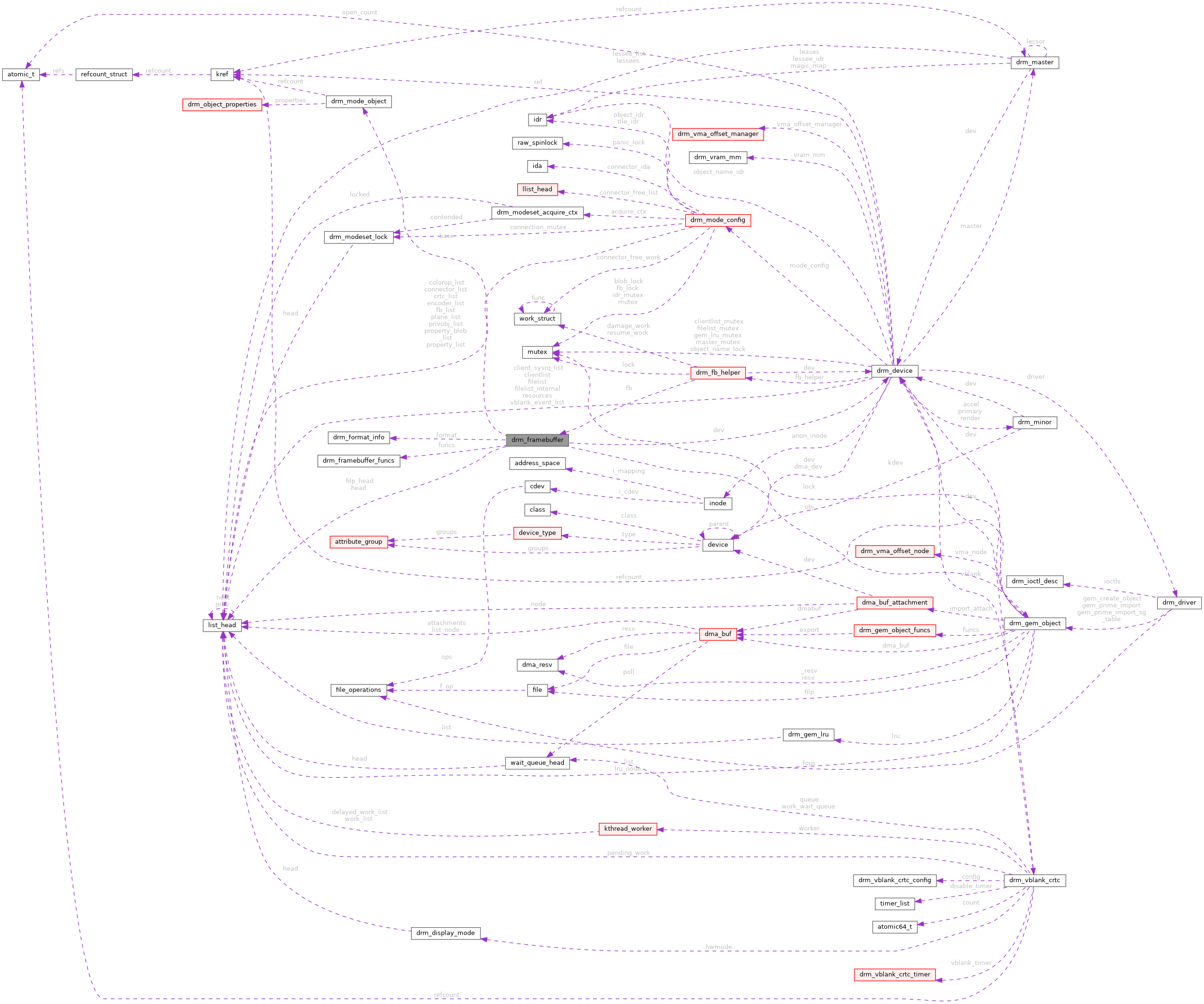
Public Attributes | |
| struct drm_device * | dev |
| struct list_head | head |
| struct drm_mode_object | base |
| char | comm [TASK_COMM_LEN] |
| const struct drm_format_info * | format |
| const struct drm_framebuffer_funcs * | funcs |
| unsigned int | pitches [DRM_FORMAT_MAX_PLANES] |
| unsigned int | offsets [DRM_FORMAT_MAX_PLANES] |
| uint64_t | modifier |
| unsigned int | width |
| unsigned int | height |
| int | flags |
| unsigned int | internal_flags |
| struct list_head | filp_head |
| struct drm_gem_object * | obj [DRM_FORMAT_MAX_PLANES] |
Detailed Description
struct drm_framebuffer - frame buffer object
Note that the fb is refcounted for the benefit of driver internals, for example some hw, disabling a CRTC/plane is asynchronous, and scanout does not actually complete until the next vblank. So some cleanup (like releasing the reference(s) on the backing GEM bo(s)) should be deferred. In cases like this, the driver would like to hold a ref to the fb even though it has already been removed from userspace perspective. See drm_framebuffer_get() and drm_framebuffer_put().
The refcount is stored inside the mode object @base.
Member Data Documentation
◆ base
| struct drm_mode_object drm_framebuffer::base |
@base: base modeset object structure, contains the reference count.
◆ comm
| char drm_framebuffer::comm[TASK_COMM_LEN] |
@comm: Name of the process allocating the fb, used for fb dumping.
◆ dev
| struct drm_device* drm_framebuffer::dev |
@dev: DRM device this framebuffer belongs to
◆ filp_head
| struct list_head drm_framebuffer::filp_head |
@filp_head: Placed on &drm_file.fbs, protected by &drm_file.fbs_lock.
◆ flags
| int drm_framebuffer::flags |
@flags: Framebuffer flags like DRM_MODE_FB_INTERLACED or DRM_MODE_FB_MODIFIERS.
◆ format
| const struct drm_format_info* drm_framebuffer::format |
@format: framebuffer format information
◆ funcs
| const struct drm_framebuffer_funcs* drm_framebuffer::funcs |
@funcs: framebuffer vfunc table
◆ head
| struct list_head drm_framebuffer::head |
@head: Place on the &drm_mode_config.fb_list, access protected by &drm_mode_config.fb_lock.
◆ height
| unsigned int drm_framebuffer::height |
@height: Logical height of the visible area of the framebuffer, in pixels.
◆ internal_flags
| unsigned int drm_framebuffer::internal_flags |
@internal_flags: Framebuffer flags like DRM_FRAMEBUFFER_HAS_HANDLE_REF.
◆ modifier
| uint64_t drm_framebuffer::modifier |
@modifier: Data layout modifier. This is used to describe tiling, or also special layouts (like compression) of auxiliary buffers. For userspace created object this is copied from drm_mode_fb_cmd2.
◆ obj
| struct drm_gem_object* drm_framebuffer::obj[DRM_FORMAT_MAX_PLANES] |
@obj: GEM objects backing the framebuffer, one per plane (optional).
This is used by the GEM framebuffer helpers, see e.g. drm_gem_fb_create().
◆ offsets
| unsigned int drm_framebuffer::offsets[DRM_FORMAT_MAX_PLANES] |
@offsets: Offset from buffer start to the actual pixel data in bytes, per buffer. For userspace created object this is copied from drm_mode_fb_cmd2.
Note that this is a linear offset and does not take into account tiling or buffer layout per @modifier. It is meant to be used when the actual pixel data for this framebuffer plane starts at an offset, e.g. when multiple planes are allocated within the same backing storage buffer object. For tiled layouts this generally means its @offsets must at least be tile-size aligned, but hardware often has stricter requirements.
This should not be used to specifiy x/y pixel offsets into the buffer data (even for linear buffers). Specifying an x/y pixel offset is instead done through the source rectangle in &struct drm_plane_state.
◆ pitches
| unsigned int drm_framebuffer::pitches[DRM_FORMAT_MAX_PLANES] |
@pitches: Line stride per buffer. For userspace created object this is copied from drm_mode_fb_cmd2.
◆ width
| unsigned int drm_framebuffer::width |
@width: Logical width of the visible area of the framebuffer, in pixels.
The documentation for this struct was generated from the following file:
- XenevaOS/BaseHdr/drm/drm_framebuffer.h
