The ECP group structure. More...
#include <ecp.h>
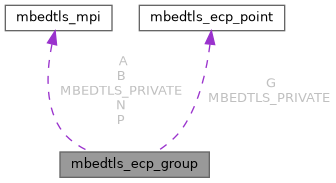
Public Member Functions | |
| unsigned int | MBEDTLS_PRIVATE (h) |
| void * | MBEDTLS_PRIVATE (t_data) |
| mbedtls_ecp_point * | MBEDTLS_PRIVATE (T) |
| size_t | MBEDTLS_PRIVATE (T_size) |
Public Attributes | |
| mbedtls_ecp_group_id | id |
| mbedtls_mpi | P |
| mbedtls_mpi | A |
| mbedtls_mpi | B |
| mbedtls_ecp_point | G |
| mbedtls_mpi | N |
| size_t | pbits |
| size_t | nbits |
| int(*)(mbedtls_mpi *) | MBEDTLS_PRIVATE (modp) |
| int(*)(mbedtls_ecp_point *, void *) | MBEDTLS_PRIVATE (t_pre) |
Detailed Description
The ECP group structure.
We consider two types of curve equations:
-
Short Weierstrass:
y^2 = x^3 + A x + B mod P(SEC1 + RFC-4492) -
Montgomery:
y^2 = x^3 + A x^2 + x mod P(Curve25519, Curve448)
In both cases, the generator (G) for a prime-order subgroup is fixed.
For Short Weierstrass, this subgroup is the whole curve, and its cardinality is denoted by N. Our code requires that N is an odd prime as mbedtls_ecp_mul() requires an odd number, and mbedtls_ecdsa_sign() requires that it is prime for blinding purposes.
The default implementation only initializes A without setting it to the authentic value for curves with A = -3(SECP256R1, etc), in which case you need to load A by yourself when using domain parameters directly, for example:
For Montgomery curves, we do not store A, but (A + 2) / 4, which is the quantity used in the formulas. Additionally, nbits is not the size of N but the required size for private keys.
If modp is NULL, reduction modulo P is done using a generic algorithm. Otherwise, modp must point to a function that takes an mbedtls_mpi in the range of 0..2^(2*pbits)-1, and transforms it in-place to an integer which is congruent mod P to the given MPI, and is close enough to pbits in size, so that it may be efficiently brought in the 0..P-1 range by a few additions or subtractions. Therefore, it is only an approximate modular reduction. It must return 0 on success and non-zero on failure.
- Note
- Alternative implementations of the ECP module must obey the following constraints.
- Group IDs must be distinct: if two group structures have the same ID, then they must be identical.
- The fields
id,P,A,B,G,N,pbitsandnbitsmust have the same type and semantics as in the built-in implementation. They must be available for reading, but direct modification of these fields does not need to be supported. They do not need to be at the same offset in the structure.
Member Function Documentation
◆ MBEDTLS_PRIVATE() [1/4]
| unsigned int mbedtls_ecp_group::MBEDTLS_PRIVATE | ( | h | ) |
◆ MBEDTLS_PRIVATE() [2/4]
| mbedtls_ecp_point * mbedtls_ecp_group::MBEDTLS_PRIVATE | ( | T | ) |
Pre-computed points for ecp_mul_comb().
◆ MBEDTLS_PRIVATE() [3/4]
| void * mbedtls_ecp_group::MBEDTLS_PRIVATE | ( | t_data | ) |
Unused.
◆ MBEDTLS_PRIVATE() [4/4]
| size_t mbedtls_ecp_group::MBEDTLS_PRIVATE | ( | T_size | ) |
The number of dynamic allocated pre-computed points.
Member Data Documentation
◆ A
| mbedtls_mpi mbedtls_ecp_group::A |
For Short Weierstrass: A in the equation. Note that A is not set to the authentic value in some cases. Refer to detailed description of mbedtls_ecp_group if using domain parameters in the structure. For Montgomery curves: (A + 2) / 4.
◆ B
| mbedtls_mpi mbedtls_ecp_group::B |
For Short Weierstrass: B in the equation. For Montgomery curves: unused.
◆ G
| mbedtls_ecp_point mbedtls_ecp_group::G |
The generator of the subgroup used.
◆ id
| mbedtls_ecp_group_id mbedtls_ecp_group::id |
An internal group identifier.
◆ MBEDTLS_PRIVATE [1/2]
| int(*)(mbedtls_mpi *) mbedtls_ecp_group::MBEDTLS_PRIVATE(modp) |
The function for fast pseudo-reduction mod P (see above).
◆ MBEDTLS_PRIVATE [2/2]
| int(*)(mbedtls_ecp_point *, void *) mbedtls_ecp_group::MBEDTLS_PRIVATE(t_post) |
Unused.
◆ N
| mbedtls_mpi mbedtls_ecp_group::N |
The order of G.
◆ nbits
| size_t mbedtls_ecp_group::nbits |
For Short Weierstrass: The number of bits in P. For Montgomery curves: the number of bits in the private keys.
◆ P
| mbedtls_mpi mbedtls_ecp_group::P |
The prime modulus of the base field.
◆ pbits
| size_t mbedtls_ecp_group::pbits |
The number of bits in P.
The documentation for this struct was generated from the following file:
- XenevaOS/Ports/mbedtls/include/mbedtls/ecp.h
