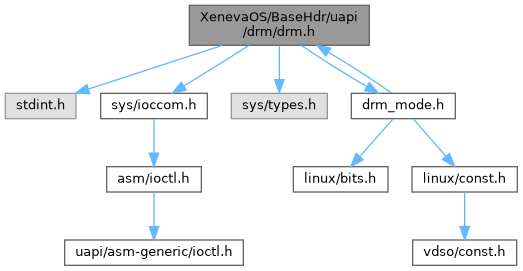

Go to the source code of this file.
Macros | |
| #define | DRM_NAME "drm" |
| #define | DRM_MIN_ORDER 5 |
| #define | DRM_MAX_ORDER 22 |
| #define | DRM_RAM_PERCENT 10 |
| #define | _DRM_LOCK_HELD 0x80000000U |
| #define | _DRM_LOCK_CONT 0x40000000U |
| #define | _DRM_LOCK_IS_HELD(lock) ((lock) & _DRM_LOCK_HELD) |
| #define | _DRM_LOCK_IS_CONT(lock) ((lock) & _DRM_LOCK_CONT) |
| #define | _DRM_LOCKING_CONTEXT(lock) ((lock) & ~(_DRM_LOCK_HELD|_DRM_LOCK_CONT)) |
| #define | _DRM_VBLANK_HIGH_CRTC_SHIFT 1 |
| #define | _DRM_VBLANK_TYPES_MASK (_DRM_VBLANK_ABSOLUTE | _DRM_VBLANK_RELATIVE) |
| #define | _DRM_VBLANK_FLAGS_MASK |
| #define | _DRM_PRE_MODESET 1 |
| #define | _DRM_POST_MODESET 2 |
| #define | DRM_SYNCOBJ_CREATE_SIGNALED (1 << 0) |
Typedefs | |
| typedef int8_t | __s8 |
| typedef uint8_t | __u8 |
| typedef int16_t | __s16 |
| typedef uint16_t | __u16 |
| typedef int32_t | __s32 |
| typedef uint32_t | __u32 |
| typedef int64_t | __s64 |
| typedef uint64_t | __u64 |
| typedef size_t | __kernel_size_t |
| typedef unsigned long | drm_handle_t |
| typedef unsigned int | drm_context_t |
| typedef unsigned int | drm_drawable_t |
| typedef unsigned int | drm_magic_t |
Macro Definition Documentation
◆ _DRM_LOCK_CONT
| #define _DRM_LOCK_CONT 0x40000000U |
Hardware lock is contended
◆ _DRM_LOCK_HELD
| #define _DRM_LOCK_HELD 0x80000000U |
Hardware lock is held
◆ _DRM_LOCK_IS_CONT
| #define _DRM_LOCK_IS_CONT | ( | lock | ) | ((lock) & _DRM_LOCK_CONT) |
◆ _DRM_LOCK_IS_HELD
| #define _DRM_LOCK_IS_HELD | ( | lock | ) | ((lock) & _DRM_LOCK_HELD) |
◆ _DRM_LOCKING_CONTEXT
| #define _DRM_LOCKING_CONTEXT | ( | lock | ) | ((lock) & ~(_DRM_LOCK_HELD|_DRM_LOCK_CONT)) |
◆ _DRM_POST_MODESET
| #define _DRM_POST_MODESET 2 |
◆ _DRM_PRE_MODESET
| #define _DRM_PRE_MODESET 1 |
◆ _DRM_VBLANK_FLAGS_MASK
| #define _DRM_VBLANK_FLAGS_MASK |
◆ _DRM_VBLANK_HIGH_CRTC_SHIFT
| #define _DRM_VBLANK_HIGH_CRTC_SHIFT 1 |
◆ _DRM_VBLANK_TYPES_MASK
| #define _DRM_VBLANK_TYPES_MASK (_DRM_VBLANK_ABSOLUTE | _DRM_VBLANK_RELATIVE) |
◆ DRM_CAP_ADDFB2_MODIFIERS
| #define DRM_CAP_ADDFB2_MODIFIERS 0x10 |
DRM_CAP_ADDFB2_MODIFIERS
If set to 1, the driver supports supplying modifiers in the &DRM_IOCTL_MODE_ADDFB2 ioctl.
◆ DRM_CAP_ASYNC_PAGE_FLIP
| #define DRM_CAP_ASYNC_PAGE_FLIP 0x7 |
DRM_CAP_ASYNC_PAGE_FLIP
If set to 1, the driver supports &DRM_MODE_PAGE_FLIP_ASYNC for legacy page-flips.
◆ DRM_CAP_ATOMIC_ASYNC_PAGE_FLIP
| #define DRM_CAP_ATOMIC_ASYNC_PAGE_FLIP 0x15 |
DRM_CAP_ATOMIC_ASYNC_PAGE_FLIP
If set to 1, the driver supports &DRM_MODE_PAGE_FLIP_ASYNC for atomic commits.
◆ DRM_CAP_CRTC_IN_VBLANK_EVENT
| #define DRM_CAP_CRTC_IN_VBLANK_EVENT 0x12 |
DRM_CAP_CRTC_IN_VBLANK_EVENT
If set to 1, the kernel supports reporting the CRTC ID in &drm_event_vblank.crtc_id for the &DRM_EVENT_VBLANK and &DRM_EVENT_FLIP_COMPLETE events.
Starting kernel version 4.12, this capability is always set to 1.
◆ DRM_CAP_CURSOR_HEIGHT
| #define DRM_CAP_CURSOR_HEIGHT 0x9 |
DRM_CAP_CURSOR_HEIGHT
See &DRM_CAP_CURSOR_WIDTH.
◆ DRM_CAP_CURSOR_WIDTH
| #define DRM_CAP_CURSOR_WIDTH 0x8 |
DRM_CAP_CURSOR_WIDTH
The CURSOR_WIDTH and CURSOR_HEIGHT capabilities return a valid width x height combination for the hardware cursor. The intention is that a hardware agnostic userspace can query a cursor plane size to use.
Note that the cross-driver contract is to merely return a valid size; drivers are free to attach another meaning on top, eg. i915 returns the maximum plane size.
◆ DRM_CAP_DUMB_BUFFER
| #define DRM_CAP_DUMB_BUFFER 0x1 |
DRM_CAP_DUMB_BUFFER
If set to 1, the driver supports creating dumb buffers via the &DRM_IOCTL_MODE_CREATE_DUMB ioctl.
◆ DRM_CAP_DUMB_PREFER_SHADOW
| #define DRM_CAP_DUMB_PREFER_SHADOW 0x4 |
DRM_CAP_DUMB_PREFER_SHADOW
If set to 1, the driver prefers userspace to render to a shadow buffer instead of directly rendering to a dumb buffer. For best speed, userspace should do streaming ordered memory copies into the dumb buffer and never read from it.
Note that this preference only applies to dumb buffers, it's irrelevant for other types of buffers.
◆ DRM_CAP_DUMB_PREFERRED_DEPTH
| #define DRM_CAP_DUMB_PREFERRED_DEPTH 0x3 |
DRM_CAP_DUMB_PREFERRED_DEPTH
The preferred bit depth for dumb buffers.
The bit depth is the number of bits used to indicate the color of a single pixel excluding any padding. This is different from the number of bits per pixel. For instance, XRGB8888 has a bit depth of 24 but has 32 bits per pixel.
Note that this preference only applies to dumb buffers, it's irrelevant for other types of buffers.
◆ DRM_CAP_PAGE_FLIP_TARGET
| #define DRM_CAP_PAGE_FLIP_TARGET 0x11 |
DRM_CAP_PAGE_FLIP_TARGET
If set to 1, the driver supports the &DRM_MODE_PAGE_FLIP_TARGET_ABSOLUTE and &DRM_MODE_PAGE_FLIP_TARGET_RELATIVE flags in &drm_mode_crtc_page_flip_target.flags for the &DRM_IOCTL_MODE_PAGE_FLIP ioctl.
◆ DRM_CAP_PRIME
| #define DRM_CAP_PRIME 0x5 |
DRM_CAP_PRIME
Bitfield of supported PRIME sharing capabilities. See &DRM_PRIME_CAP_IMPORT and &DRM_PRIME_CAP_EXPORT.
Starting from kernel version 6.6, both &DRM_PRIME_CAP_IMPORT and &DRM_PRIME_CAP_EXPORT are always advertised.
PRIME buffers are exposed as dma-buf file descriptors. See :ref:prime_buffer_sharing.
◆ DRM_CAP_SYNCOBJ
| #define DRM_CAP_SYNCOBJ 0x13 |
DRM_CAP_SYNCOBJ
If set to 1, the driver supports sync objects. See :ref:drm_sync_objects.
◆ DRM_CAP_SYNCOBJ_TIMELINE
| #define DRM_CAP_SYNCOBJ_TIMELINE 0x14 |
DRM_CAP_SYNCOBJ_TIMELINE
If set to 1, the driver supports timeline operations on sync objects. See :ref:drm_sync_objects.
◆ DRM_CAP_TIMESTAMP_MONOTONIC
| #define DRM_CAP_TIMESTAMP_MONOTONIC 0x6 |
DRM_CAP_TIMESTAMP_MONOTONIC
If set to 0, the kernel will report timestamps with CLOCK_REALTIME in struct drm_event_vblank. If set to 1, the kernel will report timestamps with CLOCK_MONOTONIC. See clock_gettime(2) for the definition of these clocks.
Starting from kernel version 2.6.39, the default value for this capability is 1. Starting kernel version 4.15, this capability is always set to 1.
◆ DRM_CAP_VBLANK_HIGH_CRTC
| #define DRM_CAP_VBLANK_HIGH_CRTC 0x2 |
DRM_CAP_VBLANK_HIGH_CRTC
If set to 1, the kernel supports specifying a :ref:CRTC index<crtc_index> in the high bits of &drm_wait_vblank_request.type.
Starting kernel version 2.6.39, this capability is always set to 1.
◆ DRM_CLIENT_CAP_ASPECT_RATIO
| #define DRM_CLIENT_CAP_ASPECT_RATIO 4 |
DRM_CLIENT_CAP_ASPECT_RATIO
If set to 1, the DRM core will provide aspect ratio information in modes. See DRM_MODE_FLAG_PIC_AR_*.
This capability is always supported for all drivers starting from kernel version 4.18.
◆ DRM_CLIENT_CAP_ATOMIC
| #define DRM_CLIENT_CAP_ATOMIC 3 |
DRM_CLIENT_CAP_ATOMIC
If set to 1, the DRM core will expose atomic properties to userspace. This implicitly enables &DRM_CLIENT_CAP_UNIVERSAL_PLANES and &DRM_CLIENT_CAP_ASPECT_RATIO.
If the driver doesn't support atomic mode-setting, enabling this capability will fail with -EOPNOTSUPP.
This capability has been introduced in kernel version 4.0. Starting from kernel version 4.2, this capability is always supported for atomic-capable drivers.
◆ DRM_CLIENT_CAP_CURSOR_PLANE_HOTSPOT
| #define DRM_CLIENT_CAP_CURSOR_PLANE_HOTSPOT 6 |
DRM_CLIENT_CAP_CURSOR_PLANE_HOTSPOT
Drivers for para-virtualized hardware (e.g. vmwgfx, qxl, virtio and virtualbox) have additional restrictions for cursor planes (thus making cursor planes on those drivers not truly universal,) e.g. they need cursor planes to act like one would expect from a mouse cursor and have correctly set hotspot properties. If this client cap is not set the DRM core will hide cursor plane on those virtualized drivers because not setting it implies that the client is not capable of dealing with those extra restictions. Clients which do set cursor hotspot and treat the cursor plane like a mouse cursor should set this property. The client must enable &DRM_CLIENT_CAP_ATOMIC first.
Setting this property on drivers which do not special case cursor planes (i.e. non-virtualized drivers) will return EOPNOTSUPP, which can be used by userspace to gauge requirements of the hardware/drivers they're running on.
This capability is always supported for atomic-capable virtualized drivers starting from kernel version 6.6.
◆ DRM_CLIENT_CAP_PLANE_COLOR_PIPELINE
| #define DRM_CLIENT_CAP_PLANE_COLOR_PIPELINE 7 |
DRM_CLIENT_CAP_PLANE_COLOR_PIPELINE
If set to 1 the DRM core will allow setting the COLOR_PIPELINE property on a &drm_plane, as well as drm_colorop properties.
Setting of these plane properties will be rejected when this client cap is set:
- COLOR_ENCODING
- COLOR_RANGE
The client must enable &DRM_CLIENT_CAP_ATOMIC first.
◆ DRM_CLIENT_CAP_STEREO_3D
| #define DRM_CLIENT_CAP_STEREO_3D 1 |
DRM_CLIENT_CAP_STEREO_3D
If set to 1, the DRM core will expose the stereo 3D capabilities of the monitor by advertising the supported 3D layouts in the flags of struct drm_mode_modeinfo. See DRM_MODE_FLAG_3D_*.
This capability is always supported for all drivers starting from kernel version 3.13.
◆ DRM_CLIENT_CAP_UNIVERSAL_PLANES
| #define DRM_CLIENT_CAP_UNIVERSAL_PLANES 2 |
DRM_CLIENT_CAP_UNIVERSAL_PLANES
If set to 1, the DRM core will expose all planes (overlay, primary, and cursor) to userspace.
This capability has been introduced in kernel version 3.15. Starting from kernel version 3.17, this capability is always supported for all drivers.
◆ DRM_CLIENT_CAP_WRITEBACK_CONNECTORS
| #define DRM_CLIENT_CAP_WRITEBACK_CONNECTORS 5 |
DRM_CLIENT_CAP_WRITEBACK_CONNECTORS
If set to 1, the DRM core will expose special connectors to be used for writing back to memory the scene setup in the commit. The client must enable &DRM_CLIENT_CAP_ATOMIC first.
This capability is always supported for atomic-capable drivers starting from kernel version 4.19.
◆ DRM_CLIENT_NAME_MAX_LEN
| #define DRM_CLIENT_NAME_MAX_LEN 64 |
◆ DRM_CLOEXEC
| #define DRM_CLOEXEC O_CLOEXEC |
◆ DRM_COMMAND_BASE
| #define DRM_COMMAND_BASE 0x40 |
◆ DRM_COMMAND_END
| #define DRM_COMMAND_END 0xA0 |
◆ DRM_CRTC_SEQUENCE_NEXT_ON_MISS
| #define DRM_CRTC_SEQUENCE_NEXT_ON_MISS 0x00000002 /* Use next sequence if we've missed */ |
◆ DRM_CRTC_SEQUENCE_RELATIVE
| #define DRM_CRTC_SEQUENCE_RELATIVE 0x00000001 /* sequence is relative to current */ |
◆ DRM_EVENT_CRTC_SEQUENCE
| #define DRM_EVENT_CRTC_SEQUENCE 0x03 |
DRM_EVENT_CRTC_SEQUENCE - CRTC sequence event
This event is sent in response to &DRM_IOCTL_CRTC_QUEUE_SEQUENCE.
The event payload is a struct drm_event_crtc_sequence.
◆ DRM_EVENT_FLIP_COMPLETE
| #define DRM_EVENT_FLIP_COMPLETE 0x02 |
DRM_EVENT_FLIP_COMPLETE - page-flip completion event
This event is sent in response to an atomic commit or legacy page-flip with the &DRM_MODE_PAGE_FLIP_EVENT flag set.
The event payload is a struct drm_event_vblank.
◆ DRM_EVENT_VBLANK
| #define DRM_EVENT_VBLANK 0x01 |
DRM_EVENT_VBLANK - vertical blanking event
This event is sent in response to &DRM_IOCTL_WAIT_VBLANK with the &_DRM_VBLANK_EVENT flag set.
The event payload is a struct drm_event_vblank.
◆ DRM_IO
| #define DRM_IO | ( | nr | ) | _IO(DRM_IOCTL_BASE,nr) |
◆ DRM_IOCTL_ADD_BUFS
| #define DRM_IOCTL_ADD_BUFS DRM_IOWR(0x16, struct drm_buf_desc) |
◆ DRM_IOCTL_ADD_CTX
◆ DRM_IOCTL_ADD_DRAW
◆ DRM_IOCTL_ADD_MAP
◆ DRM_IOCTL_AGP_ACQUIRE
| #define DRM_IOCTL_AGP_ACQUIRE DRM_IO( 0x30) |
◆ DRM_IOCTL_AGP_ALLOC
| #define DRM_IOCTL_AGP_ALLOC DRM_IOWR(0x34, struct drm_agp_buffer) |
◆ DRM_IOCTL_AGP_BIND
| #define DRM_IOCTL_AGP_BIND DRM_IOW( 0x36, struct drm_agp_binding) |
◆ DRM_IOCTL_AGP_ENABLE
| #define DRM_IOCTL_AGP_ENABLE DRM_IOW( 0x32, struct drm_agp_mode) |
◆ DRM_IOCTL_AGP_FREE
| #define DRM_IOCTL_AGP_FREE DRM_IOW( 0x35, struct drm_agp_buffer) |
◆ DRM_IOCTL_AGP_INFO
| #define DRM_IOCTL_AGP_INFO DRM_IOR( 0x33, struct drm_agp_info) |
◆ DRM_IOCTL_AGP_RELEASE
| #define DRM_IOCTL_AGP_RELEASE DRM_IO( 0x31) |
◆ DRM_IOCTL_AGP_UNBIND
| #define DRM_IOCTL_AGP_UNBIND DRM_IOW( 0x37, struct drm_agp_binding) |
◆ DRM_IOCTL_AUTH_MAGIC
◆ DRM_IOCTL_BASE
| #define DRM_IOCTL_BASE 'd' |
◆ DRM_IOCTL_BLOCK
◆ DRM_IOCTL_CONTROL
| #define DRM_IOCTL_CONTROL DRM_IOW( 0x14, struct drm_control) |
◆ DRM_IOCTL_CRTC_GET_SEQUENCE
| #define DRM_IOCTL_CRTC_GET_SEQUENCE DRM_IOWR(0x3b, struct drm_crtc_get_sequence) |
◆ DRM_IOCTL_CRTC_QUEUE_SEQUENCE
| #define DRM_IOCTL_CRTC_QUEUE_SEQUENCE DRM_IOWR(0x3c, struct drm_crtc_queue_sequence) |
◆ DRM_IOCTL_DMA
◆ DRM_IOCTL_DROP_MASTER
| #define DRM_IOCTL_DROP_MASTER DRM_IO(0x1f) |
◆ DRM_IOCTL_FINISH
◆ DRM_IOCTL_FREE_BUFS
| #define DRM_IOCTL_FREE_BUFS DRM_IOW( 0x1a, struct drm_buf_free) |
◆ DRM_IOCTL_GEM_CHANGE_HANDLE
| #define DRM_IOCTL_GEM_CHANGE_HANDLE DRM_IOWR(0xD2, struct drm_gem_change_handle) |
DRM_IOCTL_GEM_CHANGE_HANDLE - Move an object to a different handle
Some applications (notably CRIU) need objects to have specific gem handles. This ioctl changes the object at one gem handle to use a new gem handle.
◆ DRM_IOCTL_GEM_CLOSE
| #define DRM_IOCTL_GEM_CLOSE DRM_IOW (0x09, struct drm_gem_close) |
DRM_IOCTL_GEM_CLOSE - Close a GEM handle.
GEM handles are not reference-counted by the kernel. User-space is responsible for managing their lifetime. For example, if user-space imports the same memory object twice on the same DRM file description, the same GEM handle is returned by both imports, and user-space needs to ensure &DRM_IOCTL_GEM_CLOSE is performed once only. The same situation can happen when a memory object is allocated, then exported and imported again on the same DRM file description. The &DRM_IOCTL_MODE_GETFB2 IOCTL is an exception and always returns fresh new GEM handles even if an existing GEM handle already refers to the same memory object before the IOCTL is performed.
◆ DRM_IOCTL_GEM_FLINK
| #define DRM_IOCTL_GEM_FLINK DRM_IOWR(0x0a, struct drm_gem_flink) |
◆ DRM_IOCTL_GEM_OPEN
| #define DRM_IOCTL_GEM_OPEN DRM_IOWR(0x0b, struct drm_gem_open) |
◆ DRM_IOCTL_GET_CAP
| #define DRM_IOCTL_GET_CAP DRM_IOWR(0x0c, struct drm_get_cap) |
◆ DRM_IOCTL_GET_CLIENT
| #define DRM_IOCTL_GET_CLIENT DRM_IOWR(0x05, struct drm_client) |
◆ DRM_IOCTL_GET_CTX
◆ DRM_IOCTL_GET_MAGIC
◆ DRM_IOCTL_GET_MAP
◆ DRM_IOCTL_GET_SAREA_CTX
| #define DRM_IOCTL_GET_SAREA_CTX DRM_IOWR(0x1d, struct drm_ctx_priv_map) |
◆ DRM_IOCTL_GET_STATS
◆ DRM_IOCTL_GET_UNIQUE
| #define DRM_IOCTL_GET_UNIQUE DRM_IOWR(0x01, struct drm_unique) |
◆ DRM_IOCTL_INFO_BUFS
| #define DRM_IOCTL_INFO_BUFS DRM_IOWR(0x18, struct drm_buf_info) |
◆ DRM_IOCTL_IRQ_BUSID
| #define DRM_IOCTL_IRQ_BUSID DRM_IOWR(0x03, struct drm_irq_busid) |
◆ DRM_IOCTL_LOCK
◆ DRM_IOCTL_MAP_BUFS
| #define DRM_IOCTL_MAP_BUFS DRM_IOWR(0x19, struct drm_buf_map) |
◆ DRM_IOCTL_MARK_BUFS
| #define DRM_IOCTL_MARK_BUFS DRM_IOW( 0x17, struct drm_buf_desc) |
◆ DRM_IOCTL_MOD_CTX
◆ DRM_IOCTL_MODE_ADDFB
| #define DRM_IOCTL_MODE_ADDFB DRM_IOWR(0xAE, struct drm_mode_fb_cmd) |
◆ DRM_IOCTL_MODE_ADDFB2
| #define DRM_IOCTL_MODE_ADDFB2 DRM_IOWR(0xB8, struct drm_mode_fb_cmd2) |
◆ DRM_IOCTL_MODE_ATOMIC
| #define DRM_IOCTL_MODE_ATOMIC DRM_IOWR(0xBC, struct drm_mode_atomic) |
◆ DRM_IOCTL_MODE_ATTACHMODE
| #define DRM_IOCTL_MODE_ATTACHMODE DRM_IOWR(0xA8, struct drm_mode_mode_cmd) /* deprecated (never worked) */ |
◆ DRM_IOCTL_MODE_CLOSEFB
| #define DRM_IOCTL_MODE_CLOSEFB DRM_IOWR(0xD0, struct drm_mode_closefb) |
DRM_IOCTL_MODE_CLOSEFB - Close a framebuffer.
This closes a framebuffer previously added via ADDFB/ADDFB2. The IOCTL argument is a framebuffer object ID.
This IOCTL is similar to &DRM_IOCTL_MODE_RMFB, except it doesn't disable planes and CRTCs. As long as the framebuffer is used by a plane, it's kept alive. When the plane no longer uses the framebuffer (because the framebuffer is replaced with another one, or the plane is disabled), the framebuffer is cleaned up.
This is useful to implement flicker-free transitions between two processes.
Depending on the threat model, user-space may want to ensure that the framebuffer doesn't expose any sensitive user information: closed framebuffers attached to a plane can be read back by the next DRM master.
◆ DRM_IOCTL_MODE_CREATE_DUMB
| #define DRM_IOCTL_MODE_CREATE_DUMB DRM_IOWR(0xB2, struct drm_mode_create_dumb) |
DRM_IOCTL_MODE_CREATE_DUMB - Create a new dumb buffer object.
KMS dumb buffers provide a very primitive way to allocate a buffer object suitable for scanout and map it for software rendering. KMS dumb buffers are not suitable for hardware-accelerated rendering nor video decoding. KMS dumb buffers are not suitable to be displayed on any other device than the KMS device where they were allocated from. Also see :ref:kms_dumb_buffer_objects.
The IOCTL argument is a struct drm_mode_create_dumb.
User-space is expected to create a KMS dumb buffer via this IOCTL, then add it as a KMS framebuffer via &DRM_IOCTL_MODE_ADDFB and map it via &DRM_IOCTL_MODE_MAP_DUMB.
&DRM_CAP_DUMB_BUFFER indicates whether this IOCTL is supported. &DRM_CAP_DUMB_PREFERRED_DEPTH and &DRM_CAP_DUMB_PREFER_SHADOW indicate driver preferences for dumb buffers.
◆ DRM_IOCTL_MODE_CREATE_LEASE
| #define DRM_IOCTL_MODE_CREATE_LEASE DRM_IOWR(0xC6, struct drm_mode_create_lease) |
◆ DRM_IOCTL_MODE_CREATEPROPBLOB
| #define DRM_IOCTL_MODE_CREATEPROPBLOB DRM_IOWR(0xBD, struct drm_mode_create_blob) |
◆ DRM_IOCTL_MODE_CURSOR
| #define DRM_IOCTL_MODE_CURSOR DRM_IOWR(0xA3, struct drm_mode_cursor) |
◆ DRM_IOCTL_MODE_CURSOR2
| #define DRM_IOCTL_MODE_CURSOR2 DRM_IOWR(0xBB, struct drm_mode_cursor2) |
◆ DRM_IOCTL_MODE_DESTROY_DUMB
| #define DRM_IOCTL_MODE_DESTROY_DUMB DRM_IOWR(0xB4, struct drm_mode_destroy_dumb) |
◆ DRM_IOCTL_MODE_DESTROYPROPBLOB
| #define DRM_IOCTL_MODE_DESTROYPROPBLOB DRM_IOWR(0xBE, struct drm_mode_destroy_blob) |
◆ DRM_IOCTL_MODE_DETACHMODE
| #define DRM_IOCTL_MODE_DETACHMODE DRM_IOWR(0xA9, struct drm_mode_mode_cmd) /* deprecated (never worked) */ |
◆ DRM_IOCTL_MODE_DIRTYFB
| #define DRM_IOCTL_MODE_DIRTYFB DRM_IOWR(0xB1, struct drm_mode_fb_dirty_cmd) |
◆ DRM_IOCTL_MODE_GET_LEASE
| #define DRM_IOCTL_MODE_GET_LEASE DRM_IOWR(0xC8, struct drm_mode_get_lease) |
◆ DRM_IOCTL_MODE_GETCONNECTOR
| #define DRM_IOCTL_MODE_GETCONNECTOR DRM_IOWR(0xA7, struct drm_mode_get_connector) |
◆ DRM_IOCTL_MODE_GETCRTC
| #define DRM_IOCTL_MODE_GETCRTC DRM_IOWR(0xA1, struct drm_mode_crtc) |
◆ DRM_IOCTL_MODE_GETENCODER
| #define DRM_IOCTL_MODE_GETENCODER DRM_IOWR(0xA6, struct drm_mode_get_encoder) |
◆ DRM_IOCTL_MODE_GETFB
| #define DRM_IOCTL_MODE_GETFB DRM_IOWR(0xAD, struct drm_mode_fb_cmd) |
◆ DRM_IOCTL_MODE_GETFB2
| #define DRM_IOCTL_MODE_GETFB2 DRM_IOWR(0xCE, struct drm_mode_fb_cmd2) |
DRM_IOCTL_MODE_GETFB2 - Get framebuffer metadata.
This queries metadata about a framebuffer. User-space fills &drm_mode_fb_cmd2.fb_id as the input, and the kernels fills the rest of the struct as the output.
If the client is DRM master or has &CAP_SYS_ADMIN, &drm_mode_fb_cmd2.handles will be filled with GEM buffer handles. Fresh new GEM handles are always returned, even if another GEM handle referring to the same memory object already exists on the DRM file description. The caller is responsible for removing the new handles, e.g. via the &DRM_IOCTL_GEM_CLOSE IOCTL. The same new handle will be returned for multiple planes in case they use the same memory object. Planes are valid until one has a zero handle – this can be used to compute the number of planes.
Otherwise, &drm_mode_fb_cmd2.handles will be zeroed and planes are valid until one has a zero &drm_mode_fb_cmd2.pitches.
If the framebuffer has a format modifier, &DRM_MODE_FB_MODIFIERS will be set in &drm_mode_fb_cmd2.flags and &drm_mode_fb_cmd2.modifier will contain the modifier. Otherwise, user-space must ignore &drm_mode_fb_cmd2.modifier.
To obtain DMA-BUF FDs for each plane without leaking GEM handles, user-space can export each handle via &DRM_IOCTL_PRIME_HANDLE_TO_FD, then immediately close each unique handle via &DRM_IOCTL_GEM_CLOSE, making sure to not double-close handles which are specified multiple times in the array.
◆ DRM_IOCTL_MODE_GETGAMMA
| #define DRM_IOCTL_MODE_GETGAMMA DRM_IOWR(0xA4, struct drm_mode_crtc_lut) |
◆ DRM_IOCTL_MODE_GETPLANE
| #define DRM_IOCTL_MODE_GETPLANE DRM_IOWR(0xB6, struct drm_mode_get_plane) |
◆ DRM_IOCTL_MODE_GETPLANERESOURCES
| #define DRM_IOCTL_MODE_GETPLANERESOURCES DRM_IOWR(0xB5, struct drm_mode_get_plane_res) |
◆ DRM_IOCTL_MODE_GETPROPBLOB
| #define DRM_IOCTL_MODE_GETPROPBLOB DRM_IOWR(0xAC, struct drm_mode_get_blob) |
◆ DRM_IOCTL_MODE_GETPROPERTY
| #define DRM_IOCTL_MODE_GETPROPERTY DRM_IOWR(0xAA, struct drm_mode_get_property) |
◆ DRM_IOCTL_MODE_GETRESOURCES
| #define DRM_IOCTL_MODE_GETRESOURCES DRM_IOWR(0xA0, struct drm_mode_card_res) |
◆ DRM_IOCTL_MODE_LIST_LESSEES
| #define DRM_IOCTL_MODE_LIST_LESSEES DRM_IOWR(0xC7, struct drm_mode_list_lessees) |
◆ DRM_IOCTL_MODE_MAP_DUMB
| #define DRM_IOCTL_MODE_MAP_DUMB DRM_IOWR(0xB3, struct drm_mode_map_dumb) |
◆ DRM_IOCTL_MODE_OBJ_GETPROPERTIES
| #define DRM_IOCTL_MODE_OBJ_GETPROPERTIES DRM_IOWR(0xB9, struct drm_mode_obj_get_properties) |
◆ DRM_IOCTL_MODE_OBJ_SETPROPERTY
| #define DRM_IOCTL_MODE_OBJ_SETPROPERTY DRM_IOWR(0xBA, struct drm_mode_obj_set_property) |
◆ DRM_IOCTL_MODE_PAGE_FLIP
| #define DRM_IOCTL_MODE_PAGE_FLIP DRM_IOWR(0xB0, struct drm_mode_crtc_page_flip) |
◆ DRM_IOCTL_MODE_REVOKE_LEASE
| #define DRM_IOCTL_MODE_REVOKE_LEASE DRM_IOWR(0xC9, struct drm_mode_revoke_lease) |
◆ DRM_IOCTL_MODE_RMFB
| #define DRM_IOCTL_MODE_RMFB DRM_IOWR(0xAF, unsigned int) |
DRM_IOCTL_MODE_RMFB - Remove a framebuffer.
This removes a framebuffer previously added via ADDFB/ADDFB2. The IOCTL argument is a framebuffer object ID.
Warning: removing a framebuffer currently in-use on an enabled plane will disable that plane. The CRTC the plane is linked to may also be disabled (depending on driver capabilities).
◆ DRM_IOCTL_MODE_SETCRTC
| #define DRM_IOCTL_MODE_SETCRTC DRM_IOWR(0xA2, struct drm_mode_crtc) |
◆ DRM_IOCTL_MODE_SETGAMMA
| #define DRM_IOCTL_MODE_SETGAMMA DRM_IOWR(0xA5, struct drm_mode_crtc_lut) |
◆ DRM_IOCTL_MODE_SETPLANE
| #define DRM_IOCTL_MODE_SETPLANE DRM_IOWR(0xB7, struct drm_mode_set_plane) |
◆ DRM_IOCTL_MODE_SETPROPERTY
| #define DRM_IOCTL_MODE_SETPROPERTY DRM_IOWR(0xAB, struct drm_mode_connector_set_property) |
◆ DRM_IOCTL_MODESET_CTL
| #define DRM_IOCTL_MODESET_CTL DRM_IOW(0x08, struct drm_modeset_ctl) |
◆ DRM_IOCTL_NEW_CTX
◆ DRM_IOCTL_PRIME_FD_TO_HANDLE
| #define DRM_IOCTL_PRIME_FD_TO_HANDLE DRM_IOWR(0x2e, struct drm_prime_handle) |
DRM_IOCTL_PRIME_FD_TO_HANDLE - Convert a DMA-BUF FD to a GEM handle.
User-space sets &drm_prime_handle.fd with a DMA-BUF file descriptor to import, and gets back a GEM handle in &drm_prime_handle.handle. &drm_prime_handle.flags is unused.
If an existing GEM handle refers to the memory object backing the DMA-BUF, that GEM handle is returned. Therefore user-space which needs to handle arbitrary DMA-BUFs must have a user-space lookup data structure to manually reference-count duplicated GEM handles. For more information see &DRM_IOCTL_GEM_CLOSE.
The import can fail for any driver-specific reason, e.g. because import is only supported for DMA-BUFs allocated on this DRM device.
Support for importing DMA-BUFs is advertised via &DRM_PRIME_CAP_IMPORT.
◆ DRM_IOCTL_PRIME_HANDLE_TO_FD
| #define DRM_IOCTL_PRIME_HANDLE_TO_FD DRM_IOWR(0x2d, struct drm_prime_handle) |
DRM_IOCTL_PRIME_HANDLE_TO_FD - Convert a GEM handle to a DMA-BUF FD.
User-space sets &drm_prime_handle.handle with the GEM handle to export and &drm_prime_handle.flags, and gets back a DMA-BUF file descriptor in &drm_prime_handle.fd.
The export can fail for any driver-specific reason, e.g. because export is not supported for this specific GEM handle (but might be for others).
Support for exporting DMA-BUFs is advertised via &DRM_PRIME_CAP_EXPORT.
◆ DRM_IOCTL_RES_CTX
| #define DRM_IOCTL_RES_CTX DRM_IOWR(0x26, struct drm_ctx_res) |
◆ DRM_IOCTL_RM_CTX
◆ DRM_IOCTL_RM_DRAW
◆ DRM_IOCTL_RM_MAP
◆ DRM_IOCTL_SET_CLIENT_CAP
| #define DRM_IOCTL_SET_CLIENT_CAP DRM_IOW( 0x0d, struct drm_set_client_cap) |
◆ DRM_IOCTL_SET_CLIENT_NAME
| #define DRM_IOCTL_SET_CLIENT_NAME DRM_IOWR(0xD1, struct drm_set_client_name) |
DRM_IOCTL_SET_CLIENT_NAME - Attach a name to a drm_file
Having a name allows for easier tracking and debugging. The length of the name (without null ending char) must be <= DRM_CLIENT_NAME_MAX_LEN. The call will fail if the name contains whitespaces or non-printable chars.
◆ DRM_IOCTL_SET_MASTER
| #define DRM_IOCTL_SET_MASTER DRM_IO(0x1e) |
◆ DRM_IOCTL_SET_SAREA_CTX
| #define DRM_IOCTL_SET_SAREA_CTX DRM_IOW( 0x1c, struct drm_ctx_priv_map) |
◆ DRM_IOCTL_SET_UNIQUE
| #define DRM_IOCTL_SET_UNIQUE DRM_IOW( 0x10, struct drm_unique) |
◆ DRM_IOCTL_SET_VERSION
| #define DRM_IOCTL_SET_VERSION DRM_IOWR(0x07, struct drm_set_version) |
◆ DRM_IOCTL_SG_ALLOC
| #define DRM_IOCTL_SG_ALLOC DRM_IOWR(0x38, struct drm_scatter_gather) |
◆ DRM_IOCTL_SG_FREE
| #define DRM_IOCTL_SG_FREE DRM_IOW( 0x39, struct drm_scatter_gather) |
◆ DRM_IOCTL_SWITCH_CTX
◆ DRM_IOCTL_SYNCOBJ_CREATE
| #define DRM_IOCTL_SYNCOBJ_CREATE DRM_IOWR(0xBF, struct drm_syncobj_create) |
◆ DRM_IOCTL_SYNCOBJ_DESTROY
| #define DRM_IOCTL_SYNCOBJ_DESTROY DRM_IOWR(0xC0, struct drm_syncobj_destroy) |
◆ DRM_IOCTL_SYNCOBJ_EVENTFD
| #define DRM_IOCTL_SYNCOBJ_EVENTFD DRM_IOWR(0xCF, struct drm_syncobj_eventfd) |
DRM_IOCTL_SYNCOBJ_EVENTFD - Register an eventfd to be signalled by a syncobj.
This can be used to integrate a syncobj in an event loop.
The IOCTL argument is a struct drm_syncobj_eventfd.
◆ DRM_IOCTL_SYNCOBJ_FD_TO_HANDLE
| #define DRM_IOCTL_SYNCOBJ_FD_TO_HANDLE DRM_IOWR(0xC2, struct drm_syncobj_handle) |
◆ DRM_IOCTL_SYNCOBJ_HANDLE_TO_FD
| #define DRM_IOCTL_SYNCOBJ_HANDLE_TO_FD DRM_IOWR(0xC1, struct drm_syncobj_handle) |
◆ DRM_IOCTL_SYNCOBJ_QUERY
| #define DRM_IOCTL_SYNCOBJ_QUERY DRM_IOWR(0xCB, struct drm_syncobj_timeline_array) |
◆ DRM_IOCTL_SYNCOBJ_RESET
| #define DRM_IOCTL_SYNCOBJ_RESET DRM_IOWR(0xC4, struct drm_syncobj_array) |
◆ DRM_IOCTL_SYNCOBJ_SIGNAL
| #define DRM_IOCTL_SYNCOBJ_SIGNAL DRM_IOWR(0xC5, struct drm_syncobj_array) |
◆ DRM_IOCTL_SYNCOBJ_TIMELINE_SIGNAL
| #define DRM_IOCTL_SYNCOBJ_TIMELINE_SIGNAL DRM_IOWR(0xCD, struct drm_syncobj_timeline_array) |
◆ DRM_IOCTL_SYNCOBJ_TIMELINE_WAIT
| #define DRM_IOCTL_SYNCOBJ_TIMELINE_WAIT DRM_IOWR(0xCA, struct drm_syncobj_timeline_wait) |
◆ DRM_IOCTL_SYNCOBJ_TRANSFER
| #define DRM_IOCTL_SYNCOBJ_TRANSFER DRM_IOWR(0xCC, struct drm_syncobj_transfer) |
◆ DRM_IOCTL_SYNCOBJ_WAIT
| #define DRM_IOCTL_SYNCOBJ_WAIT DRM_IOWR(0xC3, struct drm_syncobj_wait) |
◆ DRM_IOCTL_UNBLOCK
◆ DRM_IOCTL_UNLOCK
◆ DRM_IOCTL_UPDATE_DRAW
| #define DRM_IOCTL_UPDATE_DRAW DRM_IOW(0x3f, struct drm_update_draw) |
◆ DRM_IOCTL_VERSION
| #define DRM_IOCTL_VERSION DRM_IOWR(0x00, struct drm_version) |
◆ DRM_IOCTL_WAIT_VBLANK
| #define DRM_IOCTL_WAIT_VBLANK DRM_IOWR(0x3a, union drm_wait_vblank) |
◆ DRM_IOR
| #define DRM_IOR | ( | nr, | |
| type | |||
| ) | _IOR(DRM_IOCTL_BASE,nr,type) |
◆ DRM_IOW
| #define DRM_IOW | ( | nr, | |
| type | |||
| ) | _IOW(DRM_IOCTL_BASE,nr,type) |
◆ DRM_IOWR
| #define DRM_IOWR | ( | nr, | |
| type | |||
| ) | _IOWR(DRM_IOCTL_BASE,nr,type) |
◆ DRM_MAX_ORDER
| #define DRM_MAX_ORDER 22 |
Up to 2^22 bytes = 4MB
◆ DRM_MIN_ORDER
| #define DRM_MIN_ORDER 5 |
At least 2^5 bytes = 32 bytes
◆ DRM_NAME
| #define DRM_NAME "drm" |
Name in kernel, /dev, and /proc
◆ DRM_PRIME_CAP_EXPORT
| #define DRM_PRIME_CAP_EXPORT 0x2 |
DRM_PRIME_CAP_EXPORT
If this bit is set in &DRM_CAP_PRIME, the driver supports exporting PRIME buffers via the &DRM_IOCTL_PRIME_HANDLE_TO_FD ioctl.
Starting from kernel version 6.6, this bit is always set in &DRM_CAP_PRIME.
◆ DRM_PRIME_CAP_IMPORT
| #define DRM_PRIME_CAP_IMPORT 0x1 |
DRM_PRIME_CAP_IMPORT
If this bit is set in &DRM_CAP_PRIME, the driver supports importing PRIME buffers via the &DRM_IOCTL_PRIME_FD_TO_HANDLE ioctl.
Starting from kernel version 6.6, this bit is always set in &DRM_CAP_PRIME.
◆ DRM_RAM_PERCENT
| #define DRM_RAM_PERCENT 10 |
How much system ram can we lock?
◆ DRM_RDWR
| #define DRM_RDWR O_RDWR |
◆ DRM_SYNCOBJ_CREATE_SIGNALED
| #define DRM_SYNCOBJ_CREATE_SIGNALED (1 << 0) |
◆ DRM_SYNCOBJ_FD_TO_HANDLE_FLAGS_IMPORT_SYNC_FILE
| #define DRM_SYNCOBJ_FD_TO_HANDLE_FLAGS_IMPORT_SYNC_FILE (1 << 0) |
◆ DRM_SYNCOBJ_FD_TO_HANDLE_FLAGS_TIMELINE
| #define DRM_SYNCOBJ_FD_TO_HANDLE_FLAGS_TIMELINE (1 << 1) |
◆ DRM_SYNCOBJ_HANDLE_TO_FD_FLAGS_EXPORT_SYNC_FILE
| #define DRM_SYNCOBJ_HANDLE_TO_FD_FLAGS_EXPORT_SYNC_FILE (1 << 0) |
◆ DRM_SYNCOBJ_HANDLE_TO_FD_FLAGS_TIMELINE
| #define DRM_SYNCOBJ_HANDLE_TO_FD_FLAGS_TIMELINE (1 << 1) |
◆ DRM_SYNCOBJ_QUERY_FLAGS_LAST_SUBMITTED
| #define DRM_SYNCOBJ_QUERY_FLAGS_LAST_SUBMITTED (1 << 0) /* last available point on timeline syncobj */ |
◆ DRM_SYNCOBJ_WAIT_FLAGS_WAIT_ALL
| #define DRM_SYNCOBJ_WAIT_FLAGS_WAIT_ALL (1 << 0) |
◆ DRM_SYNCOBJ_WAIT_FLAGS_WAIT_AVAILABLE
| #define DRM_SYNCOBJ_WAIT_FLAGS_WAIT_AVAILABLE (1 << 2) /* wait for time point to become available */ |
◆ DRM_SYNCOBJ_WAIT_FLAGS_WAIT_DEADLINE
| #define DRM_SYNCOBJ_WAIT_FLAGS_WAIT_DEADLINE (1 << 3) /* set fence deadline to deadline_nsec */ |
◆ DRM_SYNCOBJ_WAIT_FLAGS_WAIT_FOR_SUBMIT
| #define DRM_SYNCOBJ_WAIT_FLAGS_WAIT_FOR_SUBMIT (1 << 1) |
Typedef Documentation
◆ __kernel_size_t
| typedef size_t __kernel_size_t |
◆ __s16
◆ __s32
◆ __s64
◆ __s8
◆ __u16
◆ __u32
◆ __u64
◆ __u8
◆ drm_agp_binding_t
| typedef struct drm_agp_binding drm_agp_binding_t |
◆ drm_agp_buffer_t
| typedef struct drm_agp_buffer drm_agp_buffer_t |
◆ drm_agp_info_t
| typedef struct drm_agp_info drm_agp_info_t |
◆ drm_agp_mode_t
| typedef struct drm_agp_mode drm_agp_mode_t |
◆ drm_auth_t
| typedef struct drm_auth drm_auth_t |
◆ drm_block_t
| typedef struct drm_block drm_block_t |
◆ drm_buf_desc_t
| typedef struct drm_buf_desc drm_buf_desc_t |
◆ drm_buf_free_t
| typedef struct drm_buf_free drm_buf_free_t |
◆ drm_buf_info_t
| typedef struct drm_buf_info drm_buf_info_t |
◆ drm_buf_map_t
| typedef struct drm_buf_map drm_buf_map_t |
◆ drm_buf_pub_t
| typedef struct drm_buf_pub drm_buf_pub_t |
◆ drm_client_t
| typedef struct drm_client drm_client_t |
◆ drm_clip_rect_t
| typedef struct drm_clip_rect drm_clip_rect_t |
◆ drm_context_t
| typedef unsigned int drm_context_t |
◆ drm_control_t
| typedef struct drm_control drm_control_t |
◆ drm_ctx_flags_t
| typedef enum drm_ctx_flags drm_ctx_flags_t |
◆ drm_ctx_priv_map_t
| typedef struct drm_ctx_priv_map drm_ctx_priv_map_t |
◆ drm_ctx_res_t
| typedef struct drm_ctx_res drm_ctx_res_t |
◆ drm_ctx_t
◆ drm_dma_flags_t
| typedef enum drm_dma_flags drm_dma_flags_t |
◆ drm_dma_t
◆ drm_draw_t
| typedef struct drm_draw drm_draw_t |
◆ drm_drawable_info_t
| typedef struct drm_drawable_info drm_drawable_info_t |
◆ drm_drawable_t
| typedef unsigned int drm_drawable_t |
◆ drm_handle_t
| typedef unsigned long drm_handle_t |
◆ drm_hw_lock_t
| typedef struct drm_hw_lock drm_hw_lock_t |
◆ drm_irq_busid_t
| typedef struct drm_irq_busid drm_irq_busid_t |
◆ drm_list_t
| typedef struct drm_list drm_list_t |
◆ drm_lock_flags_t
| typedef enum drm_lock_flags drm_lock_flags_t |
◆ drm_lock_t
| typedef struct drm_lock drm_lock_t |
◆ drm_magic_t
| typedef unsigned int drm_magic_t |
◆ drm_map_flags_t
| typedef enum drm_map_flags drm_map_flags_t |
◆ drm_map_t
◆ drm_map_type_t
| typedef enum drm_map_type drm_map_type_t |
◆ drm_scatter_gather_t
| typedef struct drm_scatter_gather drm_scatter_gather_t |
◆ drm_set_version_t
| typedef struct drm_set_version drm_set_version_t |
◆ drm_stat_type_t
| typedef enum drm_stat_type drm_stat_type_t |
◆ drm_stats_t
| typedef struct drm_stats drm_stats_t |
◆ drm_tex_region_t
| typedef struct drm_tex_region drm_tex_region_t |
◆ drm_unique_t
| typedef struct drm_unique drm_unique_t |
◆ drm_update_draw_t
| typedef struct drm_update_draw drm_update_draw_t |
◆ drm_vblank_seq_type_t
| typedef enum drm_vblank_seq_type drm_vblank_seq_type_t |
◆ drm_version_t
| typedef struct drm_version drm_version_t |
◆ drm_wait_vblank_t
| typedef union drm_wait_vblank drm_wait_vblank_t |
Enumeration Type Documentation
◆ drm_ctx_flags
| enum drm_ctx_flags |
◆ drm_dma_flags
| enum drm_dma_flags |
◆ drm_drawable_info_type_t
◆ drm_lock_flags
| enum drm_lock_flags |
◆ drm_map_flags
| enum drm_map_flags |
◆ drm_map_type
| enum drm_map_type |
◆ drm_stat_type
| enum drm_stat_type |
◆ drm_vblank_seq_type
| enum drm_vblank_seq_type |
