#include <audrv.h>#include <aucomponent.h>#include <Cred/group.h>#include <aubuiltin.h>#include <Fs/Dev/devhw.h>#include <Fs/Dev/devgpu.h>#include <Sound/sndproxy.h>#include <Net/netproxy.h>#include <austatic.h>#include <Ipc/auipc.h>#include <Fs/srvfs.h>#include <Hal/AA64/gic.h>#include <Mm/pmmngr.h>#include <Mm/vmmngr.h>#include <string.h>#include <pe.h>#include <stdio.h>#include <Mm/kmalloc.h>#include <pcie.h>#include <aucon.h>#include <Drivers/uart.h>#include <Fs/Dev/devfs.h>#include <Sound/sound.h>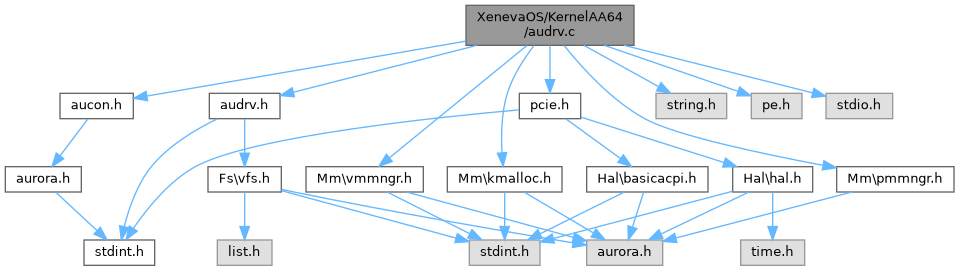
Macros | |
| #define | AU_DRIVER_BASE_START 0xFFFFC00000A00000 |
| 0xFFFFC00000400000 - 0xFFFFC00000A00000 – Kernel Boot Drivers 0xFFFFC00000A00000 - Kernel Runtime Drivers | |
| #define | AU_MAX_SUPPORTED_DEVICE 256 |
| #define | AU_DRV_MAX_FREE_REGIONS 64 |
| #define | AU_CALLER_DRIVER() AuDriverOwnerOf((uint64_t)__builtin_return_address(0)) |
Functions | |
| uint32_t | AuRequestDriverId () |
| request an unique id for driver class | |
| uint32_t | AuRequestBootDriverId () |
| void | AuDecreaseDriverCount () |
| AuDecreaseDriverCount – decrease the number of device count. | |
| void | AuIncreaseDriverCount () |
| AuIncreaseDriverCount – increase the number of device count. | |
| char * | AuGetConfEntry (uint32_t vendor_id, uint32_t device_id, uint8_t *buffer, int entryoff) |
| AuGetConfEntry – Get an entry offset in the file for required device. | |
| AuDriver * | AuCreateDriverInstance (char *drivername) |
| AuCreateDriverInstance – creates a new driver slot. | |
| AuDriver * | AuCreateBootDriverInstance (char *drivername) |
| AuCreateDriverInstance – creates a new driver slot. | |
| AuDriver * | AuGetDriverName (uint32_t vendor_id, uint32_t device_id, uint8_t *buffer, int entryoff) |
| AuGetDriverName – Extract the driver path from its entry offset. | |
| void | AuBoardIterateModule (uint8_t *board, int moduleCount) |
| AuBoardIterateModule – iterate all modules present in board config file. | |
| void | AuDriverLoad (char *filename, AuDriver *driver) |
| AuDriverLoad – Manage and loads dll drivers. | |
| bool | AuIsPCIeInitialized () |
| int | FontManagerGetFontCount (uint8_t *buffer) |
| FontManagerGetFontCount – returns number of font counts. | |
| void | AuDrvMngrInitialize (KERNEL_BOOT_INFO *info) |
| AuDrvMngrInitialize – Initialize the driver manager. | |
| AU_EXTERN AU_EXPORT void | AuRegisterDevice (AuDevice *dev) |
| AuRegisterDevice – register a new device to aurora system. | |
| AU_EXTERN AU_EXPORT bool | AuCheckDevice (uint16_t classC, uint16_t subclassC, uint8_t progIF) |
| AuCheckDevice – checks an aurora device if it's already present. | |
| void | AuBootDriverLoad (void *driverBuffer, AuDriver *driver) |
| AuBootDriverLoad – loads all boot drivers. | |
| AU_EXTERN AU_EXPORT void | AuBootDriverInitialise (KERNEL_BOOT_INFO *info) |
| AuBootDriverInitialise – Initialise and load all boot time drivers. | |
| uint64_t | AuDrvMgrGetBaseAddress () |
| AuDrvMgrGetBaseAddress – returns the current driver load base address. | |
| void | AuDrvMgrSetBaseAddress (uint64_t base_address) |
| AuDrvMgrSetBaseAddress – sets a new base address for driver to load it's highly risky because, if we set it to kernel stack location, kernel will crash. | |
| AuDriver * | AuDrvManagerCheckFault (uint64_t fault_addr) |
| AuDrvManagerCheckFault – check if this driver contain the fault address, helpful for debugging. | |
| void | AuDrvCatchFault (AuDriver *drv, uint64_t fault_addr) |
| AuDrvCatchFault – resolves original virtual address of the driver and relocate its symbol name. | |
| void | AuDrvUnloadAll () |
| AuDrvUnloadAll – call unload handler of all registered drivers. | |
| AuDriver * | AuDriverOwnerOf (uint64_t addr) |
| AuDriverOwnerOf – the loaded driver whose image contains addr. | |
| AuDriver * | AuDriverFindByName (const char *name) |
| int | AuDriverRef (AuDriver *drv) |
| void | AuDriverUnref (AuDriver *drv) |
| void | AuDriverTrack (AuDriver *drv, uint8_t kind, uint64_t value, uint64_t extra, uint64_t extra2) |
| void | AuDriverUntrack (AuDriver *drv, uint8_t kind, uint64_t value) |
| void | AuDriverUntrackAny (uint8_t kind, uint64_t value) |
| __attribute__ ((noinline)) | |
| void * | AuDriverImportOverride (const char *name) |
| AuGetProcAddress – get procedure address in a dll image. | |
| int | AuDriverUnload (AuDriver *drv) |
| AuDriverUnload – unload a running driver. | |
| int | AuDriverUnloadByName (const char *name) |
| int | AuDriverLoadByName (const char *name) |
| AuDriverLoadByName – (re)load a driver that is not currently loaded, then run its AuDriverMain. Returns 0 on success. | |
| bool | AuDriverClaimsPci (int bus, int dev, int func) |
| void | AuDriverCtlInitialize (void) |
Variables | |
| AuDriver * | drivers [246] |
| AuDriver * | bootDrivers [10] |
| AuDevice * | au_devices [AU_MAX_SUPPORTED_DEVICE] |
| uint64_t * | scratchBuffer |
Detailed Description
BSD 2-Clause License
Copyright (c) 2022-2023, Manas Kamal Choudhury All rights reserved.
Redistribution and use in source and binary forms, with or without modification, are permitted provided that the following conditions are met:
- Redistributions of source code must retain the above copyright notice, this list of conditions and the following disclaimer.
- Redistributions in binary form must reproduce the above copyright notice, this list of conditions and the following disclaimer in the documentation and/or other materials provided with the distribution.
THIS SOFTWARE IS PROVIDED BY THE COPYRIGHT HOLDERS AND CONTRIBUTORS "AS IS" AND ANY EXPRESS OR IMPLIED WARRANTIES, INCLUDING, BUT NOT LIMITED TO, THE IMPLIED WARRANTIES OF MERCHANTABILITY AND FITNESS FOR A PARTICULAR PURPOSE ARE DISCLAIMED. IN NO EVENT SHALL THE COPYRIGHT HOLDER OR CONTRIBUTORS BE LIABLE FOR ANY DIRECT, INDIRECT, INCIDENTAL, SPECIAL, EXEMPLARY, OR CONSEQUENTIAL DAMAGES (INCLUDING, BUT NOT LIMITED TO, PROCUREMENT OF SUBSTITUTE GOODS OR SERVICES; LOSS OF USE, DATA, OR PROFITS; OR BUSINESS INTERRUPTION) HOWEVER CAUSED AND ON ANY THEORY OF LIABILITY, WHETHER IN CONTRACT, STRICT LIABILITY, OR TORT (INCLUDING NEGLIGENCE OR OTHERWISE) ARISING IN ANY WAY OUT OF THE USE OF THIS SOFTWARE, EVEN IF ADVISED OF THE POSSIBILITY OF SUCH DAMAGE.
Macro Definition Documentation
◆ AU_CALLER_DRIVER
| #define AU_CALLER_DRIVER | ( | ) | AuDriverOwnerOf((uint64_t)__builtin_return_address(0)) |
◆ AU_DRIVER_BASE_START
| #define AU_DRIVER_BASE_START 0xFFFFC00000A00000 |
0xFFFFC00000400000 - 0xFFFFC00000A00000 – Kernel Boot Drivers 0xFFFFC00000A00000 - Kernel Runtime Drivers
@TODO: Implement UEFI based pcie discovery mechanism and fix AuBootDriverLoad
◆ AU_DRV_MAX_FREE_REGIONS
| #define AU_DRV_MAX_FREE_REGIONS 64 |
◆ AU_MAX_SUPPORTED_DEVICE
| #define AU_MAX_SUPPORTED_DEVICE 256 |
Function Documentation
◆ __attribute__()
| __attribute__ | ( | (noinline) | ) |
◆ AuBoardIterateModule()
| void AuBoardIterateModule | ( | uint8_t * | board, |
| int | moduleCount | ||
| ) |
AuBoardIterateModule – iterate all modules present in board config file.
- Parameters
-
board – pointer to board config buffer moduleCount – total number of module described
◆ AuBootDriverInitialise()
| AU_EXTERN AU_EXPORT void AuBootDriverInitialise | ( | KERNEL_BOOT_INFO * | info | ) |
AuBootDriverInitialise – Initialise and load all boot time drivers.
- Parameters
-
info – Kernel boot information passed by XNLDR [TODO] : Everything is hard coded for now
◆ AuBootDriverLoad()
| void AuBootDriverLoad | ( | void * | driverBuffer, |
| AuDriver * | driver | ||
| ) |
AuBootDriverLoad – loads all boot drivers.
- Parameters
-
driverBuffer - Pointer to driver location in memory driver – Pointer to aurora driver structure
◆ AuCheckDevice()
AuCheckDevice – checks an aurora device if it's already present.
- Parameters
-
classC – class code of the device to check subclassC – sub class code of the device to check progIF – programming interface of the device
◆ AuCreateBootDriverInstance()
| AuDriver * AuCreateBootDriverInstance | ( | char * | drivername | ) |
AuCreateDriverInstance – creates a new driver slot.
- Parameters
-
drivername – name of the driver
◆ AuCreateDriverInstance()
| AuDriver * AuCreateDriverInstance | ( | char * | drivername | ) |
AuCreateDriverInstance – creates a new driver slot.
- Parameters
-
drivername – name of the driver
◆ AuDecreaseDriverCount()
| void AuDecreaseDriverCount | ( | ) |
AuDecreaseDriverCount – decrease the number of device count.
◆ AuDriverClaimsPci()
| bool AuDriverClaimsPci | ( | int | bus, |
| int | dev, | ||
| int | func | ||
| ) |
◆ AuDriverCtlInitialize()
| void AuDriverCtlInitialize | ( | void | ) |
◆ AuDriverFindByName()
| AuDriver * AuDriverFindByName | ( | const char * | name | ) |
◆ AuDriverImportOverride()
| void * AuDriverImportOverride | ( | const char * | name | ) |
AuGetProcAddress – get procedure address in a dll image.
- Parameters
-
image – dll image procname – procedure name
- Returns
- return the procedure address in memory
◆ AuDriverLoad()
| void AuDriverLoad | ( | char * | filename, |
| AuDriver * | driver | ||
| ) |
AuDriverLoad – Manage and loads dll drivers.
- Parameters
-
filename – file path driver – driver instance
◆ AuDriverLoadByName()
| int AuDriverLoadByName | ( | const char * | name | ) |
AuDriverLoadByName – (re)load a driver that is not currently loaded, then run its AuDriverMain. Returns 0 on success.
◆ AuDriverOwnerOf()
AuDriverOwnerOf – the loaded driver whose image contains addr.
◆ AuDriverRef()
| int AuDriverRef | ( | AuDriver * | drv | ) |
◆ AuDriverTrack()
| void AuDriverTrack | ( | AuDriver * | drv, |
| uint8_t | kind, | ||
| uint64_t | value, | ||
| uint64_t | extra, | ||
| uint64_t | extra2 | ||
| ) |
◆ AuDriverUnload()
| int AuDriverUnload | ( | AuDriver * | drv | ) |
AuDriverUnload – unload a running driver.
Order matters: ask the driver first (it may veto), then cut every kernel -> driver path BEFORE the image is unmapped: IRQ handlers are cleared and the driver's MMIO mappings removed. Physical pages the driver still owns are only REPORTED, never force-freed: the kernel may have taken them over without telling the ledger, and a leak is safe where a double free is not. Returns an AU_UNLOAD_* code.
◆ AuDriverUnloadByName()
| int AuDriverUnloadByName | ( | const char * | name | ) |
◆ AuDriverUnref()
| void AuDriverUnref | ( | AuDriver * | drv | ) |
◆ AuDriverUntrack()
◆ AuDriverUntrackAny()
◆ AuDrvCatchFault()
AuDrvCatchFault – resolves original virtual address of the driver and relocate its symbol name.
- Parameters
-
drv – Pointer to driver fault_addr – istruction pointer address
◆ AuDrvManagerCheckFault()
AuDrvManagerCheckFault – check if this driver contain the fault address, helpful for debugging.
- Parameters
-
fault_addr – address of fault
◆ AuDrvMgrGetBaseAddress()
| uint64_t AuDrvMgrGetBaseAddress | ( | ) |
AuDrvMgrGetBaseAddress – returns the current driver load base address.
◆ AuDrvMgrSetBaseAddress()
| void AuDrvMgrSetBaseAddress | ( | uint64_t | base_address | ) |
AuDrvMgrSetBaseAddress – sets a new base address for driver to load it's highly risky because, if we set it to kernel stack location, kernel will crash.
◆ AuDrvMngrInitialize()
| void AuDrvMngrInitialize | ( | KERNEL_BOOT_INFO * | info | ) |
AuDrvMngrInitialize – Initialize the driver manager.
- Parameters
-
info – kernel boot info
now initialize board specific driver list
using font manager's function because both board config data and font manager config data shares same style
◆ AuDrvUnloadAll()
| void AuDrvUnloadAll | ( | ) |
AuDrvUnloadAll – call unload handler of all registered drivers.
◆ AuGetConfEntry()
AuGetConfEntry – Get an entry offset in the file for required device.
- Parameters
-
vendor_id – vendor id of the product device_id – device id of the product buffer – configuration file buffer entryoff – entry offset from where search begins
◆ AuGetDriverName()
| AuDriver * AuGetDriverName | ( | uint32_t | vendor_id, |
| uint32_t | device_id, | ||
| uint8_t * | buffer, | ||
| int | entryoff | ||
| ) |
AuGetDriverName – Extract the driver path from its entry offset.
- Parameters
-
vendor_id – vendor id of the product device_id – device id of the product buffer – configuration file buffer entryoff – entry offset from where search begins
◆ AuIncreaseDriverCount()
| void AuIncreaseDriverCount | ( | ) |
AuIncreaseDriverCount – increase the number of device count.
◆ AuIsPCIeInitialized()
|
extern |
◆ AuRegisterDevice()
AuRegisterDevice – register a new device to aurora system.
- Parameters
-
dev – Pointer to device to add
◆ AuRequestBootDriverId()
| uint32_t AuRequestBootDriverId | ( | ) |
◆ AuRequestDriverId()
| uint32_t AuRequestDriverId | ( | ) |
request an unique id for driver class
◆ FontManagerGetFontCount()
|
extern |
FontManagerGetFontCount – returns number of font counts.
we're using FontManagerGetFontCount because both board config descriptor file and font config file share same writing style
- Parameters
-
fontlst – font list buffer
- Returns
- the number of total font available in the system
Variable Documentation
◆ au_devices
| AuDevice* au_devices[AU_MAX_SUPPORTED_DEVICE] |
◆ base
| uint64_t base |
◆ bootDrivers
| AuDriver* bootDrivers[10] |
◆ drivers
| AuDriver* drivers[246] |
◆ fn
| void* fn |
◆ name
| const char* name |
◆ pages
| size_t pages |
◆ scratchBuffer
| uint64_t* scratchBuffer |
