SSL/TLS functions. More...
#include "mbedtls/platform_util.h"#include "mbedtls/private_access.h"#include "mbedtls/build_info.h"#include "mbedtls/bignum.h"#include "mbedtls/ecp.h"#include "mbedtls/ssl_ciphersuites.h"#include "mbedtls/md.h"#include "psa/crypto.h"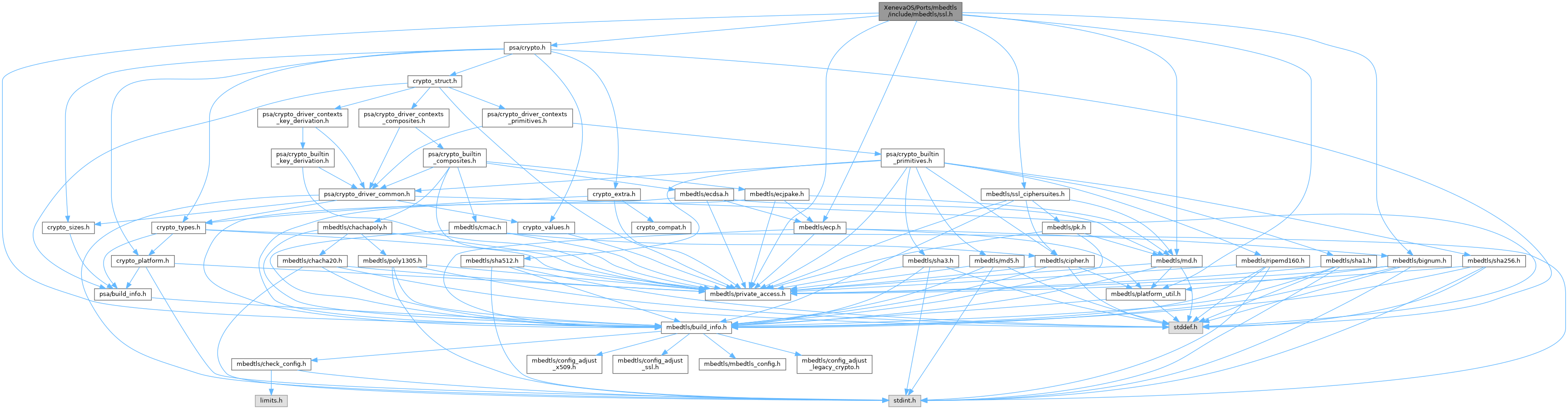
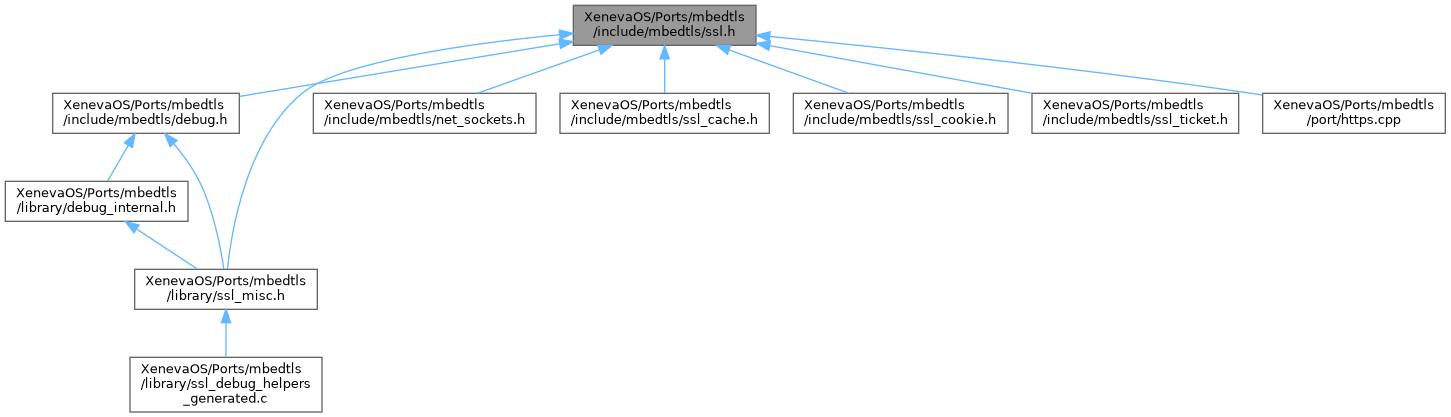
Go to the source code of this file.
Classes | |
| union | mbedtls_ssl_premaster_secret |
| struct | mbedtls_ssl_tls13_application_secrets |
| struct | mbedtls_ssl_session |
| union | mbedtls_ssl_user_data_t |
| struct | mbedtls_ssl_config |
| struct | mbedtls_ssl_context |
Typedefs | |
| typedef int | mbedtls_ssl_send_t(void *ctx, const unsigned char *buf, size_t len) |
| Callback type: send data on the network. | |
| typedef int | mbedtls_ssl_recv_t(void *ctx, unsigned char *buf, size_t len) |
| Callback type: receive data from the network. | |
| typedef int | mbedtls_ssl_recv_timeout_t(void *ctx, unsigned char *buf, size_t len, uint32_t timeout) |
| Callback type: receive data from the network, with timeout. | |
| typedef void | mbedtls_ssl_set_timer_t(void *ctx, uint32_t int_ms, uint32_t fin_ms) |
| Callback type: set a pair of timers/delays to watch. | |
| typedef int | mbedtls_ssl_get_timer_t(void *ctx) |
| Callback type: get status of timers/delays. | |
| typedef struct mbedtls_ssl_session | mbedtls_ssl_session |
| typedef struct mbedtls_ssl_context | mbedtls_ssl_context |
| typedef struct mbedtls_ssl_config | mbedtls_ssl_config |
| typedef struct mbedtls_ssl_transform | mbedtls_ssl_transform |
| typedef struct mbedtls_ssl_handshake_params | mbedtls_ssl_handshake_params |
| typedef struct mbedtls_ssl_sig_hash_set_t | mbedtls_ssl_sig_hash_set_t |
| typedef int | mbedtls_ssl_cache_get_t(void *data, unsigned char const *session_id, size_t session_id_len, mbedtls_ssl_session *session) |
| Callback type: server-side session cache getter. | |
| typedef int | mbedtls_ssl_cache_set_t(void *data, unsigned char const *session_id, size_t session_id_len, const mbedtls_ssl_session *session) |
| Callback type: server-side session cache setter. | |
| typedef void | mbedtls_ssl_export_keys_t(void *p_expkey, mbedtls_ssl_key_export_type type, const unsigned char *secret, size_t secret_len, const unsigned char client_random[32], const unsigned char server_random[32], mbedtls_tls_prf_types tls_prf_type) |
| Callback type: Export key alongside random values for session identification, and PRF for implementation of TLS key exporters. | |
| typedef int | mbedtls_ssl_ticket_write_t(void *p_ticket, const mbedtls_ssl_session *session, unsigned char *start, const unsigned char *end, size_t *tlen, uint32_t *lifetime) |
| Callback type: generate and write session ticket. | |
| typedef int | mbedtls_ssl_ticket_parse_t(void *p_ticket, mbedtls_ssl_session *session, unsigned char *buf, size_t len) |
| Callback type: parse and load session ticket. | |
| typedef int | mbedtls_ssl_cookie_write_t(void *ctx, unsigned char **p, unsigned char *end, const unsigned char *info, size_t ilen) |
| Callback type: generate a cookie. | |
| typedef int | mbedtls_ssl_cookie_check_t(void *ctx, const unsigned char *cookie, size_t clen, const unsigned char *info, size_t ilen) |
| Callback type: verify a cookie. | |
Functions | |
| const char * | mbedtls_ssl_get_ciphersuite_name (const int ciphersuite_id) |
| Return the name of the ciphersuite associated with the given ID. | |
| int | mbedtls_ssl_get_ciphersuite_id (const char *ciphersuite_name) |
| Return the ID of the ciphersuite associated with the given name. | |
| void | mbedtls_ssl_init (mbedtls_ssl_context *ssl) |
| Initialize an SSL context Just makes the context ready for mbedtls_ssl_setup() or mbedtls_ssl_free() | |
| int | mbedtls_ssl_setup (mbedtls_ssl_context *ssl, const mbedtls_ssl_config *conf) |
| Set up an SSL context for use. | |
| int | mbedtls_ssl_session_reset (mbedtls_ssl_context *ssl) |
| Reset an already initialized SSL context for re-use while retaining application-set variables, function pointers and data. | |
| void | mbedtls_ssl_conf_endpoint (mbedtls_ssl_config *conf, int endpoint) |
| Set the current endpoint type. | |
| void | mbedtls_ssl_conf_transport (mbedtls_ssl_config *conf, int transport) |
| Set the transport type (TLS or DTLS). Default: TLS. | |
| void | mbedtls_ssl_conf_authmode (mbedtls_ssl_config *conf, int authmode) |
| Set the certificate verification mode Default: NONE on server, REQUIRED on client. | |
| void | mbedtls_ssl_conf_rng (mbedtls_ssl_config *conf, mbedtls_f_rng_t *f_rng, void *p_rng) |
| Set the random number generator callback. | |
| void | mbedtls_ssl_conf_dbg (mbedtls_ssl_config *conf, void(*f_dbg)(void *, int, const char *, int, const char *), void *p_dbg) |
| Set the debug callback. | |
| void | mbedtls_ssl_set_bio (mbedtls_ssl_context *ssl, void *p_bio, mbedtls_ssl_send_t *f_send, mbedtls_ssl_recv_t *f_recv, mbedtls_ssl_recv_timeout_t *f_recv_timeout) |
| Set the underlying BIO callbacks for write, read and read-with-timeout. | |
| void | mbedtls_ssl_conf_read_timeout (mbedtls_ssl_config *conf, uint32_t timeout) |
| Set the timeout period for mbedtls_ssl_read() (Default: no timeout.) | |
| int | mbedtls_ssl_check_record (mbedtls_ssl_context const *ssl, unsigned char *buf, size_t buflen) |
| Check whether a buffer contains a valid and authentic record that has not been seen before. (DTLS only). | |
| void | mbedtls_ssl_set_timer_cb (mbedtls_ssl_context *ssl, void *p_timer, mbedtls_ssl_set_timer_t *f_set_timer, mbedtls_ssl_get_timer_t *f_get_timer) |
| Set the timer callbacks (Mandatory for DTLS.) | |
| void | mbedtls_ssl_set_export_keys_cb (mbedtls_ssl_context *ssl, mbedtls_ssl_export_keys_t *f_export_keys, void *p_export_keys) |
| Configure a key export callback. (Default: none.) | |
| void | mbedtls_ssl_conf_dtls_badmac_limit (mbedtls_ssl_config *conf, unsigned limit) |
| Set a limit on the number of records with a bad MAC before terminating the connection. (DTLS only, no effect on TLS.) Default: 0 (disabled). | |
| int | mbedtls_ssl_session_load (mbedtls_ssl_session *session, const unsigned char *buf, size_t len) |
| Load serialized session data into a session structure. On client, this can be used for loading saved sessions before resuming them with mbedtls_ssl_set_session(). On server, this can be used for alternative implementations of session cache or session tickets. | |
| int | mbedtls_ssl_session_save (const mbedtls_ssl_session *session, unsigned char *buf, size_t buf_len, size_t *olen) |
| Save session structure as serialized data in a buffer. On client, this can be used for saving session data, potentially in non-volatile storage, for resuming later. On server, this can be used for alternative implementations of session cache or session tickets. | |
| void | mbedtls_ssl_conf_ciphersuites (mbedtls_ssl_config *conf, const int *ciphersuites) |
| Set the list of allowed ciphersuites and the preference order. First in the list has the highest preference. | |
| void | mbedtls_ssl_conf_groups (mbedtls_ssl_config *conf, const uint16_t *groups) |
| Set the allowed groups in order of preference. | |
| void MBEDTLS_DEPRECATED | mbedtls_ssl_conf_max_version (mbedtls_ssl_config *conf, int major, int minor) |
| Set the maximum supported version sent from the client side and/or accepted at the server side. | |
| void MBEDTLS_DEPRECATED | mbedtls_ssl_conf_min_version (mbedtls_ssl_config *conf, int major, int minor) |
| Set the minimum accepted SSL/TLS protocol version. | |
| void | mbedtls_ssl_conf_legacy_renegotiation (mbedtls_ssl_config *conf, int allow_legacy) |
| Prevent or allow legacy renegotiation. (Default: MBEDTLS_SSL_LEGACY_NO_RENEGOTIATION) | |
| int | mbedtls_ssl_check_pending (const mbedtls_ssl_context *ssl) |
| Check if there is data already read from the underlying transport but not yet processed. | |
| size_t | mbedtls_ssl_get_bytes_avail (const mbedtls_ssl_context *ssl) |
| Return the number of application data bytes remaining to be read from the current record. | |
| uint32_t | mbedtls_ssl_get_verify_result (const mbedtls_ssl_context *ssl) |
| Return the result of the certificate verification. | |
| int | mbedtls_ssl_get_ciphersuite_id_from_ssl (const mbedtls_ssl_context *ssl) |
| Return the id of the current ciphersuite. | |
| const char * | mbedtls_ssl_get_ciphersuite (const mbedtls_ssl_context *ssl) |
| Return the name of the current ciphersuite. | |
| const char * | mbedtls_ssl_get_version (const mbedtls_ssl_context *ssl) |
| Return the current TLS version. | |
| int | mbedtls_ssl_get_record_expansion (const mbedtls_ssl_context *ssl) |
| Return the (maximum) number of bytes added by the record layer: header + encryption/MAC overhead (inc. padding) | |
| int | mbedtls_ssl_get_max_out_record_payload (const mbedtls_ssl_context *ssl) |
| Return the current maximum outgoing record payload in bytes. | |
| int | mbedtls_ssl_get_max_in_record_payload (const mbedtls_ssl_context *ssl) |
| Return the current maximum incoming record payload in bytes. | |
| int | mbedtls_ssl_handshake (mbedtls_ssl_context *ssl) |
| Perform the SSL handshake. | |
| int | mbedtls_ssl_handshake_step (mbedtls_ssl_context *ssl) |
| Perform a single step of the SSL handshake. | |
| int | mbedtls_ssl_read (mbedtls_ssl_context *ssl, unsigned char *buf, size_t len) |
| Read at most 'len' application data bytes. | |
| int | mbedtls_ssl_write (mbedtls_ssl_context *ssl, const unsigned char *buf, size_t len) |
| Try to write exactly 'len' application data bytes. | |
| int | mbedtls_ssl_send_alert_message (mbedtls_ssl_context *ssl, unsigned char level, unsigned char message) |
| Send an alert message. | |
| int | mbedtls_ssl_close_notify (mbedtls_ssl_context *ssl) |
| Notify the peer that the connection is being closed. | |
| void | mbedtls_ssl_free (mbedtls_ssl_context *ssl) |
| Free referenced items in an SSL context and clear memory. | |
| void | mbedtls_ssl_config_init (mbedtls_ssl_config *conf) |
| Initialize an SSL configuration context Just makes the context ready for mbedtls_ssl_config_defaults() or mbedtls_ssl_config_free(). | |
| int | mbedtls_ssl_config_defaults (mbedtls_ssl_config *conf, int endpoint, int transport, int preset) |
| Load reasonable default SSL configuration values. (You need to call mbedtls_ssl_config_init() first.) | |
| void | mbedtls_ssl_config_free (mbedtls_ssl_config *conf) |
| Free an SSL configuration context. | |
| void | mbedtls_ssl_session_init (mbedtls_ssl_session *session) |
| Initialize SSL session structure. | |
| void | mbedtls_ssl_session_free (mbedtls_ssl_session *session) |
| Free referenced items in an SSL session including the peer certificate and clear memory. | |
| int | mbedtls_ssl_tls_prf (const mbedtls_tls_prf_types prf, const unsigned char *secret, size_t slen, const char *label, const unsigned char *random, size_t rlen, unsigned char *dstbuf, size_t dlen) |
| TLS-PRF function for key derivation. | |
Detailed Description
SSL/TLS functions.
Macro Definition Documentation
◆ MBEDTLS_ERR_SSL_ALLOC_FAILED
| #define MBEDTLS_ERR_SSL_ALLOC_FAILED -0x7F00 |
Memory allocation failed
◆ MBEDTLS_ERR_SSL_ASYNC_IN_PROGRESS
| #define MBEDTLS_ERR_SSL_ASYNC_IN_PROGRESS -0x6500 |
The asynchronous operation is not completed yet.
◆ MBEDTLS_ERR_SSL_BAD_CERTIFICATE
| #define MBEDTLS_ERR_SSL_BAD_CERTIFICATE -0x7A00 |
Processing of the Certificate handshake message failed.
◆ MBEDTLS_ERR_SSL_BAD_CONFIG
| #define MBEDTLS_ERR_SSL_BAD_CONFIG -0x5E80 |
Invalid value in SSL config
◆ MBEDTLS_ERR_SSL_BAD_INPUT_DATA
| #define MBEDTLS_ERR_SSL_BAD_INPUT_DATA -0x7100 |
Bad input parameters to function.
◆ MBEDTLS_ERR_SSL_BAD_PROTOCOL_VERSION
| #define MBEDTLS_ERR_SSL_BAD_PROTOCOL_VERSION -0x6E80 |
Handshake protocol not within min/max boundaries
◆ MBEDTLS_ERR_SSL_BUFFER_TOO_SMALL
| #define MBEDTLS_ERR_SSL_BUFFER_TOO_SMALL -0x6A00 |
A buffer is too small to receive or write a message
◆ MBEDTLS_ERR_SSL_CA_CHAIN_REQUIRED
| #define MBEDTLS_ERR_SSL_CA_CHAIN_REQUIRED -0x7680 |
No CA Chain is set, but required to operate.
◆ MBEDTLS_ERR_SSL_CACHE_ENTRY_NOT_FOUND
| #define MBEDTLS_ERR_SSL_CACHE_ENTRY_NOT_FOUND -0x7E80 |
Cache entry not found
◆ MBEDTLS_ERR_SSL_CANNOT_READ_EARLY_DATA
| #define MBEDTLS_ERR_SSL_CANNOT_READ_EARLY_DATA -0x7B80 |
Not possible to read early data
◆ MBEDTLS_ERR_SSL_CANNOT_WRITE_EARLY_DATA
| #define MBEDTLS_ERR_SSL_CANNOT_WRITE_EARLY_DATA -0x7C80 |
Not possible to write early data
◆ MBEDTLS_ERR_SSL_CERTIFICATE_VERIFICATION_WITHOUT_HOSTNAME
| #define MBEDTLS_ERR_SSL_CERTIFICATE_VERIFICATION_WITHOUT_HOSTNAME -0x5D80 |
Attempt to verify a certificate without an expected hostname. This is usually insecure.
In TLS clients, when a client authenticates a server through its certificate, the client normally checks three things:
- the certificate chain must be valid;
- the chain must start from a trusted CA;
- the certificate must cover the server name that is expected by the client.
Omitting any of these checks is generally insecure, and can allow a malicious server to impersonate a legitimate server.
The third check may be safely skipped in some unusual scenarios, such as networks where eavesdropping is a risk but not active attacks, or a private PKI where the client equally trusts all servers that are accredited by the root CA.
You should call mbedtls_ssl_set_hostname() with the expected server name before starting a TLS handshake on a client (unless the client is set up to only use PSK-based authentication, which does not rely on the host name). If you have determined that server name verification is not required for security in your scenario, call mbedtls_ssl_set_hostname() with NULL as the server name.
This error is raised if all of the following conditions are met:
- A TLS client is configured with the authentication mode MBEDTLS_SSL_VERIFY_REQUIRED (default).
- Certificate authentication is enabled.
- The client does not call mbedtls_ssl_set_hostname().
- The configuration option MBEDTLS_SSL_CLI_ALLOW_WEAK_CERTIFICATE_VERIFICATION_WITHOUT_HOSTNAME is not enabled.
◆ MBEDTLS_ERR_SSL_CLIENT_RECONNECT
| #define MBEDTLS_ERR_SSL_CLIENT_RECONNECT -0x6780 |
The client initiated a reconnect from the same port.
◆ MBEDTLS_ERR_SSL_CONN_EOF
| #define MBEDTLS_ERR_SSL_CONN_EOF -0x7280 |
The connection indicated an EOF.
◆ MBEDTLS_ERR_SSL_CONTINUE_PROCESSING
| #define MBEDTLS_ERR_SSL_CONTINUE_PROCESSING -0x6580 |
Internal-only message signaling that further message-processing should be done
◆ MBEDTLS_ERR_SSL_COUNTER_WRAPPING
| #define MBEDTLS_ERR_SSL_COUNTER_WRAPPING -0x6B80 |
A counter would wrap (eg, too many messages exchanged).
◆ MBEDTLS_ERR_SSL_CRYPTO_IN_PROGRESS
| #define MBEDTLS_ERR_SSL_CRYPTO_IN_PROGRESS -0x7000 |
A cryptographic operation is in progress. Try again later.
◆ MBEDTLS_ERR_SSL_DECODE_ERROR
| #define MBEDTLS_ERR_SSL_DECODE_ERROR -0x7300 |
A message could not be parsed due to a syntactic error.
◆ MBEDTLS_ERR_SSL_EARLY_MESSAGE
| #define MBEDTLS_ERR_SSL_EARLY_MESSAGE -0x6480 |
Internal-only message signaling that a message arrived early.
◆ MBEDTLS_ERR_SSL_FATAL_ALERT_MESSAGE
| #define MBEDTLS_ERR_SSL_FATAL_ALERT_MESSAGE -0x7780 |
A fatal alert message was received from our peer.
◆ MBEDTLS_ERR_SSL_FEATURE_UNAVAILABLE
| #define MBEDTLS_ERR_SSL_FEATURE_UNAVAILABLE -0x7080 |
The requested feature is not available.
◆ MBEDTLS_ERR_SSL_HANDSHAKE_FAILURE
| #define MBEDTLS_ERR_SSL_HANDSHAKE_FAILURE -0x6E00 |
The handshake negotiation failed.
◆ MBEDTLS_ERR_SSL_HELLO_VERIFY_REQUIRED
| #define MBEDTLS_ERR_SSL_HELLO_VERIFY_REQUIRED -0x6A80 |
DTLS client must retry for hello verification
◆ MBEDTLS_ERR_SSL_HW_ACCEL_FAILED
| #define MBEDTLS_ERR_SSL_HW_ACCEL_FAILED -0x7F80 |
Hardware acceleration function returned with error
◆ MBEDTLS_ERR_SSL_HW_ACCEL_FALLTHROUGH
| #define MBEDTLS_ERR_SSL_HW_ACCEL_FALLTHROUGH -0x6F80 |
Hardware acceleration function skipped / left alone data
◆ MBEDTLS_ERR_SSL_ILLEGAL_PARAMETER
| #define MBEDTLS_ERR_SSL_ILLEGAL_PARAMETER -0x6600 |
A field in a message was incorrect or inconsistent with other fields.
◆ MBEDTLS_ERR_SSL_INTERNAL_ERROR
| #define MBEDTLS_ERR_SSL_INTERNAL_ERROR -0x6C00 |
Internal error (eg, unexpected failure in lower-level module)
◆ MBEDTLS_ERR_SSL_INVALID_MAC
| #define MBEDTLS_ERR_SSL_INVALID_MAC -0x7180 |
Verification of the message MAC failed.
◆ MBEDTLS_ERR_SSL_INVALID_RECORD
| #define MBEDTLS_ERR_SSL_INVALID_RECORD -0x7200 |
An invalid SSL record was received.
◆ MBEDTLS_ERR_SSL_NO_APPLICATION_PROTOCOL
| #define MBEDTLS_ERR_SSL_NO_APPLICATION_PROTOCOL -0x7580 |
No ALPN protocols supported that the client advertises
◆ MBEDTLS_ERR_SSL_NO_CLIENT_CERTIFICATE
| #define MBEDTLS_ERR_SSL_NO_CLIENT_CERTIFICATE -0x7480 |
No client certification received from the client, but required by the authentication mode.
◆ MBEDTLS_ERR_SSL_NO_RNG
| #define MBEDTLS_ERR_SSL_NO_RNG -0x7400 |
No RNG was provided to the SSL module.
◆ MBEDTLS_ERR_SSL_NON_FATAL
| #define MBEDTLS_ERR_SSL_NON_FATAL -0x6680 |
The alert message received indicates a non-fatal error.
◆ MBEDTLS_ERR_SSL_PEER_CLOSE_NOTIFY
| #define MBEDTLS_ERR_SSL_PEER_CLOSE_NOTIFY -0x7880 |
The peer notified us that the connection is going to be closed.
◆ MBEDTLS_ERR_SSL_PK_TYPE_MISMATCH
| #define MBEDTLS_ERR_SSL_PK_TYPE_MISMATCH -0x6D00 |
Public key type mismatch (eg, asked for RSA key exchange and presented EC key)
◆ MBEDTLS_ERR_SSL_PRIVATE_KEY_REQUIRED
| #define MBEDTLS_ERR_SSL_PRIVATE_KEY_REQUIRED -0x7600 |
The own private key or pre-shared key is not set, but needed.
◆ MBEDTLS_ERR_SSL_RECEIVED_EARLY_DATA
| #define MBEDTLS_ERR_SSL_RECEIVED_EARLY_DATA -0x7C00 |
Early data has been received as part of an on-going handshake. This error code can be returned only on server side if and only if early data has been enabled by means of the mbedtls_ssl_conf_early_data() API. This error code can then be returned by mbedtls_ssl_handshake(), mbedtls_ssl_handshake_step(), mbedtls_ssl_read() or mbedtls_ssl_write() if early data has been received as part of the handshake sequence they triggered. To read the early data, call mbedtls_ssl_read_early_data().
◆ MBEDTLS_ERR_SSL_RECEIVED_NEW_SESSION_TICKET
| #define MBEDTLS_ERR_SSL_RECEIVED_NEW_SESSION_TICKET -0x7B00 |
A TLS 1.3 NewSessionTicket message has been received.
◆ MBEDTLS_ERR_SSL_SESSION_TICKET_EXPIRED
| #define MBEDTLS_ERR_SSL_SESSION_TICKET_EXPIRED -0x6D80 |
Session ticket has expired.
◆ MBEDTLS_ERR_SSL_TIMEOUT
| #define MBEDTLS_ERR_SSL_TIMEOUT -0x6800 |
The operation timed out.
◆ MBEDTLS_ERR_SSL_UNEXPECTED_CID
| #define MBEDTLS_ERR_SSL_UNEXPECTED_CID -0x6000 |
An encrypted DTLS-frame with an unexpected CID was received.
◆ MBEDTLS_ERR_SSL_UNEXPECTED_MESSAGE
| #define MBEDTLS_ERR_SSL_UNEXPECTED_MESSAGE -0x7700 |
An unexpected message was received from our peer.
◆ MBEDTLS_ERR_SSL_UNEXPECTED_RECORD
| #define MBEDTLS_ERR_SSL_UNEXPECTED_RECORD -0x6700 |
Record header looks valid but is not expected.
◆ MBEDTLS_ERR_SSL_UNKNOWN_IDENTITY
| #define MBEDTLS_ERR_SSL_UNKNOWN_IDENTITY -0x6C80 |
Unknown identity received (eg, PSK identity)
◆ MBEDTLS_ERR_SSL_UNRECOGNIZED_NAME
| #define MBEDTLS_ERR_SSL_UNRECOGNIZED_NAME -0x7800 |
No server could be identified matching the client's SNI.
◆ MBEDTLS_ERR_SSL_UNSUPPORTED_EXTENSION
| #define MBEDTLS_ERR_SSL_UNSUPPORTED_EXTENSION -0x7500 |
Client received an extended server hello containing an unsupported extension
◆ MBEDTLS_ERR_SSL_VERSION_MISMATCH
| #define MBEDTLS_ERR_SSL_VERSION_MISMATCH -0x5F00 |
An operation failed due to an unexpected version or configuration.
◆ MBEDTLS_ERR_SSL_WAITING_SERVER_HELLO_RENEGO
| #define MBEDTLS_ERR_SSL_WAITING_SERVER_HELLO_RENEGO -0x6B00 |
Unexpected message at ServerHello in renegotiation.
◆ MBEDTLS_ERR_SSL_WANT_READ
| #define MBEDTLS_ERR_SSL_WANT_READ -0x6900 |
No data of requested type currently available on underlying transport.
◆ MBEDTLS_ERR_SSL_WANT_WRITE
| #define MBEDTLS_ERR_SSL_WANT_WRITE -0x6880 |
Connection requires a write call.
◆ MBEDTLS_PREMASTER_SIZE
| #define MBEDTLS_PREMASTER_SIZE sizeof(union mbedtls_ssl_premaster_secret) |
◆ MBEDTLS_PSK_MAX_LEN
| #define MBEDTLS_PSK_MAX_LEN 32 /* 256 bits */ |
◆ MBEDTLS_SSL_ALERT_LEVEL_FATAL
| #define MBEDTLS_SSL_ALERT_LEVEL_FATAL 2 |
◆ MBEDTLS_SSL_ALERT_LEVEL_WARNING
| #define MBEDTLS_SSL_ALERT_LEVEL_WARNING 1 |
◆ MBEDTLS_SSL_ALERT_MSG_ACCESS_DENIED
| #define MBEDTLS_SSL_ALERT_MSG_ACCESS_DENIED 49 /* 0x31 */ |
◆ MBEDTLS_SSL_ALERT_MSG_BAD_CERT
| #define MBEDTLS_SSL_ALERT_MSG_BAD_CERT 42 /* 0x2A */ |
◆ MBEDTLS_SSL_ALERT_MSG_BAD_RECORD_MAC
| #define MBEDTLS_SSL_ALERT_MSG_BAD_RECORD_MAC 20 /* 0x14 */ |
◆ MBEDTLS_SSL_ALERT_MSG_CERT_EXPIRED
| #define MBEDTLS_SSL_ALERT_MSG_CERT_EXPIRED 45 /* 0x2D */ |
◆ MBEDTLS_SSL_ALERT_MSG_CERT_REQUIRED
| #define MBEDTLS_SSL_ALERT_MSG_CERT_REQUIRED 116 /* 0x74 */ |
◆ MBEDTLS_SSL_ALERT_MSG_CERT_REVOKED
| #define MBEDTLS_SSL_ALERT_MSG_CERT_REVOKED 44 /* 0x2C */ |
◆ MBEDTLS_SSL_ALERT_MSG_CERT_UNKNOWN
| #define MBEDTLS_SSL_ALERT_MSG_CERT_UNKNOWN 46 /* 0x2E */ |
◆ MBEDTLS_SSL_ALERT_MSG_CLOSE_NOTIFY
| #define MBEDTLS_SSL_ALERT_MSG_CLOSE_NOTIFY 0 /* 0x00 */ |
◆ MBEDTLS_SSL_ALERT_MSG_DECODE_ERROR
| #define MBEDTLS_SSL_ALERT_MSG_DECODE_ERROR 50 /* 0x32 */ |
◆ MBEDTLS_SSL_ALERT_MSG_DECOMPRESSION_FAILURE
| #define MBEDTLS_SSL_ALERT_MSG_DECOMPRESSION_FAILURE 30 /* 0x1E */ |
◆ MBEDTLS_SSL_ALERT_MSG_DECRYPT_ERROR
| #define MBEDTLS_SSL_ALERT_MSG_DECRYPT_ERROR 51 /* 0x33 */ |
◆ MBEDTLS_SSL_ALERT_MSG_DECRYPTION_FAILED
| #define MBEDTLS_SSL_ALERT_MSG_DECRYPTION_FAILED 21 /* 0x15 */ |
◆ MBEDTLS_SSL_ALERT_MSG_EXPORT_RESTRICTION
| #define MBEDTLS_SSL_ALERT_MSG_EXPORT_RESTRICTION 60 /* 0x3C */ |
◆ MBEDTLS_SSL_ALERT_MSG_HANDSHAKE_FAILURE
| #define MBEDTLS_SSL_ALERT_MSG_HANDSHAKE_FAILURE 40 /* 0x28 */ |
◆ MBEDTLS_SSL_ALERT_MSG_ILLEGAL_PARAMETER
| #define MBEDTLS_SSL_ALERT_MSG_ILLEGAL_PARAMETER 47 /* 0x2F */ |
◆ MBEDTLS_SSL_ALERT_MSG_INAPROPRIATE_FALLBACK
| #define MBEDTLS_SSL_ALERT_MSG_INAPROPRIATE_FALLBACK 86 /* 0x56 */ |
◆ MBEDTLS_SSL_ALERT_MSG_INSUFFICIENT_SECURITY
| #define MBEDTLS_SSL_ALERT_MSG_INSUFFICIENT_SECURITY 71 /* 0x47 */ |
◆ MBEDTLS_SSL_ALERT_MSG_INTERNAL_ERROR
| #define MBEDTLS_SSL_ALERT_MSG_INTERNAL_ERROR 80 /* 0x50 */ |
◆ MBEDTLS_SSL_ALERT_MSG_MISSING_EXTENSION
| #define MBEDTLS_SSL_ALERT_MSG_MISSING_EXTENSION 109 /* 0x6d -- new in TLS 1.3 */ |
◆ MBEDTLS_SSL_ALERT_MSG_NO_APPLICATION_PROTOCOL
| #define MBEDTLS_SSL_ALERT_MSG_NO_APPLICATION_PROTOCOL 120 /* 0x78 */ |
◆ MBEDTLS_SSL_ALERT_MSG_NO_CERT
| #define MBEDTLS_SSL_ALERT_MSG_NO_CERT 41 /* 0x29 */ |
◆ MBEDTLS_SSL_ALERT_MSG_NO_RENEGOTIATION
| #define MBEDTLS_SSL_ALERT_MSG_NO_RENEGOTIATION 100 /* 0x64 */ |
◆ MBEDTLS_SSL_ALERT_MSG_PROTOCOL_VERSION
| #define MBEDTLS_SSL_ALERT_MSG_PROTOCOL_VERSION 70 /* 0x46 */ |
◆ MBEDTLS_SSL_ALERT_MSG_RECORD_OVERFLOW
| #define MBEDTLS_SSL_ALERT_MSG_RECORD_OVERFLOW 22 /* 0x16 */ |
◆ MBEDTLS_SSL_ALERT_MSG_UNEXPECTED_MESSAGE
| #define MBEDTLS_SSL_ALERT_MSG_UNEXPECTED_MESSAGE 10 /* 0x0A */ |
◆ MBEDTLS_SSL_ALERT_MSG_UNKNOWN_CA
| #define MBEDTLS_SSL_ALERT_MSG_UNKNOWN_CA 48 /* 0x30 */ |
◆ MBEDTLS_SSL_ALERT_MSG_UNKNOWN_PSK_IDENTITY
| #define MBEDTLS_SSL_ALERT_MSG_UNKNOWN_PSK_IDENTITY 115 /* 0x73 */ |
◆ MBEDTLS_SSL_ALERT_MSG_UNRECOGNIZED_NAME
| #define MBEDTLS_SSL_ALERT_MSG_UNRECOGNIZED_NAME 112 /* 0x70 */ |
◆ MBEDTLS_SSL_ALERT_MSG_UNSUPPORTED_CERT
| #define MBEDTLS_SSL_ALERT_MSG_UNSUPPORTED_CERT 43 /* 0x2B */ |
◆ MBEDTLS_SSL_ALERT_MSG_UNSUPPORTED_EXT
| #define MBEDTLS_SSL_ALERT_MSG_UNSUPPORTED_EXT 110 /* 0x6E */ |
◆ MBEDTLS_SSL_ALERT_MSG_USER_CANCELED
| #define MBEDTLS_SSL_ALERT_MSG_USER_CANCELED 90 /* 0x5A */ |
◆ MBEDTLS_SSL_ANTI_REPLAY_DISABLED
| #define MBEDTLS_SSL_ANTI_REPLAY_DISABLED 0 |
◆ MBEDTLS_SSL_ANTI_REPLAY_ENABLED
| #define MBEDTLS_SSL_ANTI_REPLAY_ENABLED 1 |
◆ MBEDTLS_SSL_CERT_REQ_CA_LIST_DISABLED
| #define MBEDTLS_SSL_CERT_REQ_CA_LIST_DISABLED 0 |
◆ MBEDTLS_SSL_CERT_REQ_CA_LIST_ENABLED
| #define MBEDTLS_SSL_CERT_REQ_CA_LIST_ENABLED 1 |
◆ MBEDTLS_SSL_CERT_TYPE_ECDSA_SIGN
| #define MBEDTLS_SSL_CERT_TYPE_ECDSA_SIGN 64 |
◆ MBEDTLS_SSL_CERT_TYPE_RSA_SIGN
| #define MBEDTLS_SSL_CERT_TYPE_RSA_SIGN 1 |
◆ MBEDTLS_SSL_CID_DISABLED
| #define MBEDTLS_SSL_CID_DISABLED 0 |
◆ MBEDTLS_SSL_CID_ENABLED
| #define MBEDTLS_SSL_CID_ENABLED 1 |
◆ MBEDTLS_SSL_CID_IN_LEN_MAX
| #define MBEDTLS_SSL_CID_IN_LEN_MAX 32 |
The maximum length of CIDs used for incoming DTLS messages.
◆ MBEDTLS_SSL_CID_OUT_LEN_MAX
| #define MBEDTLS_SSL_CID_OUT_LEN_MAX 32 |
The maximum length of CIDs used for outgoing DTLS messages.
◆ MBEDTLS_SSL_CID_TLS1_3_PADDING_GRANULARITY
| #define MBEDTLS_SSL_CID_TLS1_3_PADDING_GRANULARITY 16 |
This option controls the use of record plaintext padding in TLS 1.3 and when using the Connection ID extension in DTLS 1.2.
The padding will always be chosen so that the length of the padded plaintext is a multiple of the value of this option.
Note: A value of 1 means that no padding will be used for outgoing records.
Note: On systems lacking division instructions, a power of two should be preferred.
◆ MBEDTLS_SSL_COMPRESS_NULL
| #define MBEDTLS_SSL_COMPRESS_NULL 0 |
◆ MBEDTLS_SSL_DTLS_MAX_BUFFERING
| #define MBEDTLS_SSL_DTLS_MAX_BUFFERING 32768 |
Maximum number of heap-allocated bytes for the purpose of DTLS handshake message reassembly and future message buffering.
This should be at least 9/8 * MBEDTLS_SSL_IN_CONTENT_LEN to account for a reassembled handshake message of maximum size, together with its reassembly bitmap.
A value of 2 * MBEDTLS_SSL_IN_CONTENT_LEN (32768 by default) should be sufficient for all practical situations as it allows to reassembly a large handshake message (such as a certificate) while buffering multiple smaller handshake messages.
◆ MBEDTLS_SSL_DTLS_SRTP_MKI_SUPPORTED
| #define MBEDTLS_SSL_DTLS_SRTP_MKI_SUPPORTED 1 |
◆ MBEDTLS_SSL_DTLS_SRTP_MKI_UNSUPPORTED
| #define MBEDTLS_SSL_DTLS_SRTP_MKI_UNSUPPORTED 0 |
◆ MBEDTLS_SSL_DTLS_TIMEOUT_DFL_MAX
| #define MBEDTLS_SSL_DTLS_TIMEOUT_DFL_MAX 60000 |
◆ MBEDTLS_SSL_DTLS_TIMEOUT_DFL_MIN
| #define MBEDTLS_SSL_DTLS_TIMEOUT_DFL_MIN 1000 |
◆ MBEDTLS_SSL_EARLY_DATA_DISABLED
| #define MBEDTLS_SSL_EARLY_DATA_DISABLED 0 |
◆ MBEDTLS_SSL_EARLY_DATA_DISCARD
| #define MBEDTLS_SSL_EARLY_DATA_DISCARD 2 |
◆ MBEDTLS_SSL_EARLY_DATA_ENABLED
| #define MBEDTLS_SSL_EARLY_DATA_ENABLED 1 |
◆ MBEDTLS_SSL_EARLY_DATA_NO_DISCARD
| #define MBEDTLS_SSL_EARLY_DATA_NO_DISCARD 0 |
◆ MBEDTLS_SSL_EARLY_DATA_TRY_TO_DEPROTECT_AND_DISCARD
| #define MBEDTLS_SSL_EARLY_DATA_TRY_TO_DEPROTECT_AND_DISCARD 1 |
◆ MBEDTLS_SSL_EMPTY_RENEGOTIATION_INFO
| #define MBEDTLS_SSL_EMPTY_RENEGOTIATION_INFO 0xFF |
renegotiation info ext
◆ MBEDTLS_SSL_ETM_DISABLED
| #define MBEDTLS_SSL_ETM_DISABLED 0 |
◆ MBEDTLS_SSL_ETM_ENABLED
| #define MBEDTLS_SSL_ETM_ENABLED 1 |
◆ MBEDTLS_SSL_EXTENDED_MS_DISABLED
| #define MBEDTLS_SSL_EXTENDED_MS_DISABLED 0 |
◆ MBEDTLS_SSL_EXTENDED_MS_ENABLED
| #define MBEDTLS_SSL_EXTENDED_MS_ENABLED 1 |
◆ MBEDTLS_SSL_HASH_MD5
| #define MBEDTLS_SSL_HASH_MD5 1 |
◆ MBEDTLS_SSL_HASH_NONE
| #define MBEDTLS_SSL_HASH_NONE 0 |
◆ MBEDTLS_SSL_HASH_SHA1
| #define MBEDTLS_SSL_HASH_SHA1 2 |
◆ MBEDTLS_SSL_HASH_SHA224
| #define MBEDTLS_SSL_HASH_SHA224 3 |
◆ MBEDTLS_SSL_HASH_SHA256
| #define MBEDTLS_SSL_HASH_SHA256 4 |
◆ MBEDTLS_SSL_HASH_SHA384
| #define MBEDTLS_SSL_HASH_SHA384 5 |
◆ MBEDTLS_SSL_HASH_SHA512
| #define MBEDTLS_SSL_HASH_SHA512 6 |
◆ MBEDTLS_SSL_HS_CERTIFICATE
| #define MBEDTLS_SSL_HS_CERTIFICATE 11 |
◆ MBEDTLS_SSL_HS_CERTIFICATE_REQUEST
| #define MBEDTLS_SSL_HS_CERTIFICATE_REQUEST 13 |
◆ MBEDTLS_SSL_HS_CERTIFICATE_VERIFY
| #define MBEDTLS_SSL_HS_CERTIFICATE_VERIFY 15 |
◆ MBEDTLS_SSL_HS_CLIENT_HELLO
| #define MBEDTLS_SSL_HS_CLIENT_HELLO 1 |
◆ MBEDTLS_SSL_HS_CLIENT_KEY_EXCHANGE
| #define MBEDTLS_SSL_HS_CLIENT_KEY_EXCHANGE 16 |
◆ MBEDTLS_SSL_HS_ENCRYPTED_EXTENSIONS
| #define MBEDTLS_SSL_HS_ENCRYPTED_EXTENSIONS 8 |
◆ MBEDTLS_SSL_HS_END_OF_EARLY_DATA
| #define MBEDTLS_SSL_HS_END_OF_EARLY_DATA 5 |
◆ MBEDTLS_SSL_HS_FINISHED
| #define MBEDTLS_SSL_HS_FINISHED 20 |
◆ MBEDTLS_SSL_HS_HELLO_REQUEST
| #define MBEDTLS_SSL_HS_HELLO_REQUEST 0 |
◆ MBEDTLS_SSL_HS_HELLO_VERIFY_REQUEST
| #define MBEDTLS_SSL_HS_HELLO_VERIFY_REQUEST 3 |
◆ MBEDTLS_SSL_HS_MESSAGE_HASH
| #define MBEDTLS_SSL_HS_MESSAGE_HASH 254 |
◆ MBEDTLS_SSL_HS_NEW_SESSION_TICKET
| #define MBEDTLS_SSL_HS_NEW_SESSION_TICKET 4 |
◆ MBEDTLS_SSL_HS_SERVER_HELLO
| #define MBEDTLS_SSL_HS_SERVER_HELLO 2 |
◆ MBEDTLS_SSL_HS_SERVER_HELLO_DONE
| #define MBEDTLS_SSL_HS_SERVER_HELLO_DONE 14 |
◆ MBEDTLS_SSL_HS_SERVER_KEY_EXCHANGE
| #define MBEDTLS_SSL_HS_SERVER_KEY_EXCHANGE 12 |
◆ MBEDTLS_SSL_IANA_TLS_GROUP_BP256R1
| #define MBEDTLS_SSL_IANA_TLS_GROUP_BP256R1 0x001A |
◆ MBEDTLS_SSL_IANA_TLS_GROUP_BP384R1
| #define MBEDTLS_SSL_IANA_TLS_GROUP_BP384R1 0x001B |
◆ MBEDTLS_SSL_IANA_TLS_GROUP_BP512R1
| #define MBEDTLS_SSL_IANA_TLS_GROUP_BP512R1 0x001C |
◆ MBEDTLS_SSL_IANA_TLS_GROUP_FFDHE2048
| #define MBEDTLS_SSL_IANA_TLS_GROUP_FFDHE2048 0x0100 |
◆ MBEDTLS_SSL_IANA_TLS_GROUP_FFDHE3072
| #define MBEDTLS_SSL_IANA_TLS_GROUP_FFDHE3072 0x0101 |
◆ MBEDTLS_SSL_IANA_TLS_GROUP_FFDHE4096
| #define MBEDTLS_SSL_IANA_TLS_GROUP_FFDHE4096 0x0102 |
◆ MBEDTLS_SSL_IANA_TLS_GROUP_FFDHE6144
| #define MBEDTLS_SSL_IANA_TLS_GROUP_FFDHE6144 0x0103 |
◆ MBEDTLS_SSL_IANA_TLS_GROUP_FFDHE8192
| #define MBEDTLS_SSL_IANA_TLS_GROUP_FFDHE8192 0x0104 |
◆ MBEDTLS_SSL_IANA_TLS_GROUP_NONE
| #define MBEDTLS_SSL_IANA_TLS_GROUP_NONE 0 |
◆ MBEDTLS_SSL_IANA_TLS_GROUP_SECP192K1
| #define MBEDTLS_SSL_IANA_TLS_GROUP_SECP192K1 0x0012 |
◆ MBEDTLS_SSL_IANA_TLS_GROUP_SECP192R1
| #define MBEDTLS_SSL_IANA_TLS_GROUP_SECP192R1 0x0013 |
◆ MBEDTLS_SSL_IANA_TLS_GROUP_SECP224K1
| #define MBEDTLS_SSL_IANA_TLS_GROUP_SECP224K1 0x0014 |
◆ MBEDTLS_SSL_IANA_TLS_GROUP_SECP224R1
| #define MBEDTLS_SSL_IANA_TLS_GROUP_SECP224R1 0x0015 |
◆ MBEDTLS_SSL_IANA_TLS_GROUP_SECP256K1
| #define MBEDTLS_SSL_IANA_TLS_GROUP_SECP256K1 0x0016 |
◆ MBEDTLS_SSL_IANA_TLS_GROUP_SECP256R1
| #define MBEDTLS_SSL_IANA_TLS_GROUP_SECP256R1 0x0017 |
◆ MBEDTLS_SSL_IANA_TLS_GROUP_SECP384R1
| #define MBEDTLS_SSL_IANA_TLS_GROUP_SECP384R1 0x0018 |
◆ MBEDTLS_SSL_IANA_TLS_GROUP_SECP521R1
| #define MBEDTLS_SSL_IANA_TLS_GROUP_SECP521R1 0x0019 |
◆ MBEDTLS_SSL_IANA_TLS_GROUP_X25519
| #define MBEDTLS_SSL_IANA_TLS_GROUP_X25519 0x001D |
◆ MBEDTLS_SSL_IANA_TLS_GROUP_X448
| #define MBEDTLS_SSL_IANA_TLS_GROUP_X448 0x001E |
◆ MBEDTLS_SSL_IN_CONTENT_LEN
| #define MBEDTLS_SSL_IN_CONTENT_LEN 16384 |
Maximum length (in bytes) of incoming plaintext fragments.
This determines the size of the incoming TLS I/O buffer in such a way that it is capable of holding the specified amount of plaintext data, regardless of the protection mechanism used.
- Note
- When using a value less than the default of 16KB on the client, it is recommended to use the Maximum Fragment Length (MFL) extension to inform the server about this limitation. On the server, there is no supported, standardized way of informing the client about restriction on the maximum size of incoming messages, and unless the limitation has been communicated by other means, it is recommended to only change the outgoing buffer size MBEDTLS_SSL_OUT_CONTENT_LEN while keeping the default value of 16KB for the incoming buffer.
Uncomment to set the maximum plaintext size of the incoming I/O buffer.
◆ MBEDTLS_SSL_IS_CLIENT
| #define MBEDTLS_SSL_IS_CLIENT 0 |
◆ MBEDTLS_SSL_IS_SERVER
| #define MBEDTLS_SSL_IS_SERVER 1 |
◆ MBEDTLS_SSL_LEGACY_ALLOW_RENEGOTIATION
| #define MBEDTLS_SSL_LEGACY_ALLOW_RENEGOTIATION 1 |
◆ MBEDTLS_SSL_LEGACY_BREAK_HANDSHAKE
| #define MBEDTLS_SSL_LEGACY_BREAK_HANDSHAKE 2 |
◆ MBEDTLS_SSL_LEGACY_NO_RENEGOTIATION
| #define MBEDTLS_SSL_LEGACY_NO_RENEGOTIATION 0 |
◆ MBEDTLS_SSL_LEGACY_RENEGOTIATION
| #define MBEDTLS_SSL_LEGACY_RENEGOTIATION 0 |
◆ MBEDTLS_SSL_MAJOR_VERSION_3
| #define MBEDTLS_SSL_MAJOR_VERSION_3 3 |
◆ MBEDTLS_SSL_MAX_ALPN_LIST_LEN
| #define MBEDTLS_SSL_MAX_ALPN_LIST_LEN 65535 |
Maximum size in bytes of list in alpn ext., RFC 7301
◆ MBEDTLS_SSL_MAX_ALPN_NAME_LEN
| #define MBEDTLS_SSL_MAX_ALPN_NAME_LEN 255 |
Maximum size in bytes of a protocol name in alpn ext., RFC 7301
◆ MBEDTLS_SSL_MAX_EARLY_DATA_SIZE
| #define MBEDTLS_SSL_MAX_EARLY_DATA_SIZE 1024 |
Complete list of ciphersuites to use, in order of preference.
- Warning
- No dependency checking is done on that field! This option can only be used to restrict the set of available ciphersuites. It is your responsibility to make sure the needed modules are active.
Use this to save a few hundred bytes of ROM (default ordering of all available ciphersuites) and a few to a few hundred bytes of RAM.
The value below is only an example, not the default.
The default maximum amount of 0-RTT data. See the documentation of mbedtls_ssl_conf_max_early_data_size() for more information.
It must be positive and smaller than UINT32_MAX.
If MBEDTLS_SSL_EARLY_DATA is not defined, this default value does not have any impact on the build.
◆ MBEDTLS_SSL_MAX_FRAG_LEN_1024
| #define MBEDTLS_SSL_MAX_FRAG_LEN_1024 2 |
MaxFragmentLength 2^10
◆ MBEDTLS_SSL_MAX_FRAG_LEN_2048
| #define MBEDTLS_SSL_MAX_FRAG_LEN_2048 3 |
MaxFragmentLength 2^11
◆ MBEDTLS_SSL_MAX_FRAG_LEN_4096
| #define MBEDTLS_SSL_MAX_FRAG_LEN_4096 4 |
MaxFragmentLength 2^12
◆ MBEDTLS_SSL_MAX_FRAG_LEN_512
| #define MBEDTLS_SSL_MAX_FRAG_LEN_512 1 |
MaxFragmentLength 2^9
◆ MBEDTLS_SSL_MAX_FRAG_LEN_INVALID
| #define MBEDTLS_SSL_MAX_FRAG_LEN_INVALID 5 |
first invalid value
◆ MBEDTLS_SSL_MAX_FRAG_LEN_NONE
| #define MBEDTLS_SSL_MAX_FRAG_LEN_NONE 0 |
don't use this extension
◆ MBEDTLS_SSL_MAX_HOST_NAME_LEN
| #define MBEDTLS_SSL_MAX_HOST_NAME_LEN 255 |
Maximum host name defined in RFC 1035
◆ MBEDTLS_SSL_MINOR_VERSION_3
| #define MBEDTLS_SSL_MINOR_VERSION_3 3 |
TLS v1.2
◆ MBEDTLS_SSL_MINOR_VERSION_4
| #define MBEDTLS_SSL_MINOR_VERSION_4 4 |
TLS v1.3
◆ MBEDTLS_SSL_MSG_ALERT
| #define MBEDTLS_SSL_MSG_ALERT 21 |
◆ MBEDTLS_SSL_MSG_APPLICATION_DATA
| #define MBEDTLS_SSL_MSG_APPLICATION_DATA 23 |
◆ MBEDTLS_SSL_MSG_CHANGE_CIPHER_SPEC
| #define MBEDTLS_SSL_MSG_CHANGE_CIPHER_SPEC 20 |
◆ MBEDTLS_SSL_MSG_CID
| #define MBEDTLS_SSL_MSG_CID 25 |
◆ MBEDTLS_SSL_MSG_HANDSHAKE
| #define MBEDTLS_SSL_MSG_HANDSHAKE 22 |
◆ MBEDTLS_SSL_OUT_CONTENT_LEN
| #define MBEDTLS_SSL_OUT_CONTENT_LEN 16384 |
Maximum length (in bytes) of outgoing plaintext fragments.
This determines the size of the outgoing TLS I/O buffer in such a way that it is capable of holding the specified amount of plaintext data, regardless of the protection mechanism used.
It is possible to save RAM by setting a smaller outward buffer, while keeping the default inward 16384 byte buffer to conform to the TLS specification.
The minimum required outward buffer size is determined by the handshake protocol's usage. Handshaking will fail if the outward buffer is too small. The specific size requirement depends on the configured ciphers and any certificate data which is sent during the handshake.
Uncomment to set the maximum plaintext size of the outgoing I/O buffer.
◆ MBEDTLS_SSL_PRESET_DEFAULT
| #define MBEDTLS_SSL_PRESET_DEFAULT 0 |
◆ MBEDTLS_SSL_PRESET_SUITEB
| #define MBEDTLS_SSL_PRESET_SUITEB 2 |
◆ MBEDTLS_SSL_RENEGO_MAX_RECORDS_DEFAULT
| #define MBEDTLS_SSL_RENEGO_MAX_RECORDS_DEFAULT 16 |
◆ MBEDTLS_SSL_RENEGOTIATION_DISABLED
| #define MBEDTLS_SSL_RENEGOTIATION_DISABLED 0 |
◆ MBEDTLS_SSL_RENEGOTIATION_ENABLED
| #define MBEDTLS_SSL_RENEGOTIATION_ENABLED 1 |
◆ MBEDTLS_SSL_RENEGOTIATION_NOT_ENFORCED
| #define MBEDTLS_SSL_RENEGOTIATION_NOT_ENFORCED -1 |
◆ MBEDTLS_SSL_SECURE_RENEGOTIATION
| #define MBEDTLS_SSL_SECURE_RENEGOTIATION 1 |
◆ MBEDTLS_SSL_SEQUENCE_NUMBER_LEN
| #define MBEDTLS_SSL_SEQUENCE_NUMBER_LEN 8 |
◆ MBEDTLS_SSL_SESSION_TICKETS_DISABLED
| #define MBEDTLS_SSL_SESSION_TICKETS_DISABLED 0 |
◆ MBEDTLS_SSL_SESSION_TICKETS_ENABLED
| #define MBEDTLS_SSL_SESSION_TICKETS_ENABLED 1 |
◆ MBEDTLS_SSL_SIG_ANON
| #define MBEDTLS_SSL_SIG_ANON 0 |
◆ MBEDTLS_SSL_SIG_ECDSA
| #define MBEDTLS_SSL_SIG_ECDSA 3 |
◆ MBEDTLS_SSL_SIG_RSA
| #define MBEDTLS_SSL_SIG_RSA 1 |
◆ MBEDTLS_SSL_SRV_CIPHERSUITE_ORDER_CLIENT
| #define MBEDTLS_SSL_SRV_CIPHERSUITE_ORDER_CLIENT 1 |
◆ MBEDTLS_SSL_SRV_CIPHERSUITE_ORDER_SERVER
| #define MBEDTLS_SSL_SRV_CIPHERSUITE_ORDER_SERVER 0 |
◆ MBEDTLS_SSL_TLS1_3_DEFAULT_NEW_SESSION_TICKETS
| #define MBEDTLS_SSL_TLS1_3_DEFAULT_NEW_SESSION_TICKETS 1 |
Default number of NewSessionTicket messages to be sent by a TLS 1.3 server after handshake completion. This is not used in TLS 1.2 and relevant only if the MBEDTLS_SSL_SESSION_TICKETS option is enabled.
◆ MBEDTLS_SSL_TLS1_3_KEY_EXCHANGE_MODE_ALL
| #define MBEDTLS_SSL_TLS1_3_KEY_EXCHANGE_MODE_ALL |
All TLS 1.3 key exchanges
◆ MBEDTLS_SSL_TLS1_3_KEY_EXCHANGE_MODE_EPHEMERAL
| #define MBEDTLS_SSL_TLS1_3_KEY_EXCHANGE_MODE_EPHEMERAL (1u << 1) |
Pure-Ephemeral TLS 1.3 key exchanges, including for example ECDHE and DHE key exchanges.
◆ MBEDTLS_SSL_TLS1_3_KEY_EXCHANGE_MODE_EPHEMERAL_ALL
| #define MBEDTLS_SSL_TLS1_3_KEY_EXCHANGE_MODE_EPHEMERAL_ALL |
All ephemeral TLS 1.3 key exchanges
◆ MBEDTLS_SSL_TLS1_3_KEY_EXCHANGE_MODE_NONE
| #define MBEDTLS_SSL_TLS1_3_KEY_EXCHANGE_MODE_NONE (0) |
◆ MBEDTLS_SSL_TLS1_3_KEY_EXCHANGE_MODE_PSK
| #define MBEDTLS_SSL_TLS1_3_KEY_EXCHANGE_MODE_PSK (1u << 0) |
Pure-PSK TLS 1.3 key exchange, encompassing both externally agreed PSKs as well as resumption PSKs.
◆ MBEDTLS_SSL_TLS1_3_KEY_EXCHANGE_MODE_PSK_ALL
| #define MBEDTLS_SSL_TLS1_3_KEY_EXCHANGE_MODE_PSK_ALL |
All PSK-based TLS 1.3 key exchanges
◆ MBEDTLS_SSL_TLS1_3_KEY_EXCHANGE_MODE_PSK_EPHEMERAL
| #define MBEDTLS_SSL_TLS1_3_KEY_EXCHANGE_MODE_PSK_EPHEMERAL (1u << 2) |
PSK-Ephemeral TLS 1.3 key exchanges, using both a PSK and an ephemeral key exchange.
◆ MBEDTLS_SSL_TLS1_3_PSK_MODE_ECDHE
| #define MBEDTLS_SSL_TLS1_3_PSK_MODE_ECDHE 1 /* PSK+ECDHE-based exchange */ |
◆ MBEDTLS_SSL_TLS1_3_PSK_MODE_PURE
| #define MBEDTLS_SSL_TLS1_3_PSK_MODE_PURE 0 /* Pure PSK-based exchange */ |
◆ MBEDTLS_SSL_TLS1_3_SIGNAL_NEW_SESSION_TICKETS_DISABLED
| #define MBEDTLS_SSL_TLS1_3_SIGNAL_NEW_SESSION_TICKETS_DISABLED 0 |
◆ MBEDTLS_SSL_TLS1_3_SIGNAL_NEW_SESSION_TICKETS_ENABLED
| #define MBEDTLS_SSL_TLS1_3_SIGNAL_NEW_SESSION_TICKETS_ENABLED 1 |
◆ MBEDTLS_SSL_TLS1_3_TICKET_AGE_TOLERANCE
| #define MBEDTLS_SSL_TLS1_3_TICKET_AGE_TOLERANCE 6000 |
Maximum allowed ticket age difference in milliseconds tolerated between server and client. Default value is 6000. This is not used in TLS 1.2.
- The client ticket age is the time difference between the time when the client proposes to the server to use the ticket and the time the client received the ticket from the server.
- The server ticket age is the time difference between the time when the server receives a proposition from the client to use the ticket and the time when the ticket was created by the server.
The ages might be different due to the client and server clocks not running at the same pace. The typical accuracy of an RTC crystal is ±100 to ±20 parts per million (360 to 72 milliseconds per hour). Default tolerance window is 6s, thus in the worst case clients and servers must sync up their system time every 6000/360/2~=8 hours.
See section 8.3 of the TLS 1.3 specification(RFC 8446) for more information.
◆ MBEDTLS_SSL_TLS1_3_TICKET_NONCE_LENGTH
| #define MBEDTLS_SSL_TLS1_3_TICKET_NONCE_LENGTH 32 |
Size in bytes of a ticket nonce. This is not used in TLS 1.2.
This must be less than 256.
◆ MBEDTLS_SSL_TRANSPORT_DATAGRAM
| #define MBEDTLS_SSL_TRANSPORT_DATAGRAM 1 |
DTLS
◆ MBEDTLS_SSL_TRANSPORT_STREAM
| #define MBEDTLS_SSL_TRANSPORT_STREAM 0 |
TLS
◆ MBEDTLS_SSL_TRUNC_HMAC_DISABLED
| #define MBEDTLS_SSL_TRUNC_HMAC_DISABLED 0 |
◆ MBEDTLS_SSL_TRUNC_HMAC_ENABLED
| #define MBEDTLS_SSL_TRUNC_HMAC_ENABLED 1 |
◆ MBEDTLS_SSL_TRUNCATED_HMAC_LEN
| #define MBEDTLS_SSL_TRUNCATED_HMAC_LEN 10 /* 80 bits, rfc 6066 section 7 */ |
◆ MBEDTLS_SSL_VERIFY_DATA_MAX_LEN
| #define MBEDTLS_SSL_VERIFY_DATA_MAX_LEN 12 |
◆ MBEDTLS_SSL_VERIFY_NONE
| #define MBEDTLS_SSL_VERIFY_NONE 0 |
◆ MBEDTLS_SSL_VERIFY_OPTIONAL
| #define MBEDTLS_SSL_VERIFY_OPTIONAL 1 |
◆ MBEDTLS_SSL_VERIFY_REQUIRED
| #define MBEDTLS_SSL_VERIFY_REQUIRED 2 |
◆ MBEDTLS_SSL_VERIFY_UNSET
| #define MBEDTLS_SSL_VERIFY_UNSET 3 /* Used only for sni_authmode */ |
◆ MBEDTLS_TLS1_3_MD_MAX_SIZE
| #define MBEDTLS_TLS1_3_MD_MAX_SIZE PSA_HASH_MAX_SIZE |
◆ MBEDTLS_TLS1_3_SIG_ECDSA_SECP256R1_SHA256
| #define MBEDTLS_TLS1_3_SIG_ECDSA_SECP256R1_SHA256 0x0403 |
◆ MBEDTLS_TLS1_3_SIG_ECDSA_SECP384R1_SHA384
| #define MBEDTLS_TLS1_3_SIG_ECDSA_SECP384R1_SHA384 0x0503 |
◆ MBEDTLS_TLS1_3_SIG_ECDSA_SECP521R1_SHA512
| #define MBEDTLS_TLS1_3_SIG_ECDSA_SECP521R1_SHA512 0x0603 |
◆ MBEDTLS_TLS1_3_SIG_ECDSA_SHA1
| #define MBEDTLS_TLS1_3_SIG_ECDSA_SHA1 0x0203 |
◆ MBEDTLS_TLS1_3_SIG_ED25519
| #define MBEDTLS_TLS1_3_SIG_ED25519 0x0807 |
◆ MBEDTLS_TLS1_3_SIG_ED448
| #define MBEDTLS_TLS1_3_SIG_ED448 0x0808 |
◆ MBEDTLS_TLS1_3_SIG_NONE
| #define MBEDTLS_TLS1_3_SIG_NONE 0x0 |
◆ MBEDTLS_TLS1_3_SIG_RSA_PKCS1_SHA1
| #define MBEDTLS_TLS1_3_SIG_RSA_PKCS1_SHA1 0x0201 |
◆ MBEDTLS_TLS1_3_SIG_RSA_PKCS1_SHA256
| #define MBEDTLS_TLS1_3_SIG_RSA_PKCS1_SHA256 0x0401 |
◆ MBEDTLS_TLS1_3_SIG_RSA_PKCS1_SHA384
| #define MBEDTLS_TLS1_3_SIG_RSA_PKCS1_SHA384 0x0501 |
◆ MBEDTLS_TLS1_3_SIG_RSA_PKCS1_SHA512
| #define MBEDTLS_TLS1_3_SIG_RSA_PKCS1_SHA512 0x0601 |
◆ MBEDTLS_TLS1_3_SIG_RSA_PSS_PSS_SHA256
| #define MBEDTLS_TLS1_3_SIG_RSA_PSS_PSS_SHA256 0x0809 |
◆ MBEDTLS_TLS1_3_SIG_RSA_PSS_PSS_SHA384
| #define MBEDTLS_TLS1_3_SIG_RSA_PSS_PSS_SHA384 0x080A |
◆ MBEDTLS_TLS1_3_SIG_RSA_PSS_PSS_SHA512
| #define MBEDTLS_TLS1_3_SIG_RSA_PSS_PSS_SHA512 0x080B |
◆ MBEDTLS_TLS1_3_SIG_RSA_PSS_RSAE_SHA256
| #define MBEDTLS_TLS1_3_SIG_RSA_PSS_RSAE_SHA256 0x0804 |
◆ MBEDTLS_TLS1_3_SIG_RSA_PSS_RSAE_SHA384
| #define MBEDTLS_TLS1_3_SIG_RSA_PSS_RSAE_SHA384 0x0805 |
◆ MBEDTLS_TLS1_3_SIG_RSA_PSS_RSAE_SHA512
| #define MBEDTLS_TLS1_3_SIG_RSA_PSS_RSAE_SHA512 0x0806 |
◆ MBEDTLS_TLS_EXT_ALPN
| #define MBEDTLS_TLS_EXT_ALPN 16 |
◆ MBEDTLS_TLS_EXT_CERT_AUTH
| #define MBEDTLS_TLS_EXT_CERT_AUTH 47 /* RFC 8446 TLS 1.3 */ |
◆ MBEDTLS_TLS_EXT_CID
| #define MBEDTLS_TLS_EXT_CID 54 /* RFC 9146 DTLS 1.2 CID */ |
◆ MBEDTLS_TLS_EXT_CLI_CERT_TYPE
| #define MBEDTLS_TLS_EXT_CLI_CERT_TYPE 19 /* RFC 7250 TLS 1.2 and 1.3 */ |
◆ MBEDTLS_TLS_EXT_COOKIE
| #define MBEDTLS_TLS_EXT_COOKIE 44 /* RFC 8446 TLS 1.3 */ |
◆ MBEDTLS_TLS_EXT_EARLY_DATA
| #define MBEDTLS_TLS_EXT_EARLY_DATA 42 /* RFC 8446 TLS 1.3 */ |
◆ MBEDTLS_TLS_EXT_ECJPAKE_KKPP
| #define MBEDTLS_TLS_EXT_ECJPAKE_KKPP 256 /* experimental */ |
◆ MBEDTLS_TLS_EXT_ENCRYPT_THEN_MAC
| #define MBEDTLS_TLS_EXT_ENCRYPT_THEN_MAC 22 /* 0x16 */ |
◆ MBEDTLS_TLS_EXT_EXTENDED_MASTER_SECRET
| #define MBEDTLS_TLS_EXT_EXTENDED_MASTER_SECRET 0x0017 /* 23 */ |
◆ MBEDTLS_TLS_EXT_HEARTBEAT
| #define MBEDTLS_TLS_EXT_HEARTBEAT 15 /* RFC 6520 TLS 1.2 and 1.3 */ |
◆ MBEDTLS_TLS_EXT_KEY_SHARE
| #define MBEDTLS_TLS_EXT_KEY_SHARE 51 /* RFC 8446 TLS 1.3 */ |
◆ MBEDTLS_TLS_EXT_MAX_FRAGMENT_LENGTH
| #define MBEDTLS_TLS_EXT_MAX_FRAGMENT_LENGTH 1 |
◆ MBEDTLS_TLS_EXT_OID_FILTERS
| #define MBEDTLS_TLS_EXT_OID_FILTERS 48 /* RFC 8446 TLS 1.3 */ |
◆ MBEDTLS_TLS_EXT_PADDING
| #define MBEDTLS_TLS_EXT_PADDING 21 /* RFC 7685 TLS 1.2 and 1.3 */ |
◆ MBEDTLS_TLS_EXT_POST_HANDSHAKE_AUTH
| #define MBEDTLS_TLS_EXT_POST_HANDSHAKE_AUTH 49 /* RFC 8446 TLS 1.3 */ |
◆ MBEDTLS_TLS_EXT_PRE_SHARED_KEY
| #define MBEDTLS_TLS_EXT_PRE_SHARED_KEY 41 /* RFC 8446 TLS 1.3 */ |
◆ MBEDTLS_TLS_EXT_PSK_KEY_EXCHANGE_MODES
| #define MBEDTLS_TLS_EXT_PSK_KEY_EXCHANGE_MODES 45 /* RFC 8446 TLS 1.3 */ |
◆ MBEDTLS_TLS_EXT_RECORD_SIZE_LIMIT
| #define MBEDTLS_TLS_EXT_RECORD_SIZE_LIMIT 28 /* RFC 8449 (implemented for TLS 1.3 only) */ |
◆ MBEDTLS_TLS_EXT_RENEGOTIATION_INFO
| #define MBEDTLS_TLS_EXT_RENEGOTIATION_INFO 0xFF01 |
◆ MBEDTLS_TLS_EXT_SCT
| #define MBEDTLS_TLS_EXT_SCT 18 /* RFC 6962 TLS 1.2 and 1.3 */ |
◆ MBEDTLS_TLS_EXT_SERV_CERT_TYPE
| #define MBEDTLS_TLS_EXT_SERV_CERT_TYPE 20 /* RFC 7250 TLS 1.2 and 1.3 */ |
◆ MBEDTLS_TLS_EXT_SERVERNAME
| #define MBEDTLS_TLS_EXT_SERVERNAME 0 |
◆ MBEDTLS_TLS_EXT_SERVERNAME_HOSTNAME
| #define MBEDTLS_TLS_EXT_SERVERNAME_HOSTNAME 0 |
◆ MBEDTLS_TLS_EXT_SESSION_TICKET
| #define MBEDTLS_TLS_EXT_SESSION_TICKET 35 |
◆ MBEDTLS_TLS_EXT_SIG_ALG
| #define MBEDTLS_TLS_EXT_SIG_ALG 13 /* RFC 8446 TLS 1.3 */ |
◆ MBEDTLS_TLS_EXT_SIG_ALG_CERT
| #define MBEDTLS_TLS_EXT_SIG_ALG_CERT 50 /* RFC 8446 TLS 1.3 */ |
◆ MBEDTLS_TLS_EXT_STATUS_REQUEST
| #define MBEDTLS_TLS_EXT_STATUS_REQUEST 5 /* RFC 6066 TLS 1.2 and 1.3 */ |
◆ MBEDTLS_TLS_EXT_SUPPORTED_ELLIPTIC_CURVES
| #define MBEDTLS_TLS_EXT_SUPPORTED_ELLIPTIC_CURVES 10 |
◆ MBEDTLS_TLS_EXT_SUPPORTED_GROUPS
| #define MBEDTLS_TLS_EXT_SUPPORTED_GROUPS 10 /* RFC 8422,7919 TLS 1.2 and 1.3 */ |
◆ MBEDTLS_TLS_EXT_SUPPORTED_POINT_FORMATS
| #define MBEDTLS_TLS_EXT_SUPPORTED_POINT_FORMATS 11 |
◆ MBEDTLS_TLS_EXT_SUPPORTED_VERSIONS
| #define MBEDTLS_TLS_EXT_SUPPORTED_VERSIONS 43 /* RFC 8446 TLS 1.3 */ |
◆ MBEDTLS_TLS_EXT_TRUNCATED_HMAC
| #define MBEDTLS_TLS_EXT_TRUNCATED_HMAC 4 |
◆ MBEDTLS_TLS_EXT_USE_SRTP
| #define MBEDTLS_TLS_EXT_USE_SRTP 14 |
Typedef Documentation
◆ mbedtls_ssl_cache_get_t
| typedef int mbedtls_ssl_cache_get_t(void *data, unsigned char const *session_id, size_t session_id_len, mbedtls_ssl_session *session) |
Callback type: server-side session cache getter.
            The session cache is logically a key value store, with
            keys being session IDs and values being instances of
            mbedtls_ssl_session.

            This callback retrieves an entry in this key-value store.
- Parameters
-
data The address of the session cache structure to query. session_id The buffer holding the session ID to query. session_id_len The length of session_idin Bytes.session The address of the session structure to populate. It is initialized with mbdtls_ssl_session_init(), and the callback must always leave it in a state where it can safely be freed via mbedtls_ssl_session_free() independent of the return code of this function.
- Returns
0on success- A non-zero return value on failure.
◆ mbedtls_ssl_cache_set_t
| typedef int mbedtls_ssl_cache_set_t(void *data, unsigned char const *session_id, size_t session_id_len, const mbedtls_ssl_session *session) |
Callback type: server-side session cache setter.
            The session cache is logically a key value store, with
            keys being session IDs and values being instances of
            mbedtls_ssl_session.

            This callback sets an entry in this key-value store.
- Parameters
-
data The address of the session cache structure to modify. session_id The buffer holding the session ID to query. session_id_len The length of session_idin Bytes.session The address of the session to be stored in the session cache.
- Returns
0on success- A non-zero return value on failure.
◆ mbedtls_ssl_config
| typedef struct mbedtls_ssl_config mbedtls_ssl_config |
◆ mbedtls_ssl_context
| typedef struct mbedtls_ssl_context mbedtls_ssl_context |
◆ mbedtls_ssl_cookie_check_t
| typedef int mbedtls_ssl_cookie_check_t(void *ctx, const unsigned char *cookie, size_t clen, const unsigned char *info, size_t ilen) |
Callback type: verify a cookie.
- Parameters
-
ctx Context for the callback cookie Cookie to verify clen Length of cookie info Client ID info that was passed to mbedtls_ssl_set_client_transport_id()ilen Length of info in bytes
- Returns
- The callback must return 0 if cookie is valid, or a negative error code.
◆ mbedtls_ssl_cookie_write_t
| typedef int mbedtls_ssl_cookie_write_t(void *ctx, unsigned char **p, unsigned char *end, const unsigned char *info, size_t ilen) |
Callback type: generate a cookie.
- Parameters
-
ctx Context for the callback p Buffer to write to, must be updated to point right after the cookie end Pointer to one past the end of the output buffer info Client ID info that was passed to mbedtls_ssl_set_client_transport_id()ilen Length of info in bytes
- Returns
- The callback must return 0 on success, or a negative error code.
◆ mbedtls_ssl_export_keys_t
| typedef void mbedtls_ssl_export_keys_t(void *p_expkey, mbedtls_ssl_key_export_type type, const unsigned char *secret, size_t secret_len, const unsigned char client_random[32], const unsigned char server_random[32], mbedtls_tls_prf_types tls_prf_type) |
Callback type: Export key alongside random values for session identification, and PRF for implementation of TLS key exporters.
- Parameters
-
p_expkey Context for the callback. type The type of the key that is being exported. secret The address of the buffer holding the secret that's being exporterd. secret_len The length of secretin bytes.client_random The client random bytes. server_random The server random bytes. tls_prf_type The identifier for the PRF used in the handshake to which the key belongs.
◆ mbedtls_ssl_get_timer_t
| typedef int mbedtls_ssl_get_timer_t(void *ctx) |
Callback type: get status of timers/delays.
- Parameters
-
ctx Context pointer
- Returns
- This callback must return: -1 if cancelled (fin_ms == 0), 0 if none of the delays have passed, 1 if only the intermediate delay has passed, 2 if the final delay has passed.
◆ mbedtls_ssl_handshake_params
| typedef struct mbedtls_ssl_handshake_params mbedtls_ssl_handshake_params |
◆ mbedtls_ssl_recv_t
Callback type: receive data from the network.
- Note
- That callback may be either blocking or non-blocking.
- Parameters
-
ctx Context for the receive callback (typically a file descriptor) buf Buffer to write the received data to len Length of the receive buffer
- Returns
- If data has been received, the positive number of bytes received.
-
0if the connection has been closed. -
If performing non-blocking I/O,
MBEDTLS_ERR_SSL_WANT_READmust be returned when the operation would block. - Another negative error code on other kinds of failures.
- Note
- The callback may receive fewer bytes than the length of the buffer. It must always return the number of bytes actually received and written to the buffer.
◆ mbedtls_ssl_recv_timeout_t
Callback type: receive data from the network, with timeout.
- Note
- That callback must block until data is received, or the timeout delay expires, or the operation is interrupted by a signal.
- Parameters
-
ctx Context for the receive callback (typically a file descriptor) buf Buffer to write the received data to len Length of the receive buffer timeout Maximum number of milliseconds to wait for data 0 means no timeout (potentially waiting forever)
- Returns
- The callback must return the number of bytes received, or a non-zero error code:
MBEDTLS_ERR_SSL_TIMEOUTif the operation timed out,MBEDTLS_ERR_SSL_WANT_READif interrupted by a signal.
- Note
- The callback may receive fewer bytes than the length of the buffer. It must always return the number of bytes actually received and written to the buffer.
◆ mbedtls_ssl_send_t
Callback type: send data on the network.
- Note
- That callback may be either blocking or non-blocking.
- Parameters
-
ctx Context for the send callback (typically a file descriptor) buf Buffer holding the data to send len Length of the data to send
- Returns
- The callback must return the number of bytes sent if any, or a non-zero error code. If performing non-blocking I/O,
MBEDTLS_ERR_SSL_WANT_WRITEmust be returned when the operation would block.
- Note
- The callback is allowed to send fewer bytes than requested. It must always return the number of bytes actually sent.
◆ mbedtls_ssl_session
| typedef struct mbedtls_ssl_session mbedtls_ssl_session |
◆ mbedtls_ssl_set_timer_t
Callback type: set a pair of timers/delays to watch.
- Parameters
-
ctx Context pointer int_ms Intermediate delay in milliseconds fin_ms Final delay in milliseconds 0 cancels the current timer.
- Note
- This callback must at least store the necessary information for the associated
mbedtls_ssl_get_timer_tcallback to return correct information. -
If using an event-driven style of programming, an event must be generated when the final delay is passed. The event must cause a call to
mbedtls_ssl_handshake()with the proper SSL context to be scheduled. Care must be taken to ensure that at most one such call happens at a time. - Only one timer at a time must be running. Calling this function while a timer is running must cancel it. Cancelled timers must not generate any event.
◆ mbedtls_ssl_sig_hash_set_t
| typedef struct mbedtls_ssl_sig_hash_set_t mbedtls_ssl_sig_hash_set_t |
◆ mbedtls_ssl_ticket_parse_t
| typedef int mbedtls_ssl_ticket_parse_t(void *p_ticket, mbedtls_ssl_session *session, unsigned char *buf, size_t len) |
Callback type: parse and load session ticket.
- Note
- This describes what a callback implementation should do. This callback should parse a session ticket as generated by the corresponding mbedtls_ssl_ticket_write_t function, and, if the ticket is authentic and valid, load the session.
- The implementation is allowed to modify the first len bytes of the input buffer, eg to use it as a temporary area for the decrypted ticket contents.
- Parameters
-
p_ticket Context for the callback session SSL session to be loaded buf Start of the buffer containing the ticket len Length of the ticket.
- Returns
- 0 if successful, or MBEDTLS_ERR_SSL_INVALID_MAC if not authentic, or MBEDTLS_ERR_SSL_SESSION_TICKET_EXPIRED if expired, or any other non-zero code for other failures.
◆ mbedtls_ssl_ticket_write_t
| typedef int mbedtls_ssl_ticket_write_t(void *p_ticket, const mbedtls_ssl_session *session, unsigned char *start, const unsigned char *end, size_t *tlen, uint32_t *lifetime) |
Callback type: generate and write session ticket.
- Note
- This describes what a callback implementation should do. This callback should generate an encrypted and authenticated ticket for the session and write it to the output buffer. Here, ticket means the opaque ticket part of the NewSessionTicket structure of RFC 5077.
- Parameters
-
p_ticket Context for the callback session SSL session to be written in the ticket start Start of the output buffer end End of the output buffer tlen On exit, holds the length written lifetime On exit, holds the lifetime of the ticket in seconds
- Returns
- 0 if successful, or a specific MBEDTLS_ERR_XXX code.
◆ mbedtls_ssl_transform
| typedef struct mbedtls_ssl_transform mbedtls_ssl_transform |
Enumeration Type Documentation
◆ mbedtls_ssl_key_export_type
◆ mbedtls_ssl_protocol_version
◆ mbedtls_ssl_states
| enum mbedtls_ssl_states |
◆ mbedtls_tls_prf_types
Function Documentation
◆ mbedtls_ssl_check_pending()
| int mbedtls_ssl_check_pending | ( | const mbedtls_ssl_context * | ssl | ) |
Check if there is data already read from the underlying transport but not yet processed.
- Parameters
-
ssl SSL context
- Returns
- 0 if nothing's pending, 1 otherwise.
- Note
- This is different in purpose and behaviour from
mbedtls_ssl_get_bytes_availin that it considers any kind of unprocessed data, not only unread application data. Ifmbedtls_ssl_get_bytesreturns a non-zero value, this function will also signal pending data, but the converse does not hold. For example, in DTLS there might be further records waiting to be processed from the current underlying transport's datagram. -
If this function returns 1 (data pending), this does not imply that a subsequent call to
mbedtls_ssl_readwill provide any data; e.g., the unprocessed data might turn out to be an alert or a handshake message. - This function is useful in the following situation: If the SSL/TLS module successfully returns from an operation - e.g. a handshake or an application record read - and you're awaiting incoming data next, you must not immediately idle on the underlying transport to have data ready, but you need to check the value of this function first. The reason is that the desired data might already be read but not yet processed. If, in contrast, a previous call to the SSL/TLS module returned MBEDTLS_ERR_SSL_WANT_READ, it is not necessary to call this function, as the latter error code entails that all internal data has been processed.
◆ mbedtls_ssl_check_record()
| int mbedtls_ssl_check_record | ( | mbedtls_ssl_context const * | ssl, |
| unsigned char * | buf, | ||
| size_t | buflen | ||
| ) |
Check whether a buffer contains a valid and authentic record that has not been seen before. (DTLS only).
This function does not change the user-visible state of the SSL context. Its sole purpose is to provide an indication of the legitimacy of an incoming record.
This can be useful e.g. in distributed server environments using the DTLS Connection ID feature, in which connections might need to be passed between service instances on a change of peer address, but where such disruptive operations should only happen after the validity of incoming records has been confirmed.
- Parameters
-
ssl The SSL context to use. buf The address of the buffer holding the record to be checked. This must be a read/write buffer of length buflenBytes.buflen The length of bufin Bytes.
- Note
- This routine only checks whether the provided buffer begins with a valid and authentic record that has not been seen before, but does not check potential data following the initial record. In particular, it is possible to pass DTLS datagrams containing multiple records, in which case only the first record is checked.
-
This function modifies the input buffer
buf. If you need to preserve the original record, you have to maintain a copy.
- Returns
0if the record is valid and authentic and has not been seen before.- MBEDTLS_ERR_SSL_INVALID_MAC if the check completed successfully but the record was found to be not authentic.
- MBEDTLS_ERR_SSL_INVALID_RECORD if the check completed successfully but the record was found to be invalid for a reason different from authenticity checking.
- MBEDTLS_ERR_SSL_UNEXPECTED_RECORD if the check completed successfully but the record was found to be unexpected in the state of the SSL context, including replayed records.
- Another negative error code on different kinds of failure. In this case, the SSL context becomes unusable and needs to be freed or reset before reuse.
◆ mbedtls_ssl_close_notify()
| int mbedtls_ssl_close_notify | ( | mbedtls_ssl_context * | ssl | ) |
Notify the peer that the connection is being closed.
- Parameters
-
ssl SSL context
- Returns
- 0 if successful, or a specific SSL error code.
- Note
- If this function returns something other than 0 or MBEDTLS_ERR_SSL_WANT_READ/WRITE, you must stop using the SSL context for reading or writing, and either free it or call
mbedtls_ssl_session_reset()on it before re-using it for a new connection; the current connection must be closed.
◆ mbedtls_ssl_conf_authmode()
| void mbedtls_ssl_conf_authmode | ( | mbedtls_ssl_config * | conf, |
| int | authmode | ||
| ) |
Set the certificate verification mode Default: NONE on server, REQUIRED on client.
- Parameters
-
conf SSL configuration authmode can be:
MBEDTLS_SSL_VERIFY_NONE: peer certificate is not checked (default on server) (insecure on client)
MBEDTLS_SSL_VERIFY_OPTIONAL: peer certificate is checked, however the handshake continues even if verification failed; mbedtls_ssl_get_verify_result() can be called after the handshake is complete.
MBEDTLS_SSL_VERIFY_REQUIRED: peer must present a valid certificate, handshake is aborted if verification failed. (default on client)
- Note
- On client, MBEDTLS_SSL_VERIFY_REQUIRED is the recommended mode. With MBEDTLS_SSL_VERIFY_OPTIONAL, the user needs to call mbedtls_ssl_get_verify_result() at the right time(s), which may not be obvious, while REQUIRED always perform the verification as soon as possible. For example, REQUIRED was protecting against the "triple handshake" attack even before it was found.
◆ mbedtls_ssl_conf_ciphersuites()
| void mbedtls_ssl_conf_ciphersuites | ( | mbedtls_ssl_config * | conf, |
| const int * | ciphersuites | ||
| ) |
Set the list of allowed ciphersuites and the preference order. First in the list has the highest preference.
For TLS 1.2, the notion of ciphersuite determines both the key exchange mechanism and the suite of symmetric algorithms to be used during and after the handshake.
For TLS 1.3 (in development), the notion of ciphersuite only determines the suite of symmetric algorithms to be used during and after the handshake, while key exchange mechanisms are configured separately.
In Mbed TLS, ciphersuites for both TLS 1.2 and TLS 1.3 are configured via this function. For users of TLS 1.3, there will be separate API for the configuration of key exchange mechanisms.
The list of ciphersuites passed to this function may contain a mixture of TLS 1.2 and TLS 1.3 ciphersuite identifiers. This is useful if negotiation of TLS 1.3 should be attempted, but a fallback to TLS 1.2 would be tolerated.
- Note
- By default, the server chooses its preferred ciphersuite among those that the client supports. If mbedtls_ssl_conf_preference_order() is called to prefer the client's preferences, the server instead chooses the client's preferred ciphersuite among those that the server supports.
- Warning
- The ciphersuites array
ciphersuitesis not copied. It must remain valid for the lifetime of the SSL configurationconf.
- Parameters
-
conf The SSL configuration to modify. ciphersuites A 0-terminated list of IANA identifiers of supported ciphersuites, accessible through MBEDTLS_TLS_XXXandMBEDTLS_TLS1_3_XXXmacros defined in ssl_ciphersuites.h.
◆ mbedtls_ssl_conf_dbg()
| void mbedtls_ssl_conf_dbg | ( | mbedtls_ssl_config * | conf, |
| void(*)(void *, int, const char *, int, const char *) | f_dbg, | ||
| void * | p_dbg | ||
| ) |
Set the debug callback.
            The callback has the following argument:
            void *           opaque context for the callback
            int              debug level
            const char *     file name
            int              line number
            const char *     message
- Parameters
-
conf SSL configuration f_dbg debug function p_dbg debug parameter
◆ mbedtls_ssl_conf_dtls_badmac_limit()
| void mbedtls_ssl_conf_dtls_badmac_limit | ( | mbedtls_ssl_config * | conf, |
| unsigned | limit | ||
| ) |
Set a limit on the number of records with a bad MAC before terminating the connection. (DTLS only, no effect on TLS.) Default: 0 (disabled).
- Parameters
-
conf SSL configuration limit Limit, or 0 to disable.
- Note
- If the limit is N, then the connection is terminated when the Nth non-authentic record is seen.
- Records with an invalid header are not counted, only the ones going through the authentication-decryption phase.
- This is a security trade-off related to the fact that it's often relatively easy for an active attacker to inject UDP datagrams. On one hand, setting a low limit here makes it easier for such an attacker to forcibly terminated a connection. On the other hand, a high limit or no limit might make us waste resources checking authentication on many bogus packets.
◆ mbedtls_ssl_conf_endpoint()
| void mbedtls_ssl_conf_endpoint | ( | mbedtls_ssl_config * | conf, |
| int | endpoint | ||
| ) |
Set the current endpoint type.
- Parameters
-
conf SSL configuration endpoint must be MBEDTLS_SSL_IS_CLIENT or MBEDTLS_SSL_IS_SERVER
◆ mbedtls_ssl_conf_groups()
| void mbedtls_ssl_conf_groups | ( | mbedtls_ssl_config * | conf, |
| const uint16_t * | groups | ||
| ) |
Set the allowed groups in order of preference.
            On server: This only affects the choice of key agreement mechanism

            On client: this affects the list of groups offered for any
            use. The server can override our preference order.

            Both sides: limits the set of groups accepted for use in
            key sharing.
- Note
- This function replaces the deprecated mbedtls_ssl_conf_curves(), which only allows ECP curves to be configured.
- The most recent invocation of either mbedtls_ssl_conf_curves() or mbedtls_ssl_conf_groups() nullifies all previous invocations of both.
- This list should be ordered by decreasing preference (preferred group first).
- When this function is not called, a default list is used, consisting of all supported curves at 255 bits and above, and all supported finite fields at 2048 bits and above. The order favors groups with the lowest resource usage.
- New minor versions of Mbed TLS will not remove items from the default list unless serious security concerns require it. New minor versions of Mbed TLS may change the order in keeping with the general principle of favoring the lowest resource usage.
- Parameters
-
conf SSL configuration groups List of allowed groups ordered by preference, terminated by 0. Must contain valid IANA NamedGroup IDs (provided via either an integer or using MBEDTLS_TLS1_3_NAMED_GROUP_XXX macros).
◆ mbedtls_ssl_conf_legacy_renegotiation()
| void mbedtls_ssl_conf_legacy_renegotiation | ( | mbedtls_ssl_config * | conf, |
| int | allow_legacy | ||
| ) |
Prevent or allow legacy renegotiation. (Default: MBEDTLS_SSL_LEGACY_NO_RENEGOTIATION)
MBEDTLS_SSL_LEGACY_NO_RENEGOTIATION allows connections to be established even if the peer does not support secure renegotiation, but does not allow renegotiation to take place if not secure. (Interoperable and secure option)
MBEDTLS_SSL_LEGACY_ALLOW_RENEGOTIATION allows renegotiations with non-upgraded peers. Allowing legacy renegotiation makes the connection vulnerable to specific man in the middle attacks. (See RFC 5746) (Most interoperable and least secure option)
MBEDTLS_SSL_LEGACY_BREAK_HANDSHAKE breaks off connections if peer does not support secure renegotiation. Results in interoperability issues with non-upgraded peers that do not support renegotiation altogether. (Most secure option, interoperability issues)
- Parameters
-
conf SSL configuration allow_legacy Prevent or allow (SSL_NO_LEGACY_RENEGOTIATION, SSL_ALLOW_LEGACY_RENEGOTIATION or MBEDTLS_SSL_LEGACY_BREAK_HANDSHAKE)
◆ mbedtls_ssl_conf_max_version()
| void MBEDTLS_DEPRECATED mbedtls_ssl_conf_max_version | ( | mbedtls_ssl_config * | conf, |
| int | major, | ||
| int | minor | ||
| ) |
Set the maximum supported version sent from the client side and/or accepted at the server side.
See also the documentation of mbedtls_ssl_conf_min_version().
- Note
- This ignores ciphersuites from higher versions.
-
This function is deprecated and has been replaced by
mbedtls_ssl_conf_max_tls_version().
- Parameters
-
conf SSL configuration major Major version number (MBEDTLS_SSL_MAJOR_VERSION_3) minor Minor version number (MBEDTLS_SSL_MINOR_VERSION_3 for (D)TLS 1.2, MBEDTLS_SSL_MINOR_VERSION_4 for TLS 1.3)
◆ mbedtls_ssl_conf_min_version()
| void MBEDTLS_DEPRECATED mbedtls_ssl_conf_min_version | ( | mbedtls_ssl_config * | conf, |
| int | major, | ||
| int | minor | ||
| ) |
Set the minimum accepted SSL/TLS protocol version.
- Note
- By default, all supported versions are accepted. Future versions of the library may disable older protocol versions by default if they become deprecated.
-
The following versions are supported (if enabled at compile time):
- (D)TLS 1.2:
major= MBEDTLS_SSL_MAJOR_VERSION_3,minor= MBEDTLS_SSL_MINOR_VERSION_3 - TLS 1.3:
major= MBEDTLS_SSL_MAJOR_VERSION_3,minor= MBEDTLS_SSL_MINOR_VERSION_4
- (D)TLS 1.2:
Note that the numbers in the constant names are the TLS internal protocol numbers, and the minor versions differ by one from the human-readable versions!
- Note
- Input outside of the SSL_MAX_XXXXX_VERSION and SSL_MIN_XXXXX_VERSION range is ignored.
- After the handshake, you can call mbedtls_ssl_get_version_number() to see what version was negotiated.
-
This function is deprecated and has been replaced by
mbedtls_ssl_conf_min_tls_version().
- Parameters
-
conf SSL configuration major Major version number (MBEDTLS_SSL_MAJOR_VERSION_3) minor Minor version number (MBEDTLS_SSL_MINOR_VERSION_3 for (D)TLS 1.2, MBEDTLS_SSL_MINOR_VERSION_4 for TLS 1.3)
◆ mbedtls_ssl_conf_read_timeout()
| void mbedtls_ssl_conf_read_timeout | ( | mbedtls_ssl_config * | conf, |
| uint32_t | timeout | ||
| ) |
Set the timeout period for mbedtls_ssl_read() (Default: no timeout.)
- Parameters
-
conf SSL configuration context timeout Timeout value in milliseconds. Use 0 for no timeout (default).
- Note
- With blocking I/O, this will only work if a non-NULL
f_recv_timeoutwas set withmbedtls_ssl_set_bio(). With non-blocking I/O, this will only work if timer callbacks were set withmbedtls_ssl_set_timer_cb(). - With non-blocking I/O, you may also skip this function altogether and handle timeouts at the application layer.
◆ mbedtls_ssl_conf_rng()
| void mbedtls_ssl_conf_rng | ( | mbedtls_ssl_config * | conf, |
| mbedtls_f_rng_t * | f_rng, | ||
| void * | p_rng | ||
| ) |
Set the random number generator callback.
- Note
- The callback with its parameter must remain valid as long as there is an SSL context that uses the SSL configuration.
- Parameters
-
conf SSL configuration f_rng RNG function (mandatory) p_rng RNG parameter
◆ mbedtls_ssl_conf_transport()
| void mbedtls_ssl_conf_transport | ( | mbedtls_ssl_config * | conf, |
| int | transport | ||
| ) |
Set the transport type (TLS or DTLS). Default: TLS.
- Note
- For DTLS, you must either provide a recv callback that doesn't block, or one that handles timeouts, see
mbedtls_ssl_set_bio(). You also need to provide timer callbacks withmbedtls_ssl_set_timer_cb().
- Parameters
-
conf SSL configuration transport transport type: MBEDTLS_SSL_TRANSPORT_STREAM for TLS, MBEDTLS_SSL_TRANSPORT_DATAGRAM for DTLS.
◆ mbedtls_ssl_config_defaults()
| int mbedtls_ssl_config_defaults | ( | mbedtls_ssl_config * | conf, |
| int | endpoint, | ||
| int | transport, | ||
| int | preset | ||
| ) |
Load reasonable default SSL configuration values. (You need to call mbedtls_ssl_config_init() first.)
- Parameters
-
conf SSL configuration context endpoint MBEDTLS_SSL_IS_CLIENT or MBEDTLS_SSL_IS_SERVER transport MBEDTLS_SSL_TRANSPORT_STREAM for TLS, or MBEDTLS_SSL_TRANSPORT_DATAGRAM for DTLS preset a MBEDTLS_SSL_PRESET_XXX value
- Note
- See
mbedtls_ssl_conf_transport()for notes on DTLS.
- Returns
- 0 if successful, or MBEDTLS_ERR_XXX_ALLOC_FAILED on memory allocation error.
◆ mbedtls_ssl_config_free()
| void mbedtls_ssl_config_free | ( | mbedtls_ssl_config * | conf | ) |
Free an SSL configuration context.
- Parameters
-
conf SSL configuration context
◆ mbedtls_ssl_config_init()
| void mbedtls_ssl_config_init | ( | mbedtls_ssl_config * | conf | ) |
Initialize an SSL configuration context Just makes the context ready for mbedtls_ssl_config_defaults() or mbedtls_ssl_config_free().
- Note
- You need to call mbedtls_ssl_config_defaults() unless you manually set all of the relevant fields yourself.
- Parameters
-
conf SSL configuration context
◆ mbedtls_ssl_free()
| void mbedtls_ssl_free | ( | mbedtls_ssl_context * | ssl | ) |
Free referenced items in an SSL context and clear memory.
- Parameters
-
ssl SSL context
◆ mbedtls_ssl_get_bytes_avail()
| size_t mbedtls_ssl_get_bytes_avail | ( | const mbedtls_ssl_context * | ssl | ) |
Return the number of application data bytes remaining to be read from the current record.
- Parameters
-
ssl SSL context
- Returns
- How many bytes are available in the application data record read buffer.
- Note
- When working over a datagram transport, this is useful to detect the current datagram's boundary in case
mbedtls_ssl_readhas written the maximal amount of data fitting into the input buffer.
◆ mbedtls_ssl_get_ciphersuite()
| const char * mbedtls_ssl_get_ciphersuite | ( | const mbedtls_ssl_context * | ssl | ) |
Return the name of the current ciphersuite.
- Parameters
-
ssl SSL context
- Returns
- a string containing the ciphersuite name
◆ mbedtls_ssl_get_ciphersuite_id()
| int mbedtls_ssl_get_ciphersuite_id | ( | const char * | ciphersuite_name | ) |
Return the ID of the ciphersuite associated with the given name.
- Parameters
-
ciphersuite_name SSL ciphersuite name
- Returns
- the ID with the ciphersuite or 0 if not found
◆ mbedtls_ssl_get_ciphersuite_id_from_ssl()
| int mbedtls_ssl_get_ciphersuite_id_from_ssl | ( | const mbedtls_ssl_context * | ssl | ) |
Return the id of the current ciphersuite.
- Parameters
-
ssl SSL context
- Returns
- a ciphersuite id
◆ mbedtls_ssl_get_ciphersuite_name()
| const char * mbedtls_ssl_get_ciphersuite_name | ( | const int | ciphersuite_id | ) |
Return the name of the ciphersuite associated with the given ID.
- Parameters
-
ciphersuite_id SSL ciphersuite ID
- Returns
- a string containing the ciphersuite name
◆ mbedtls_ssl_get_max_in_record_payload()
| int mbedtls_ssl_get_max_in_record_payload | ( | const mbedtls_ssl_context * | ssl | ) |
Return the current maximum incoming record payload in bytes.
- Note
- The logic to determine the maximum incoming record payload is version-specific. It takes into account various factors, such as the mbedtls_config.h setting
MBEDTLS_SSL_IN_CONTENT_LEN, extensions such as the max fragment length extension or record size limit extension if used, and the current record expansion.
- See also
- mbedtls_ssl_set_mtu()
- mbedtls_ssl_get_max_in_record_payload()
- mbedtls_ssl_get_record_expansion()
- Parameters
-
ssl SSL context
- Returns
- Current maximum payload for an incoming record, or a negative error code.
◆ mbedtls_ssl_get_max_out_record_payload()
| int mbedtls_ssl_get_max_out_record_payload | ( | const mbedtls_ssl_context * | ssl | ) |
Return the current maximum outgoing record payload in bytes.
- Note
- The logic to determine the maximum outgoing record payload is version-specific. It takes into account various factors, such as the mbedtls_config.h setting
MBEDTLS_SSL_OUT_CONTENT_LEN, extensions such as the max fragment length or record size limit extension if used, and for DTLS the path MTU as configured and current record expansion. -
With DTLS,
mbedtls_ssl_write()will return an error if called with a larger length value. With TLS,mbedtls_ssl_write()will fragment the input if necessary and return the number of bytes written; it is up to the caller to callmbedtls_ssl_write()again in order to send the remaining bytes if any.
- Parameters
-
ssl SSL context
- Returns
- Current maximum payload for an outgoing record, or a negative error code.
◆ mbedtls_ssl_get_record_expansion()
| int mbedtls_ssl_get_record_expansion | ( | const mbedtls_ssl_context * | ssl | ) |
Return the (maximum) number of bytes added by the record layer: header + encryption/MAC overhead (inc. padding)
- Parameters
-
ssl SSL context
- Returns
- Current maximum record expansion in bytes
◆ mbedtls_ssl_get_verify_result()
| uint32_t mbedtls_ssl_get_verify_result | ( | const mbedtls_ssl_context * | ssl | ) |
Return the result of the certificate verification.
- Parameters
-
ssl The SSL context to use.
- Returns
0if the certificate verification was successful.-
-1uif the result is not available. This may happen e.g. if the handshake aborts early, or a verification callback returned a fatal error. -
A bitwise combination of
MBEDTLS_X509_BADCERT_XXXandMBEDTLS_X509_BADCRL_XXXfailure flags; see x509.h.
◆ mbedtls_ssl_get_version()
| const char * mbedtls_ssl_get_version | ( | const mbedtls_ssl_context * | ssl | ) |
Return the current TLS version.
- Parameters
-
ssl SSL context
- Returns
- a string containing the TLS version
◆ mbedtls_ssl_handshake()
| int mbedtls_ssl_handshake | ( | mbedtls_ssl_context * | ssl | ) |
Perform the SSL handshake.
- Parameters
-
ssl SSL context
- Returns
0if successful.- MBEDTLS_ERR_SSL_WANT_READ or MBEDTLS_ERR_SSL_WANT_WRITE if the handshake is incomplete and waiting for data to be available for reading from or writing to the underlying transport - in this case you must call this function again when the underlying transport is ready for the operation.
- MBEDTLS_ERR_SSL_ASYNC_IN_PROGRESS if an asynchronous operation is in progress (see mbedtls_ssl_conf_async_private_cb()) - in this case you must call this function again when the operation is ready.
- MBEDTLS_ERR_SSL_CRYPTO_IN_PROGRESS if a cryptographic operation is in progress (see mbedtls_ecp_set_max_ops()) - in this case you must call this function again to complete the handshake when you're done attending other tasks.
- MBEDTLS_ERR_SSL_HELLO_VERIFY_REQUIRED if DTLS is in use and the client did not demonstrate reachability yet - in this case you must stop using the context (see below).
- MBEDTLS_ERR_SSL_RECEIVED_NEW_SESSION_TICKET if a TLS 1.3 NewSessionTicket message has been received. See the documentation of mbedtls_ssl_read() for more information about this error code.
- MBEDTLS_ERR_SSL_RECEIVED_EARLY_DATA if early data, as defined in RFC 8446 (TLS 1.3 specification), has been received as part of the handshake. This is server specific and may occur only if the early data feature has been enabled on server (see mbedtls_ssl_conf_early_data() documentation). You must call mbedtls_ssl_read_early_data() to read the early data before resuming the handshake.
- Another SSL error code - in this case you must stop using the context (see below).
- Warning
- If this function returns something other than
0, MBEDTLS_ERR_SSL_WANT_READ, MBEDTLS_ERR_SSL_WANT_WRITE, MBEDTLS_ERR_SSL_ASYNC_IN_PROGRESS or MBEDTLS_ERR_SSL_CRYPTO_IN_PROGRESS or MBEDTLS_ERR_SSL_RECEIVED_NEW_SESSION_TICKET or MBEDTLS_ERR_SSL_RECEIVED_EARLY_DATA, you must stop using the SSL context for reading or writing, and either free it or callmbedtls_ssl_session_reset()on it before re-using it for a new connection; the current connection must be closed.
- Note
- If DTLS is in use, then you may choose to handle MBEDTLS_ERR_SSL_HELLO_VERIFY_REQUIRED specially for logging purposes, as it is an expected return value rather than an actual error, but you still need to reset/free the context.
- Remarks regarding event-driven DTLS: If the function returns MBEDTLS_ERR_SSL_WANT_READ, no datagram from the underlying transport layer is currently being processed, and it is safe to idle until the timer or the underlying transport signal a new event. This is not true for a successful handshake, in which case the datagram of the underlying transport that is currently being processed might or might not contain further DTLS records.
- If MBEDTLS_USE_PSA_CRYPTO is enabled, the PSA crypto subsystem must have been initialized by calling psa_crypto_init() before calling this function. Otherwise, the handshake may call psa_crypto_init() if a negotiation involving TLS 1.3 takes place (this may be the case even if TLS 1.3 is offered but eventually not selected).
-
In TLS, reception of fragmented handshake messages is supported with some limitations (those limitations do not apply to DTLS, where defragmentation is fully supported):
- On an Mbed TLS server that only accepts TLS 1.2, the initial ClientHello message must not be fragmented. A TLS 1.2 ClientHello may be fragmented if the server also accepts TLS 1.3 connections (meaning that MBEDTLS_SSL_PROTO_TLS1_3 enabled, and the accepted versions have not been restricted with mbedtls_ssl_conf_max_tls_version() or the like).
- The first fragment of a handshake message must be at least 4 bytes long.
- Non-handshake records must not be interleaved between the fragments of a handshake message. (This is permitted in TLS 1.2 but not in TLS 1.3, but Mbed TLS rejects it even in TLS 1.2.)
◆ mbedtls_ssl_handshake_step()
| int mbedtls_ssl_handshake_step | ( | mbedtls_ssl_context * | ssl | ) |
Perform a single step of the SSL handshake.
- Note
- The state of the context (ssl->state) will be at the next state after this function returns
0. Do not call this function if mbedtls_ssl_is_handshake_over() returns1.
- Warning
- Whilst in the past you may have used direct access to the context state (ssl->state) in order to ascertain when to stop calling this function and although you can still do so with something like ssl->MBEDTLS_PRIVATE(state) or by defining MBEDTLS_ALLOW_PRIVATE_ACCESS, this is now considered deprecated and could be broken in any future release. If you still find you have good reason for such direct access, then please do contact the team to explain this (raise an issue or post to the mailing list), so that we can add a solution to your problem that will be guaranteed to work in the future.
- Parameters
-
ssl SSL context
- Returns
- See mbedtls_ssl_handshake().
- Warning
- If this function returns something other than
0, MBEDTLS_ERR_SSL_WANT_READ, MBEDTLS_ERR_SSL_WANT_WRITE, MBEDTLS_ERR_SSL_ASYNC_IN_PROGRESS, MBEDTLS_ERR_SSL_CRYPTO_IN_PROGRESS or MBEDTLS_ERR_SSL_RECEIVED_NEW_SESSION_TICKET or MBEDTLS_ERR_SSL_RECEIVED_EARLY_DATA, you must stop using the SSL context for reading or writing, and either free it or callmbedtls_ssl_session_reset()on it before re-using it for a new connection; the current connection must be closed.
◆ mbedtls_ssl_init()
| void mbedtls_ssl_init | ( | mbedtls_ssl_context * | ssl | ) |
Initialize an SSL context Just makes the context ready for mbedtls_ssl_setup() or mbedtls_ssl_free()
- Parameters
-
ssl SSL context
◆ mbedtls_ssl_read()
| int mbedtls_ssl_read | ( | mbedtls_ssl_context * | ssl, |
| unsigned char * | buf, | ||
| size_t | len | ||
| ) |
Read at most 'len' application data bytes.
- Parameters
-
ssl SSL context buf buffer that will hold the data len maximum number of bytes to read
- Returns
- The (positive) number of bytes read if successful.
-
0if the read end of the underlying transport was closed without sending a CloseNotify beforehand, which might happen because of various reasons (internal error of an underlying stack, non-conformant peer not sending a CloseNotify and such) - in this case you must stop using the context (see below). - MBEDTLS_ERR_SSL_PEER_CLOSE_NOTIFY if the underlying transport is still functional, but the peer has acknowledged to not send anything anymore.
- MBEDTLS_ERR_SSL_WANT_READ or MBEDTLS_ERR_SSL_WANT_WRITE if the handshake is incomplete and waiting for data to be available for reading from or writing to the underlying transport - in this case you must call this function again when the underlying transport is ready for the operation.
- MBEDTLS_ERR_SSL_ASYNC_IN_PROGRESS if an asynchronous operation is in progress (see mbedtls_ssl_conf_async_private_cb()) - in this case you must call this function again when the operation is ready.
- MBEDTLS_ERR_SSL_CRYPTO_IN_PROGRESS if a cryptographic operation is in progress (see mbedtls_ecp_set_max_ops()) - in this case you must call this function again to complete the handshake when you're done attending other tasks.
- MBEDTLS_ERR_SSL_CLIENT_RECONNECT if we're at the server side of a DTLS connection and the client is initiating a new connection using the same source port. See below.
- MBEDTLS_ERR_SSL_RECEIVED_NEW_SESSION_TICKET if a TLS 1.3 NewSessionTicket message has been received. This error code is only returned on the client side. It is only returned if handling of TLS 1.3 NewSessionTicket messages has been enabled through mbedtls_ssl_conf_tls13_enable_signal_new_session_tickets(). This error code indicates that a TLS 1.3 NewSessionTicket message has been received and parsed successfully by the client. The ticket data can be retrieved from the SSL context by calling mbedtls_ssl_get_session(). It remains available until the next call to mbedtls_ssl_read().
- MBEDTLS_ERR_SSL_RECEIVED_EARLY_DATA if early data, as defined in RFC 8446 (TLS 1.3 specification), has been received as part of the handshake. This is server specific and may occur only if the early data feature has been enabled on server (see mbedtls_ssl_conf_early_data() documentation). You must call mbedtls_ssl_read_early_data() to read the early data before resuming the handshake.
- Another SSL error code - in this case you must stop using the context (see below).
- Warning
- If this function returns something other than a positive value, MBEDTLS_ERR_SSL_WANT_READ, MBEDTLS_ERR_SSL_WANT_WRITE, MBEDTLS_ERR_SSL_ASYNC_IN_PROGRESS, MBEDTLS_ERR_SSL_CRYPTO_IN_PROGRESS, MBEDTLS_ERR_SSL_CLIENT_RECONNECT or MBEDTLS_ERR_SSL_RECEIVED_NEW_SESSION_TICKET or MBEDTLS_ERR_SSL_RECEIVED_EARLY_DATA, you must stop using the SSL context for reading or writing, and either free it or call
mbedtls_ssl_session_reset()on it before re-using it for a new connection; the current connection must be closed.
- Note
- When this function returns MBEDTLS_ERR_SSL_CLIENT_RECONNECT (which can only happen server-side), it means that a client is initiating a new connection using the same source port. You can either treat that as a connection close and wait for the client to resend a ClientHello, or directly continue with
mbedtls_ssl_handshake()with the same context (as it has been reset internally). Either way, you must make sure this is seen by the application as a new connection: application state, if any, should be reset, and most importantly the identity of the client must be checked again. WARNING: not validating the identity of the client again, or not transmitting the new identity to the application layer, would allow authentication bypass! -
Remarks regarding event-driven DTLS:
- If the function returns MBEDTLS_ERR_SSL_WANT_READ, no datagram from the underlying transport layer is currently being processed, and it is safe to idle until the timer or the underlying transport signal a new event.
- This function may return MBEDTLS_ERR_SSL_WANT_READ even if data was initially available on the underlying transport, as this data may have been only e.g. duplicated messages or a renegotiation request. Therefore, you must be prepared to receive MBEDTLS_ERR_SSL_WANT_READ even when reacting to an incoming-data event from the underlying transport.
- On success, the datagram of the underlying transport that is currently being processed may contain further DTLS records. You should call
mbedtls_ssl_check_pendingto check for remaining records.
◆ mbedtls_ssl_send_alert_message()
| int mbedtls_ssl_send_alert_message | ( | mbedtls_ssl_context * | ssl, |
| unsigned char | level, | ||
| unsigned char | message | ||
| ) |
Send an alert message.
- Parameters
-
ssl SSL context level The alert level of the message (MBEDTLS_SSL_ALERT_LEVEL_WARNING or MBEDTLS_SSL_ALERT_LEVEL_FATAL) message The alert message (SSL_ALERT_MSG_*)
- Returns
- 0 if successful, or a specific SSL error code.
- Note
- If this function returns something other than 0 or MBEDTLS_ERR_SSL_WANT_READ/WRITE, you must stop using the SSL context for reading or writing, and either free it or call
mbedtls_ssl_session_reset()on it before re-using it for a new connection; the current connection must be closed.
◆ mbedtls_ssl_session_free()
| void mbedtls_ssl_session_free | ( | mbedtls_ssl_session * | session | ) |
Free referenced items in an SSL session including the peer certificate and clear memory.
- Note
- A session object can be freed even if the SSL context that was used to retrieve the session is still in use.
- Parameters
-
session SSL session
◆ mbedtls_ssl_session_init()
| void mbedtls_ssl_session_init | ( | mbedtls_ssl_session * | session | ) |
Initialize SSL session structure.
- Parameters
-
session SSL session
◆ mbedtls_ssl_session_load()
| int mbedtls_ssl_session_load | ( | mbedtls_ssl_session * | session, |
| const unsigned char * | buf, | ||
| size_t | len | ||
| ) |
Load serialized session data into a session structure. On client, this can be used for loading saved sessions before resuming them with mbedtls_ssl_set_session(). On server, this can be used for alternative implementations of session cache or session tickets.
- Warning
- If a peer certificate chain is associated with the session, the serialized state will only contain the peer's end-entity certificate and the result of the chain verification (unless verification was disabled), but not the rest of the chain.
- See also
- mbedtls_ssl_session_save()
- mbedtls_ssl_set_session()
- Parameters
-
session The session structure to be populated. It must have been initialised with mbedtls_ssl_session_init() but not populated yet. buf The buffer holding the serialized session data. It must be a readable buffer of at least lenbytes.len The size of the serialized data in bytes.
- Returns
0if successful.- MBEDTLS_ERR_SSL_ALLOC_FAILED if memory allocation failed.
- MBEDTLS_ERR_SSL_BAD_INPUT_DATA if input data is invalid.
- MBEDTLS_ERR_SSL_VERSION_MISMATCH if the serialized data was generated in a different version or configuration of Mbed TLS.
- Another negative value for other kinds of errors (for example, unsupported features in the embedded certificate).
◆ mbedtls_ssl_session_reset()
| int mbedtls_ssl_session_reset | ( | mbedtls_ssl_context * | ssl | ) |
Reset an already initialized SSL context for re-use while retaining application-set variables, function pointers and data.
- Parameters
-
ssl SSL context
- Returns
- 0 if successful, or MBEDTLS_ERR_SSL_ALLOC_FAILED or MBEDTLS_ERR_SSL_HW_ACCEL_FAILED
◆ mbedtls_ssl_session_save()
| int mbedtls_ssl_session_save | ( | const mbedtls_ssl_session * | session, |
| unsigned char * | buf, | ||
| size_t | buf_len, | ||
| size_t * | olen | ||
| ) |
Save session structure as serialized data in a buffer. On client, this can be used for saving session data, potentially in non-volatile storage, for resuming later. On server, this can be used for alternative implementations of session cache or session tickets.
- See also
- mbedtls_ssl_session_load()
- Parameters
-
session The session structure to be saved. buf The buffer to write the serialized data to. It must be a writeable buffer of at least buf_lenbytes, or may beNULLifbuf_lenis0.buf_len The number of bytes available for writing in buf.olen The size in bytes of the data that has been or would have been written. It must point to a valid size_t.
- Note
olenis updated to the correct value regardless of whetherbuf_lenwas large enough. This makes it possible to determine the necessary size by calling this function withbufset toNULLandbuf_lento0.- For TLS 1.3 sessions, this feature is supported only if the MBEDTLS_SSL_SESSION_TICKETS configuration option is enabled, as in TLS 1.3 session resumption is possible only with tickets.
- Returns
0if successful.-
MBEDTLS_ERR_SSL_BUFFER_TOO_SMALL if
bufis too small. - MBEDTLS_ERR_SSL_FEATURE_UNAVAILABLE if the MBEDTLS_SSL_SESSION_TICKETS configuration option is disabled and the session is a TLS 1.3 session.
◆ mbedtls_ssl_set_bio()
| void mbedtls_ssl_set_bio | ( | mbedtls_ssl_context * | ssl, |
| void * | p_bio, | ||
| mbedtls_ssl_send_t * | f_send, | ||
| mbedtls_ssl_recv_t * | f_recv, | ||
| mbedtls_ssl_recv_timeout_t * | f_recv_timeout | ||
| ) |
Set the underlying BIO callbacks for write, read and read-with-timeout.
- Parameters
-
ssl SSL context p_bio parameter (context) shared by BIO callbacks f_send write callback f_recv read callback f_recv_timeout blocking read callback with timeout.
- Note
- One of f_recv or f_recv_timeout can be NULL, in which case the other is used. If both are non-NULL, f_recv_timeout is used and f_recv is ignored (as if it were NULL).
-
The two most common use cases are:
- non-blocking I/O, f_recv != NULL, f_recv_timeout == NULL
- blocking I/O, f_recv == NULL, f_recv_timeout != NULL
- For DTLS, you need to provide either a non-NULL f_recv_timeout callback, or a f_recv that doesn't block.
-
See the documentations of
mbedtls_ssl_send_t,mbedtls_ssl_recv_tandmbedtls_ssl_recv_timeout_tfor the conventions those callbacks must follow. -
On some platforms, net_sockets.c provides
mbedtls_net_send(),mbedtls_net_recv()andmbedtls_net_recv_timeout()that are suitable to be used here.
◆ mbedtls_ssl_set_export_keys_cb()
| void mbedtls_ssl_set_export_keys_cb | ( | mbedtls_ssl_context * | ssl, |
| mbedtls_ssl_export_keys_t * | f_export_keys, | ||
| void * | p_export_keys | ||
| ) |
Configure a key export callback. (Default: none.)
This API can be used for two purposes:
- Debugging: Use this API to e.g. generate an NSSKeylog file and use it to inspect encrypted traffic in tools such as Wireshark.
- Application-specific export: Use this API to implement key exporters, e.g. for EAP-TLS or DTLS-SRTP.
- Parameters
-
ssl The SSL context to which the export callback should be attached. f_export_keys The callback for the key export. p_export_keys The opaque context pointer to be passed to the callback f_export_keys.
◆ mbedtls_ssl_set_timer_cb()
| void mbedtls_ssl_set_timer_cb | ( | mbedtls_ssl_context * | ssl, |
| void * | p_timer, | ||
| mbedtls_ssl_set_timer_t * | f_set_timer, | ||
| mbedtls_ssl_get_timer_t * | f_get_timer | ||
| ) |
Set the timer callbacks (Mandatory for DTLS.)
- Parameters
-
ssl SSL context p_timer parameter (context) shared by timer callbacks f_set_timer set timer callback f_get_timer get timer callback. Must return:
- Note
- See the documentation of
mbedtls_ssl_set_timer_tandmbedtls_ssl_get_timer_tfor the conventions this pair of callbacks must follow. -
On some platforms, timing.c provides
mbedtls_timing_set_delay()andmbedtls_timing_get_delay()that are suitable for using here, except if using an event-driven style. - See also the "DTLS tutorial" article in our knowledge base. https://mbed-tls.readthedocs.io/en/latest/kb/how-to/dtls-tutorial
◆ mbedtls_ssl_setup()
| int mbedtls_ssl_setup | ( | mbedtls_ssl_context * | ssl, |
| const mbedtls_ssl_config * | conf | ||
| ) |
Set up an SSL context for use.
- Note
- No copy of the configuration context is made, it can be shared by many mbedtls_ssl_context structures.
- Warning
- The conf structure will be accessed during the session. It must not be modified or freed as long as the session is active.
- This function must be called exactly once per context. Calling mbedtls_ssl_setup again is not supported, even if no session is active.
- After setting up a client context, if certificate-based authentication is enabled, you should call mbedtls_ssl_set_hostname() to specifiy the expected name of the server. Without this, in most scenarios, the TLS connection is insecure. See MBEDTLS_ERR_SSL_CERTIFICATE_VERIFICATION_WITHOUT_HOSTNAME for more information.
- Note
- If MBEDTLS_USE_PSA_CRYPTO is enabled, the PSA crypto subsystem must have been initialized by calling psa_crypto_init() before calling this function.
- Parameters
-
ssl SSL context conf SSL configuration to use
- Returns
- 0 if successful, or MBEDTLS_ERR_SSL_ALLOC_FAILED if memory allocation failed
◆ mbedtls_ssl_tls_prf()
| int mbedtls_ssl_tls_prf | ( | const mbedtls_tls_prf_types | prf, |
| const unsigned char * | secret, | ||
| size_t | slen, | ||
| const char * | label, | ||
| const unsigned char * | random, | ||
| size_t | rlen, | ||
| unsigned char * | dstbuf, | ||
| size_t | dlen | ||
| ) |
TLS-PRF function for key derivation.
- Parameters
-
prf The tls_prf type function type to be used. secret Secret for the key derivation function. slen Length of the secret. label String label for the key derivation function, terminated with null character. random Random bytes. rlen Length of the random bytes buffer. dstbuf The buffer holding the derived key. dlen Length of the output buffer.
- Returns
- 0 on success. An SSL specific error on failure.
◆ mbedtls_ssl_write()
| int mbedtls_ssl_write | ( | mbedtls_ssl_context * | ssl, |
| const unsigned char * | buf, | ||
| size_t | len | ||
| ) |
Try to write exactly 'len' application data bytes.
- Warning
- This function will do partial writes in some cases. If the return value is non-negative but less than length, the function must be called again with updated arguments: buf + ret, len - ret (if ret is the return value) until it returns a value equal to the last 'len' argument.
- Parameters
-
ssl SSL context buf buffer holding the data len how many bytes must be written
- Returns
- The (non-negative) number of bytes actually written if successful (may be less than
len). - MBEDTLS_ERR_SSL_WANT_READ or MBEDTLS_ERR_SSL_WANT_WRITE if the handshake is incomplete and waiting for data to be available for reading from or writing to the underlying transport - in this case you must call this function again when the underlying transport is ready for the operation.
- MBEDTLS_ERR_SSL_ASYNC_IN_PROGRESS if an asynchronous operation is in progress (see mbedtls_ssl_conf_async_private_cb()) - in this case you must call this function again when the operation is ready.
- MBEDTLS_ERR_SSL_CRYPTO_IN_PROGRESS if a cryptographic operation is in progress (see mbedtls_ecp_set_max_ops()) - in this case you must call this function again to complete the handshake when you're done attending other tasks.
- MBEDTLS_ERR_SSL_RECEIVED_NEW_SESSION_TICKET if a TLS 1.3 NewSessionTicket message has been received. See the documentation of mbedtls_ssl_read() for more information about this error code.
- MBEDTLS_ERR_SSL_RECEIVED_EARLY_DATA if early data, as defined in RFC 8446 (TLS 1.3 specification), has been received as part of the handshake. This is server specific and may occur only if the early data feature has been enabled on server (see mbedtls_ssl_conf_early_data() documentation). You must call mbedtls_ssl_read_early_data() to read the early data before resuming the handshake.
- Another SSL error code - in this case you must stop using the context (see below).
- Warning
- If this function returns something other than a non-negative value, MBEDTLS_ERR_SSL_WANT_READ, MBEDTLS_ERR_SSL_WANT_WRITE, MBEDTLS_ERR_SSL_ASYNC_IN_PROGRESS, MBEDTLS_ERR_SSL_CRYPTO_IN_PROGRESS or MBEDTLS_ERR_SSL_RECEIVED_NEW_SESSION_TICKET or MBEDTLS_ERR_SSL_RECEIVED_EARLY_DATA, you must stop using the SSL context for reading or writing, and either free it or call
mbedtls_ssl_session_reset()on it before re-using it for a new connection; the current connection must be closed.
- Note
- When this function returns MBEDTLS_ERR_SSL_WANT_WRITE/READ, it must be called later with the same arguments, until it returns a value greater than or equal to 0. When the function returns MBEDTLS_ERR_SSL_WANT_WRITE there may be some partial data in the output buffer, however this is not yet sent.
-
If the requested length is greater than the maximum fragment length (either the built-in limit or the one set or negotiated with the peer), then:
- with TLS, less bytes than requested are written.
- with DTLS, MBEDTLS_ERR_SSL_BAD_INPUT_DATA is returned.
mbedtls_ssl_get_max_out_record_payload()may be used to query the active maximum fragment length.
- Attempting to write 0 bytes will result in an empty TLS application record being sent.
