#include <drm_property.h>
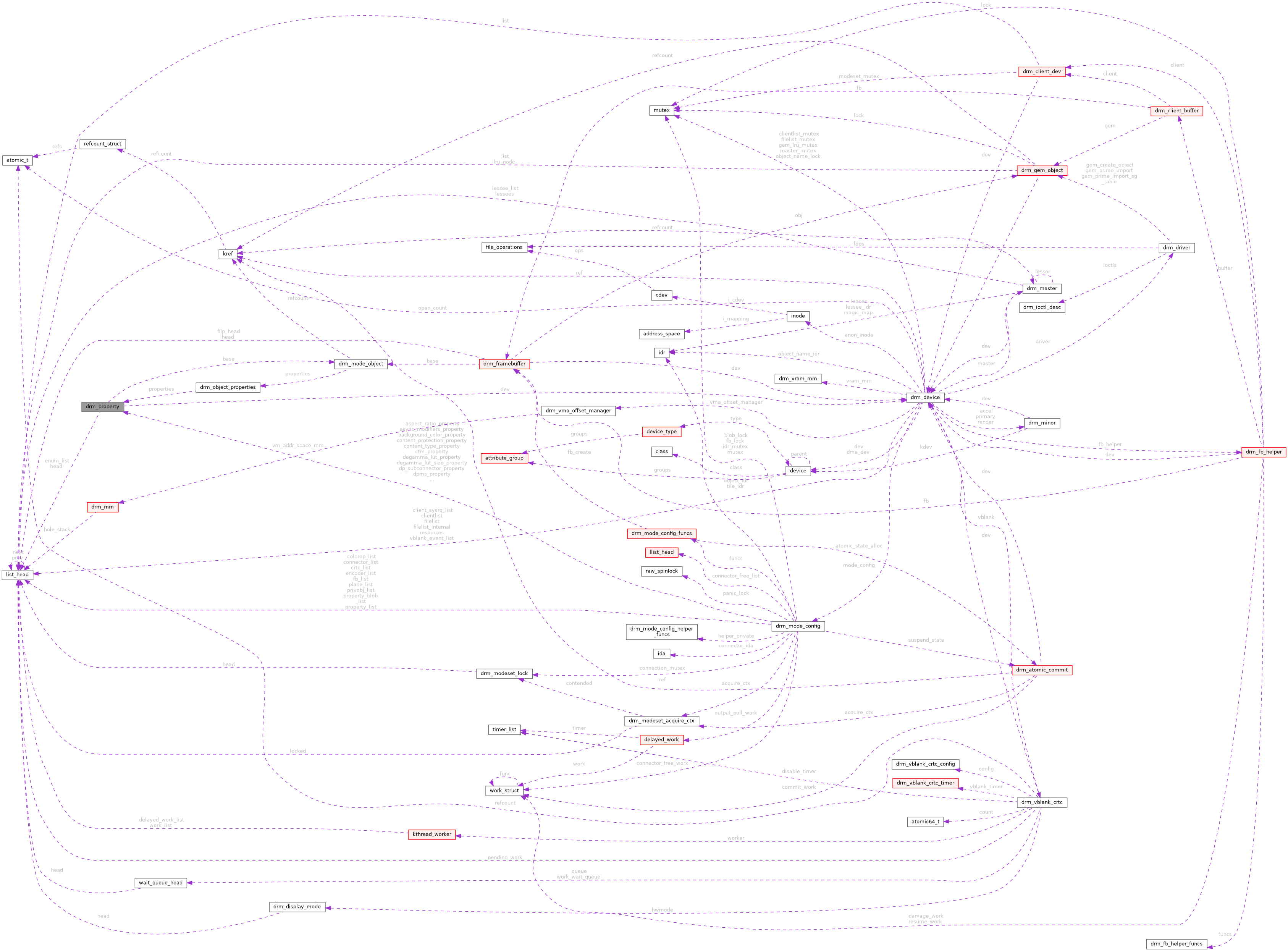
Public Attributes | |
| struct list_head | head |
| struct drm_mode_object | base |
| uint32_t | flags |
: symbolic name of the properties | |
| char | name [DRM_PROP_NAME_LEN] |
| uint32_t | num_values |
| uint64_t * | values |
| struct drm_device * | dev |
| struct list_head | enum_list |
Detailed Description
struct drm_property - modeset object property
This structure represent a modeset object property. It combines both the name of the property with the set of permissible values. This means that when a driver wants to use a property with the same name on different objects, but with different value ranges, then it must create property for each one. An example would be rotation of &drm_plane, when e.g. the primary plane cannot be rotated. But if both the name and the value range match, then the same property structure can be instantiated multiple times for the same object. Userspace must be able to cope with this and cannot assume that the same symbolic property will have the same modeset object ID on all modeset objects.
Properties are created by one of the special functions, as explained in detail in the @flags structure member.
To actually expose a property it must be attached to each object using drm_object_attach_property(). Currently properties can only be attached to &drm_connector, &drm_crtc and &drm_plane.
Properties are also used as the generic metadatatransport for the atomic IOCTL. Everything that was set directly in structures in the legacy modeset IOCTLs (like the plane source or destination windows, or e.g. the links to the CRTC) is exposed as a property with the DRM_MODE_PROP_ATOMIC flag set.
Member Data Documentation
◆ base
| struct drm_mode_object drm_property::base |
@base: base KMS object
◆ dev
| struct drm_device* drm_property::dev |
@dev: DRM device
◆ enum_list
| struct list_head drm_property::enum_list |
@enum_list:
List of &drm_prop_enum_list structures with the symbolic names for enum and bitmask values.
◆ flags
| uint32_t drm_property::flags |
@flags:
Property flags and type. A property needs to be one of the following types:
DRM_MODE_PROP_RANGE Range properties report their minimum and maximum admissible unsigned values. The KMS core verifies that values set by application fit in that range. The range is unsigned. Range properties are created using drm_property_create_range().
DRM_MODE_PROP_SIGNED_RANGE Range properties report their minimum and maximum admissible unsigned values. The KMS core verifies that values set by application fit in that range. The range is signed. Range properties are created using drm_property_create_signed_range().
DRM_MODE_PROP_ENUM Enumerated properties take a numerical value that ranges from 0 to the number of enumerated values defined by the property minus one, and associate a free-formed string name to each value. Applications can retrieve the list of defined value-name pairs and use the numerical value to get and set property instance values. Enum properties are created using drm_property_create_enum().
DRM_MODE_PROP_BITMASK Bitmask properties are enumeration properties that additionally restrict all enumerated values to the 0..63 range. Bitmask property instance values combine one or more of the enumerated bits defined by the property. Bitmask properties are created using drm_property_create_bitmask().
DRM_MODE_PROP_OBJECT Object properties are used to link modeset objects. This is used extensively in the atomic support to create the display pipeline, by linking &drm_framebuffer to &drm_plane, &drm_plane to &drm_crtc and &drm_connector to &drm_crtc. An object property can only link to a specific type of &drm_mode_object, this limit is enforced by the core. Object properties are created using drm_property_create_object().
Object properties work like blob properties, but in a more general fashion. They are limited to atomic drivers and must have the DRM_MODE_PROP_ATOMIC flag set.
DRM_MODE_PROP_BLOB Blob properties store a binary blob without any format restriction. The binary blobs are created as KMS standalone objects, and blob property instance values store the ID of their associated blob object. Blob properties are created by calling drm_property_create() with DRM_MODE_PROP_BLOB as the type.
Actual blob objects to contain blob data are created using drm_property_create_blob(), or through the corresponding IOCTL.
Besides the built-in limit to only accept blob objects blob properties work exactly like object properties. The only reasons blob properties exist is backwards compatibility with existing userspace.
In addition a property can have any combination of the below flags:
DRM_MODE_PROP_ATOMIC Set for properties which encode atomic modeset state. Such properties are not exposed to legacy userspace.
DRM_MODE_PROP_IMMUTABLE Set for properties whose values cannot be changed by userspace. The kernel is allowed to update the value of these properties. This is generally used to expose probe state to userspace, e.g. the EDID, or the connector path property on DP MST sinks. Kernel can update the value of an immutable property by calling drm_object_property_set_value().
◆ head
| struct list_head drm_property::head |
@head: per-device list of properties, for cleanup.
◆ name
| char drm_property::name[DRM_PROP_NAME_LEN] |
◆ num_values
| uint32_t drm_property::num_values |
@num_values: size of the @values array.
◆ values
| uint64_t* drm_property::values |
@values:
Array with limits and values for the property. The interpretation of these limits is dependent upon the type per @flags.
The documentation for this struct was generated from the following file:
- XenevaOS/BaseHdr/drm/drm_property.h
