#include <drm_connector.h>
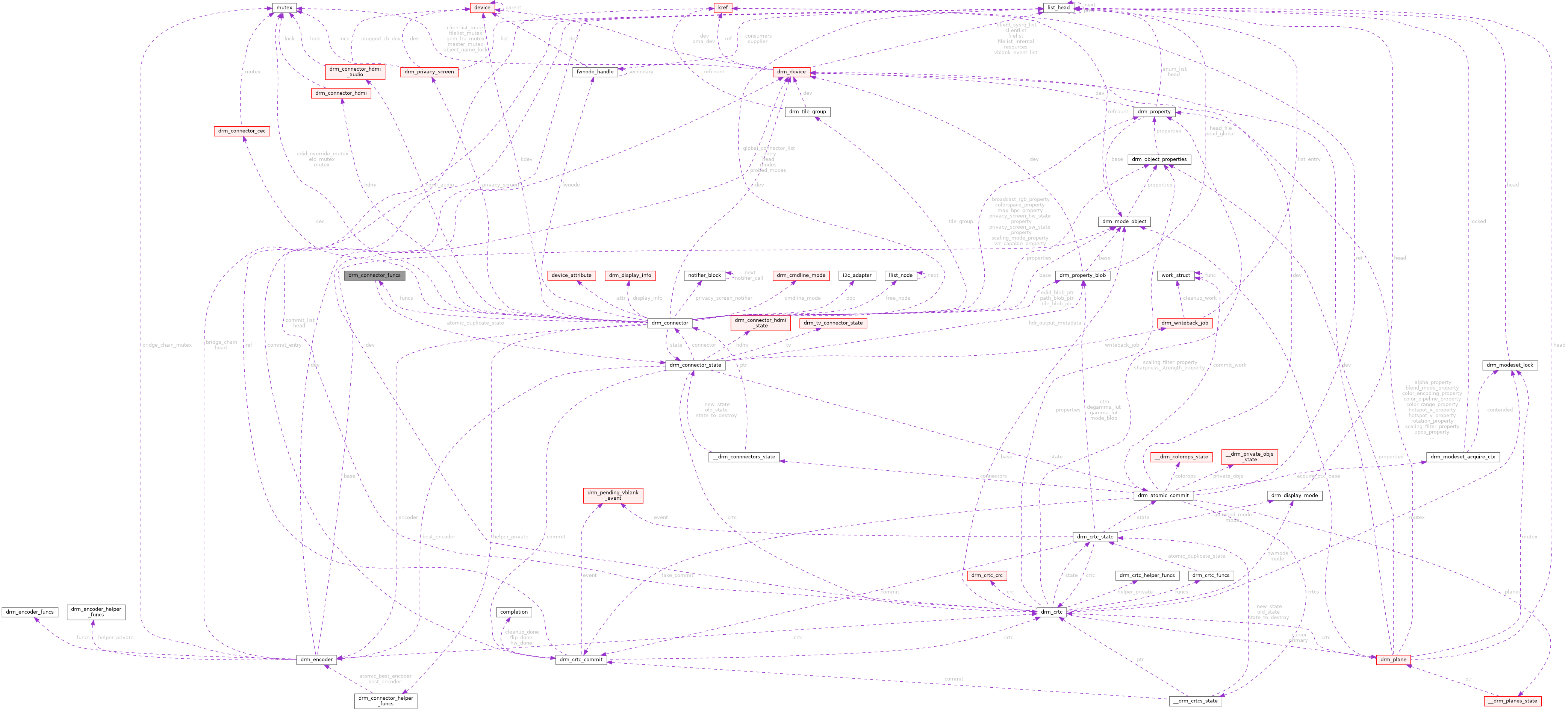
Public Attributes | |
| int(* | dpms )(struct drm_connector *connector, int mode) |
| void(* | reset )(struct drm_connector *connector) |
| enum drm_connector_status(* | detect )(struct drm_connector *connector, bool force) |
| void(* | force )(struct drm_connector *connector) |
| int(* | fill_modes )(struct drm_connector *connector, uint32_t max_width, uint32_t max_height) |
| int(* | set_property )(struct drm_connector *connector, struct drm_property *property, uint64_t val) |
| int(* | late_register )(struct drm_connector *connector) |
| void(* | early_unregister )(struct drm_connector *connector) |
| void(* | destroy )(struct drm_connector *connector) |
| struct drm_connector_state *(* | atomic_duplicate_state )(struct drm_connector *connector) |
| void(* | atomic_destroy_state )(struct drm_connector *connector, struct drm_connector_state *state) |
| int(* | atomic_set_property )(struct drm_connector *connector, struct drm_connector_state *state, struct drm_property *property, uint64_t val) |
| int(* | atomic_get_property )(struct drm_connector *connector, const struct drm_connector_state *state, struct drm_property *property, uint64_t *val) |
| void(* | atomic_print_state )(struct drm_printer *p, const struct drm_connector_state *state) |
| void(* | oob_hotplug_event )(struct drm_connector *connector, enum drm_connector_status status) |
| void(* | debugfs_init )(struct drm_connector *connector, struct dentry *root) |
Detailed Description
struct drm_connector_funcs - control connectors on a given device
Each CRTC may have one or more connectors attached to it. The functions below allow the core DRM code to control connectors, enumerate available modes, etc.
Member Data Documentation
◆ atomic_destroy_state
| void(* drm_connector_funcs::atomic_destroy_state) (struct drm_connector *connector, struct drm_connector_state *state) |
@atomic_destroy_state:
Destroy a state duplicated with @atomic_duplicate_state and release or unreference all resources it references
This callback is mandatory for atomic drivers.
◆ atomic_duplicate_state
| struct drm_connector_state *(* drm_connector_funcs::atomic_duplicate_state) (struct drm_connector *connector) |
@atomic_duplicate_state:
Duplicate the current atomic state for this connector and return it. The core and helpers guarantee that any atomic state duplicated with this hook and still owned by the caller (i.e. not transferred to the driver by calling &drm_mode_config_funcs.atomic_commit) will be cleaned up by calling the @atomic_destroy_state hook in this structure.
This callback is mandatory for atomic drivers.
Atomic drivers which don't subclass &struct drm_connector_state should use drm_atomic_helper_connector_duplicate_state(). Drivers that subclass the state structure to extend it with driver-private state should use __drm_atomic_helper_connector_duplicate_state() to make sure shared state is duplicated in a consistent fashion across drivers.
It is an error to call this hook before &drm_connector.state has been initialized correctly.
NOTE:
If the duplicate state references refcounted resources this hook must acquire a reference for each of them. The driver must release these references again in @atomic_destroy_state.
RETURNS:
Duplicated atomic state or NULL when the allocation failed.
◆ atomic_get_property
| int(* drm_connector_funcs::atomic_get_property) (struct drm_connector *connector, const struct drm_connector_state *state, struct drm_property *property, uint64_t *val) |
@atomic_get_property:
Reads out the decoded driver-private property. This is used to implement the GETCONNECTOR IOCTL.
Do not call this function directly, use drm_atomic_connector_get_property() instead.
This callback is optional if the driver does not support any driver-private atomic properties.
RETURNS:
0 on success, -EINVAL if the property isn't implemented by the driver (which shouldn't ever happen, the core only asks for properties attached to this connector).
◆ atomic_print_state
| void(* drm_connector_funcs::atomic_print_state) (struct drm_printer *p, const struct drm_connector_state *state) |
@atomic_print_state:
If driver subclasses &struct drm_connector_state, it should implement this optional hook for printing additional driver specific state.
Do not call this directly, use drm_atomic_connector_print_state() instead.
◆ atomic_set_property
| int(* drm_connector_funcs::atomic_set_property) (struct drm_connector *connector, struct drm_connector_state *state, struct drm_property *property, uint64_t val) |
@atomic_set_property:
Decode a driver-private property value and store the decoded value into the passed-in state structure. Since the atomic core decodes all standardized properties (even for extensions beyond the core set of properties which might not be implemented by all drivers) this requires drivers to subclass the state structure.
Such driver-private properties should really only be implemented for truly hardware/vendor specific state. Instead it is preferred to standardize atomic extension and decode the properties used to expose such an extension in the core.
Do not call this function directly, use drm_atomic_connector_set_property() instead.
This callback is optional if the driver does not support any driver-private atomic properties.
NOTE:
This function is called in the state assembly phase of atomic modesets, which can be aborted for any reason (including on userspace's request to just check whether a configuration would be possible). Drivers MUST NOT touch any persistent state (hardware or software) or data structures except the passed in @state parameter.
Also since userspace controls in which order properties are set this function must not do any input validation (since the state update is incomplete and hence likely inconsistent). Instead any such input validation must be done in the various atomic_check callbacks.
RETURNS:
0 if the property has been found, -EINVAL if the property isn't implemented by the driver (which shouldn't ever happen, the core only asks for properties attached to this connector). No other validation is allowed by the driver. The core already checks that the property value is within the range (integer, valid enum value, ...) the driver set when registering the property.
◆ debugfs_init
| void(* drm_connector_funcs::debugfs_init) (struct drm_connector *connector, struct dentry *root) |
@debugfs_init:
Allows connectors to create connector-specific debugfs files.
◆ destroy
| void(* drm_connector_funcs::destroy) (struct drm_connector *connector) |
@destroy:
Clean up connector resources. This is called at driver unload time through drm_mode_config_cleanup(). It can also be called at runtime when a connector is being hot-unplugged for drivers that support connector hotplugging (e.g. DisplayPort MST).
◆ detect
| enum drm_connector_status(* drm_connector_funcs::detect) (struct drm_connector *connector, bool force) |
@detect:
Check to see if anything is attached to the connector. The parameter force is set to false whilst polling, true when checking the connector due to a user request. force can be used by the driver to avoid expensive, destructive operations during automated probing.
This callback is optional, if not implemented the connector will be considered as always being attached.
FIXME:
Note that this hook is only called by the probe helper. It's not in the helper library vtable purely for historical reasons. The only DRM core entry point to probe connector state is @fill_modes.
Note that the helper library will already hold &drm_mode_config.connection_mutex. Drivers which need to grab additional locks to avoid races with concurrent modeset changes need to use &drm_connector_helper_funcs.detect_ctx instead.
Also note that this callback can be called no matter the state the connector is in. Drivers that need the underlying device to be powered to perform the detection will first need to make sure it's been properly enabled.
RETURNS:
drm_connector_status indicating the connector's status.
◆ dpms
| int(* drm_connector_funcs::dpms) (struct drm_connector *connector, int mode) |
@dpms:
Legacy entry point to set the per-connector DPMS state. Legacy DPMS is exposed as a standard property on the connector, but diverted to this callback in the drm core. Note that atomic drivers don't implement the 4 level DPMS support on the connector any more, but instead only have an on/off "ACTIVE" property on the CRTC object.
This hook is not used by atomic drivers, remapping of the legacy DPMS property is entirely handled in the DRM core.
RETURNS:
0 on success or a negative error code on failure.
◆ early_unregister
| void(* drm_connector_funcs::early_unregister) (struct drm_connector *connector) |
@early_unregister:
This optional hook should be used to unregister the additional userspace interfaces attached to the connector from late_register(). It is called from drm_connector_unregister(), early in the driver unload sequence to disable userspace access before data structures are torndown.
This is called while holding &drm_connector.mutex.
◆ fill_modes
| int(* drm_connector_funcs::fill_modes) (struct drm_connector *connector, uint32_t max_width, uint32_t max_height) |
@fill_modes:
Entry point for output detection and basic mode validation. The driver should reprobe the output if needed (e.g. when hotplug handling is unreliable), add all detected modes to &drm_connector.modes and filter out any the device can't support in any configuration. It also needs to filter out any modes wider or higher than the parameters max_width and max_height indicate.
The drivers must also prune any modes no longer valid from &drm_connector.modes. Furthermore it must update &drm_connector.status and &drm_connector.edid. If no EDID has been received for this output connector->edid must be NULL.
Drivers using the probe helpers should use drm_helper_probe_single_connector_modes() to implement this function.
RETURNS:
The number of modes detected and filled into &drm_connector.modes.
◆ force
| void(* drm_connector_funcs::force) (struct drm_connector *connector) |
@force:
This function is called to update internal encoder state when the connector is forced to a certain state by userspace, either through the sysfs interfaces or on the kernel cmdline. In that case the @detect callback isn't called.
FIXME:
Note that this hook is only called by the probe helper. It's not in the helper library vtable purely for historical reasons. The only DRM core entry point to probe connector state is @fill_modes.
◆ late_register
| int(* drm_connector_funcs::late_register) (struct drm_connector *connector) |
@late_register:
This optional hook can be used to register additional userspace interfaces attached to the connector, light backlight control, i2c, DP aux or similar interfaces. It is called late in the driver load sequence from drm_connector_register() when registering all the core drm connector interfaces. Everything added from this callback should be unregistered in the early_unregister callback.
This is called while holding &drm_connector.mutex.
Returns:
0 on success, or a negative error code on failure.
◆ oob_hotplug_event
| void(* drm_connector_funcs::oob_hotplug_event) (struct drm_connector *connector, enum drm_connector_status status) |
@oob_hotplug_event:
This will get called when a hotplug-event for a drm-connector has been received from a source outside the display driver / device.
◆ reset
| void(* drm_connector_funcs::reset) (struct drm_connector *connector) |
@reset:
Reset connector hardware and software state to off. This function isn't called by the core directly, only through drm_mode_config_reset(). It's not a helper hook only for historical reasons.
Atomic drivers can use drm_atomic_helper_connector_reset() to reset atomic state using this hook.
◆ set_property
| int(* drm_connector_funcs::set_property) (struct drm_connector *connector, struct drm_property *property, uint64_t val) |
@set_property:
This is the legacy entry point to update a property attached to the connector.
This callback is optional if the driver does not support any legacy driver-private properties. For atomic drivers it is not used because property handling is done entirely in the DRM core.
RETURNS:
0 on success or a negative error code on failure.
The documentation for this struct was generated from the following file:
- XenevaOS/BaseHdr/drm/drm_connector.h
