#include <drm_modeset_helper_vtables.h>
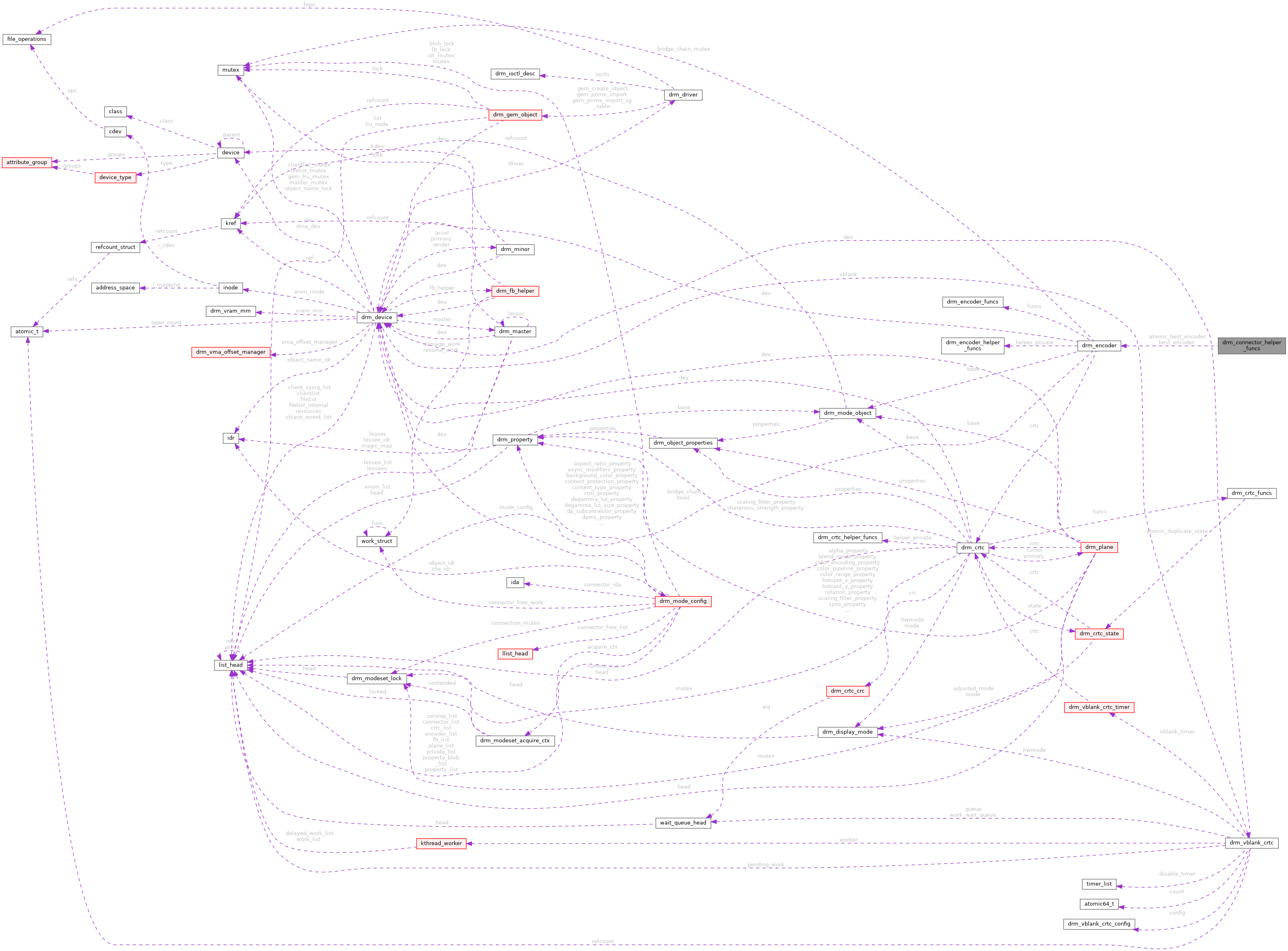
Detailed Description
struct drm_connector_helper_funcs - helper operations for connectors
These functions are used by the atomic and legacy modeset helpers and by the probe helpers.
Member Data Documentation
◆ atomic_best_encoder
| struct drm_encoder *(* drm_connector_helper_funcs::atomic_best_encoder) (struct drm_connector *connector, struct drm_atomic_commit *state) |
@atomic_best_encoder:
This is the atomic version of @best_encoder for atomic drivers which need to select the best encoder depending upon the desired configuration and can't select it statically.
This function is used by drm_atomic_helper_check_modeset(). If it is not implemented, the core will fallback to @best_encoder (or drm_connector_get_single_encoder() if @best_encoder is NULL).
NOTE:
This function is called in the check phase of an atomic update. The driver is not allowed to change anything outside of the &drm_atomic_commit update tracking structure passed in.
RETURNS:
Encoder that should be used for the given connector and connector state, or NULL if no suitable encoder exists. Note that the helpers will ensure that encoders aren't used twice, drivers should not check for this.
◆ atomic_check
| int(* drm_connector_helper_funcs::atomic_check) (struct drm_connector *connector, struct drm_atomic_commit *state) |
@atomic_check:
This hook is used to validate connector state. This function is called from &drm_atomic_helper_check_modeset, and is called when a connector property is set, or a modeset on the crtc is forced.
Because &drm_atomic_helper_check_modeset may be called multiple times, this function should handle being called multiple times as well.
This function is also allowed to inspect any other object's state and can add more state objects to the atomic commit if needed. Care must be taken though to ensure that state check and compute functions for these added states are all called, and derived state in other objects all updated. Again the recommendation is to just call check helpers until a maximal configuration is reached.
NOTE:
This function is called in the check phase of an atomic update. The driver is not allowed to change anything outside of the free-standing state objects passed-in or assembled in the overall &drm_atomic_commit update tracking structure.
RETURNS:
0 on success, -EINVAL if the state or the transition can't be supported, -ENOMEM on memory allocation failure and -EDEADLK if an attempt to obtain another state object ran into a &drm_modeset_lock deadlock.
◆ atomic_commit
| void(* drm_connector_helper_funcs::atomic_commit) (struct drm_connector *connector, struct drm_atomic_commit *state) |
@atomic_commit:
This hook is to be used by drivers implementing writeback connectors that need a point when to commit the writeback job to the hardware. The writeback_job to commit is available in the new connector state, in &drm_connector_state.writeback_job.
This hook is optional.
This callback is used by the atomic modeset helpers.
◆ best_encoder
| struct drm_encoder *(* drm_connector_helper_funcs::best_encoder) (struct drm_connector *connector) |
@best_encoder:
This function should select the best encoder for the given connector.
This function is used by both the atomic helpers (in the drm_atomic_helper_check_modeset() function) and in the legacy CRTC helpers.
NOTE:
In atomic drivers this function is called in the check phase of an atomic update. The driver is not allowed to change or inspect anything outside of arguments passed-in. Atomic drivers which need to inspect dynamic configuration state should instead use @atomic_best_encoder.
You can leave this function to NULL if the connector is only attached to a single encoder. In this case, the core will call drm_connector_get_single_encoder() for you.
RETURNS:
Encoder that should be used for the given connector and connector state, or NULL if no suitable encoder exists. Note that the helpers will ensure that encoders aren't used twice, drivers should not check for this.
◆ cleanup_writeback_job
| void(* drm_connector_helper_funcs::cleanup_writeback_job) (struct drm_writeback_connector *connector, struct drm_writeback_job *job) |
@cleanup_writeback_job:
This optional connector operation is used to support the cleanup of writeback jobs. The job cleanup operation is called from the existing drm_writeback_cleanup_job() function, invoked both when destroying the job as part of an aborted commit, or when the job completes.
This operation is optional.
This callback is used by the atomic modeset helpers.
◆ detect_ctx
| int(* drm_connector_helper_funcs::detect_ctx) (struct drm_connector *connector, struct drm_modeset_acquire_ctx *ctx, bool force) |
@detect_ctx:
Check to see if anything is attached to the connector. The parameter force is set to false whilst polling, true when checking the connector due to a user request. force can be used by the driver to avoid expensive, destructive operations during automated probing.
This callback is optional, if not implemented the connector will be considered as always being attached.
This is the atomic version of &drm_connector_funcs.detect.
To avoid races against concurrent connector state updates, the helper libraries always call this with ctx set to a valid context, and &drm_mode_config.connection_mutex will always be locked with the ctx parameter set to this ctx. This allows taking additional locks as required.
RETURNS:
&drm_connector_status indicating the connector's status, or the error code returned by drm_modeset_lock(), -EDEADLK.
◆ disable_hpd
| void(* drm_connector_helper_funcs::disable_hpd) (struct drm_connector *connector) |
@disable_hpd:
Disable hot-plug detection for the connector.
This operation is optional.
This callback is used by the drm_kms_helper_poll_disable() helpers.
This operation does not need to perform any hpd state tracking as the DRM core handles that maintenance and ensures the calls to enable and disable hpd are balanced.
◆ enable_hpd
| void(* drm_connector_helper_funcs::enable_hpd) (struct drm_connector *connector) |
@enable_hpd:
Enable hot-plug detection for the connector.
This operation is optional.
This callback is used by the drm_kms_helper_poll_enable() helpers.
This operation does not need to perform any hpd state tracking as the DRM core handles that maintenance and ensures the calls to enable and disable hpd are balanced.
◆ get_modes
| int(* drm_connector_helper_funcs::get_modes) (struct drm_connector *connector) |
@get_modes:
This function should fill in all modes currently valid for the sink into the &drm_connector.probed_modes list. It should also update the EDID property by calling drm_connector_update_edid_property().
The usual way to implement this is to cache the EDID retrieved in the probe callback somewhere in the driver-private connector structure. In this function drivers then parse the modes in the EDID and add them by calling drm_add_edid_modes(). But connectors that drive a fixed panel can also manually add specific modes using drm_mode_probed_add(). Drivers which manually add modes should also make sure that the &drm_connector.display_info, &drm_connector.width_mm and &drm_connector.height_mm fields are filled in.
Note that the caller function will automatically add standard VESA DMT modes up to 1024x768 if the .get_modes() helper operation returns no mode and if the connector status is connector_status_connected or connector_status_unknown. There is no need to call drm_add_modes_noedid() manually in that case.
Virtual drivers that just want some standard VESA mode with a given resolution can call drm_add_modes_noedid(), and mark the preferred one using drm_set_preferred_mode().
This function is only called after the @detect hook has indicated that a sink is connected and when the EDID isn't overridden through sysfs or the kernel commandline.
This callback is used by the probe helpers in e.g. drm_helper_probe_single_connector_modes().
To avoid races with concurrent connector state updates, the helper libraries always call this with the &drm_mode_config.connection_mutex held. Because of this it's safe to inspect &drm_connector->state.
RETURNS:
The number of modes added by calling drm_mode_probed_add(). Return 0 on failures (no modes) instead of negative error codes.
◆ mode_valid
| enum drm_mode_status(* drm_connector_helper_funcs::mode_valid) (struct drm_connector *connector, const struct drm_display_mode *mode) |
@mode_valid:
Callback to validate a mode for a connector, irrespective of the specific display configuration.
This callback is used by the probe helpers to filter the mode list (which is usually derived from the EDID data block from the sink). See e.g. drm_helper_probe_single_connector_modes().
This function is optional.
NOTE:
This only filters the mode list supplied to userspace in the GETCONNECTOR IOCTL. Compared to &drm_encoder_helper_funcs.mode_valid, &drm_crtc_helper_funcs.mode_valid and &drm_bridge_funcs.mode_valid, which are also called by the atomic helpers from drm_atomic_helper_check_modeset(). This allows userspace to force and ignore sink constraint (like the pixel clock limits in the screen's EDID), which is useful for e.g. testing, or working around a broken EDID. Any source hardware constraint (which always need to be enforced) therefore should be checked in one of the above callbacks, and not this one here.
To avoid races with concurrent connector state updates, the helper libraries always call this with the &drm_mode_config.connection_mutex held. Because of this it's safe to inspect &drm_connector->state.
RETURNS:
Either &drm_mode_status.MODE_OK or one of the failure reasons in &enum drm_mode_status.
◆ mode_valid_ctx
| int(* drm_connector_helper_funcs::mode_valid_ctx) (struct drm_connector *connector, const struct drm_display_mode *mode, struct drm_modeset_acquire_ctx *ctx, enum drm_mode_status *status) |
@mode_valid_ctx:
Callback to validate a mode for a connector, irrespective of the specific display configuration.
This callback is used by the probe helpers to filter the mode list (which is usually derived from the EDID data block from the sink). See e.g. drm_helper_probe_single_connector_modes().
This function is optional, and is the atomic version of &drm_connector_helper_funcs.mode_valid.
To allow for accessing the atomic state of modesetting objects, the helper libraries always call this with ctx set to a valid context, and &drm_mode_config.connection_mutex will always be locked with the ctx parameter set to @ctx. This allows for taking additional locks as required.
Even though additional locks may be acquired, this callback is still expected not to take any constraints into account which would be influenced by the currently set display state - such constraints should be handled in the driver's atomic check. For example, if a connector shares display bandwidth with other connectors then it would be ok to validate the minimum bandwidth requirement of a mode against the maximum possible bandwidth of the connector. But it wouldn't be ok to take the current bandwidth usage of other connectors into account, as this would change depending on the display state.
Returns: 0 if &drm_connector_helper_funcs.mode_valid_ctx succeeded and wrote the &enum drm_mode_status value to @status, or a negative error code otherwise.
◆ prepare_writeback_job
| int(* drm_connector_helper_funcs::prepare_writeback_job) (struct drm_writeback_connector *connector, struct drm_writeback_job *job) |
@prepare_writeback_job:
As writeback jobs contain a framebuffer, drivers may need to prepare and clean them up the same way they can prepare and clean up framebuffers for planes. This optional connector operation is used to support the preparation of writeback jobs. The job prepare operation is called from drm_atomic_helper_prepare_planes() for struct &drm_writeback_connector connectors only.
This operation is optional.
This callback is used by the atomic modeset helpers.
The documentation for this struct was generated from the following file:
- XenevaOS/BaseHdr/drm/drm_modeset_helper_vtables.h
