#include <drm_crtc.h>
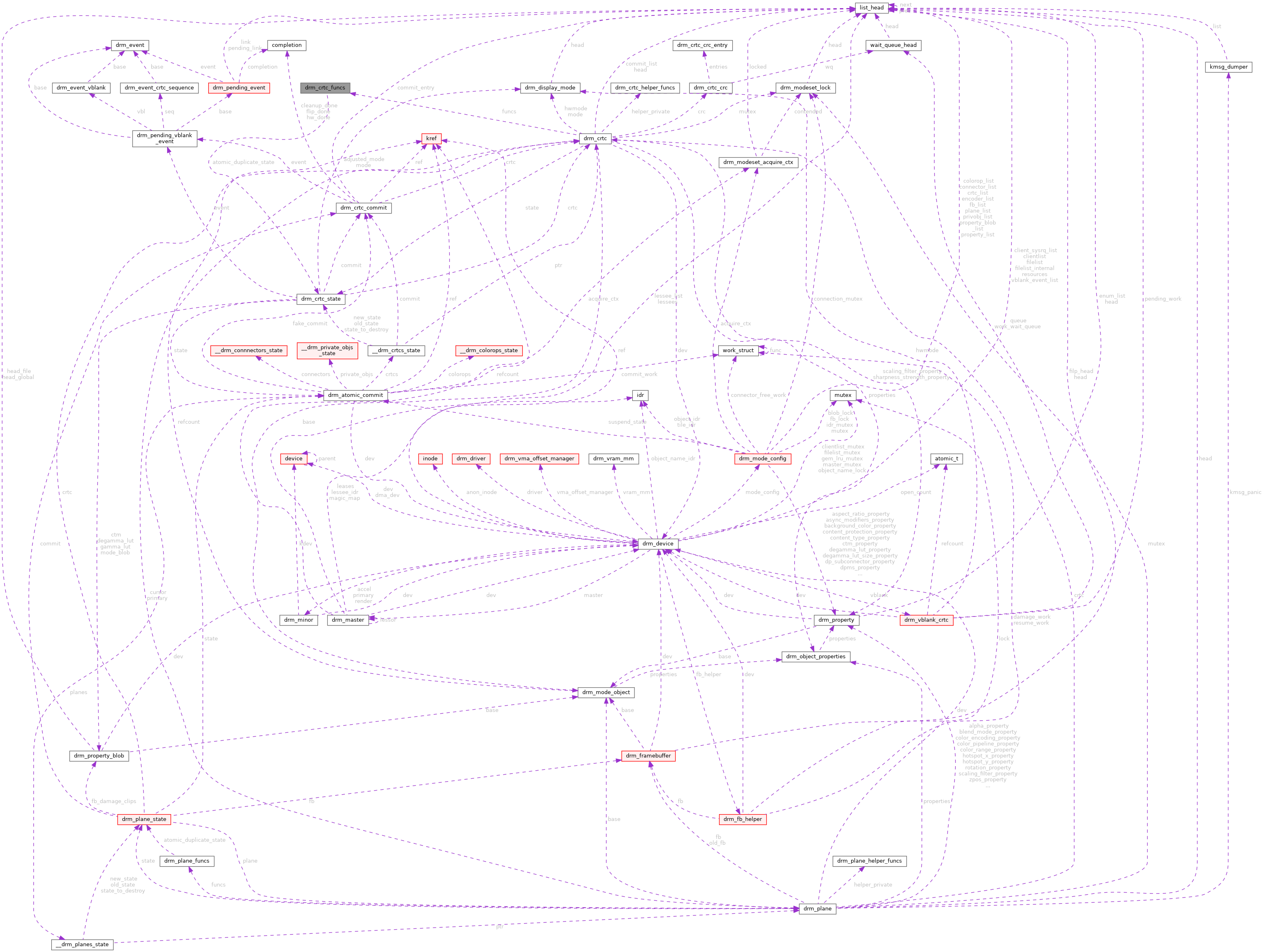
Detailed Description
struct drm_crtc_funcs - control CRTCs for a given device
The drm_crtc_funcs structure is the central CRTC management structure in the DRM. Each CRTC controls one or more connectors (note that the name CRTC is simply historical, a CRTC may control LVDS, VGA, DVI, TV out, etc. connectors, not just CRTs).
Each driver is responsible for filling out this structure at startup time, in addition to providing other modesetting features, like i2c and DDC bus accessors.
Member Data Documentation
◆ atomic_destroy_state
| void(* drm_crtc_funcs::atomic_destroy_state) (struct drm_crtc *crtc, struct drm_crtc_state *state) |
@atomic_destroy_state:
Destroy a state duplicated with @atomic_duplicate_state and release or unreference all resources it references
This callback is mandatory for atomic drivers.
◆ atomic_duplicate_state
| struct drm_crtc_state *(* drm_crtc_funcs::atomic_duplicate_state) (struct drm_crtc *crtc) |
@atomic_duplicate_state:
Duplicate the current atomic state for this CRTC and return it. The core and helpers guarantee that any atomic state duplicated with this hook and still owned by the caller (i.e. not transferred to the driver by calling &drm_mode_config_funcs.atomic_commit) will be cleaned up by calling the @atomic_destroy_state hook in this structure.
This callback is mandatory for atomic drivers.
Atomic drivers which don't subclass &struct drm_crtc_state should use drm_atomic_helper_crtc_duplicate_state(). Drivers that subclass the state structure to extend it with driver-private state should use __drm_atomic_helper_crtc_duplicate_state() to make sure shared state is duplicated in a consistent fashion across drivers.
It is an error to call this hook before &drm_crtc.state has been initialized correctly.
NOTE:
If the duplicate state references refcounted resources this hook must acquire a reference for each of them. The driver must release these references again in @atomic_destroy_state.
RETURNS:
Duplicated atomic state or NULL when the allocation failed.
◆ atomic_get_property
| int(* drm_crtc_funcs::atomic_get_property) (struct drm_crtc *crtc, const struct drm_crtc_state *state, struct drm_property *property, uint64_t *val) |
@atomic_get_property:
Reads out the decoded driver-private property. This is used to implement the GETCRTC IOCTL.
Do not call this function directly, use drm_atomic_crtc_get_property() instead.
This callback is optional if the driver does not support any driver-private atomic properties.
RETURNS:
0 on success, -EINVAL if the property isn't implemented by the driver (which should never happen, the core only asks for properties attached to this CRTC).
◆ atomic_print_state
| void(* drm_crtc_funcs::atomic_print_state) (struct drm_printer *p, const struct drm_crtc_state *state) |
@atomic_print_state:
If driver subclasses &struct drm_crtc_state, it should implement this optional hook for printing additional driver specific state.
Do not call this directly, use drm_atomic_crtc_print_state() instead.
◆ atomic_set_property
| int(* drm_crtc_funcs::atomic_set_property) (struct drm_crtc *crtc, struct drm_crtc_state *state, struct drm_property *property, uint64_t val) |
@atomic_set_property:
Decode a driver-private property value and store the decoded value into the passed-in state structure. Since the atomic core decodes all standardized properties (even for extensions beyond the core set of properties which might not be implemented by all drivers) this requires drivers to subclass the state structure.
Such driver-private properties should really only be implemented for truly hardware/vendor specific state. Instead it is preferred to standardize atomic extension and decode the properties used to expose such an extension in the core.
Do not call this function directly, use drm_atomic_crtc_set_property() instead.
This callback is optional if the driver does not support any driver-private atomic properties.
NOTE:
This function is called in the state assembly phase of atomic modesets, which can be aborted for any reason (including on userspace's request to just check whether a configuration would be possible). Drivers MUST NOT touch any persistent state (hardware or software) or data structures except the passed in @state parameter.
Also since userspace controls in which order properties are set this function must not do any input validation (since the state update is incomplete and hence likely inconsistent). Instead any such input validation must be done in the various atomic_check callbacks.
RETURNS:
0 if the property has been found, -EINVAL if the property isn't implemented by the driver (which should never happen, the core only asks for properties attached to this CRTC). No other validation is allowed by the driver. The core already checks that the property value is within the range (integer, valid enum value, ...) the driver set when registering the property.
◆ cursor_move
@cursor_move:
Update the cursor position. The cursor does not need to be visible when this hook is called.
This entry point is deprecated, drivers should instead implement universal plane support and register a proper cursor plane using drm_crtc_init_with_planes().
This callback is optional.
RETURNS:
0 on success or a negative error code on failure.
◆ cursor_set
| int(* drm_crtc_funcs::cursor_set) (struct drm_crtc *crtc, struct drm_file *file_priv, uint32_t handle, uint32_t width, uint32_t height) |
@cursor_set:
Update the cursor image. The cursor position is relative to the CRTC and can be partially or fully outside of the visible area.
Note that contrary to all other KMS functions the legacy cursor entry points don't take a framebuffer object, but instead take directly a raw buffer object id from the driver's buffer manager (which is either GEM or TTM for current drivers).
This entry point is deprecated, drivers should instead implement universal plane support and register a proper cursor plane using drm_crtc_init_with_planes().
This callback is optional
RETURNS:
0 on success or a negative error code on failure.
◆ cursor_set2
| int(* drm_crtc_funcs::cursor_set2) (struct drm_crtc *crtc, struct drm_file *file_priv, uint32_t handle, uint32_t width, uint32_t height, int32_t hot_x, int32_t hot_y) |
@cursor_set2:
Update the cursor image, including hotspot information. The hotspot must not affect the cursor position in CRTC coordinates, but is only meant as a hint for virtualized display hardware to coordinate the guests and hosts cursor position. The cursor hotspot is relative to the cursor image. Otherwise this works exactly like @cursor_set.
This entry point is deprecated, drivers should instead implement universal plane support and register a proper cursor plane using drm_crtc_init_with_planes().
This callback is optional.
RETURNS:
0 on success or a negative error code on failure.
◆ destroy
@destroy:
Clean up CRTC resources. This is only called at driver unload time through drm_mode_config_cleanup() since a CRTC cannot be hotplugged in DRM.
◆ disable_vblank
@disable_vblank:
Disable vblank interrupts for the CRTC. It's meant to be used by new drivers as the replacement of &drm_driver.disable_vblank hook.
◆ early_unregister
@early_unregister:
This optional hook should be used to unregister the additional userspace interfaces attached to the crtc from @late_register. It is called from drm_dev_unregister(), early in the driver unload sequence to disable userspace access before data structures are torndown.
◆ enable_vblank
@enable_vblank:
Enable vblank interrupts for the CRTC. It's meant to be used by new drivers as the replacement of &drm_driver.enable_vblank hook.
Returns:
Zero on success, appropriate errno if the vblank interrupt cannot be enabled.
◆ gamma_set
| int(* drm_crtc_funcs::gamma_set) (struct drm_crtc *crtc, u16 *r, u16 *g, u16 *b, uint32_t size, struct drm_modeset_acquire_ctx *ctx) |
@gamma_set:
Set gamma on the CRTC.
This callback is optional.
Atomic drivers who want to support gamma tables should implement the atomic color management support, enabled by calling drm_crtc_enable_color_mgmt(), which then supports the legacy gamma interface through the drm_atomic_helper_legacy_gamma_set() compatibility implementation.
◆ get_crc_sources
@get_crc_sources:
Driver callback for getting a list of all the available sources for CRC generation. This callback depends upon verify_crc_source, So verify_crc_source callback should be implemented before implementing this. Driver can pass full list of available crc sources, this callback does the verification on each crc-source before passing it to userspace.
This callback is optional if the driver does not support exporting of possible CRC sources list.
RETURNS:
a constant character pointer to the list of all the available CRC sources. On failure driver should return NULL. count should be updated with number of sources in list. if zero we don't process any source from the list.
◆ get_vblank_counter
@get_vblank_counter:
Driver callback for fetching a raw hardware vblank counter for the CRTC. It's meant to be used by new drivers as the replacement of &drm_driver.get_vblank_counter hook.
This callback is optional. If a device doesn't have a hardware counter, the driver can simply leave the hook as NULL. The DRM core will account for missed vblank events while interrupts where disabled based on system timestamps.
Wraparound handling and loss of events due to modesetting is dealt with in the DRM core code, as long as drivers call drm_crtc_vblank_off() and drm_crtc_vblank_on() when disabling or enabling a CRTC.
See also &drm_device.vblank_disable_immediate and &drm_device.max_vblank_count.
Returns:
Raw vblank counter value.
◆ get_vblank_timestamp
| bool(* drm_crtc_funcs::get_vblank_timestamp) (struct drm_crtc *crtc, int *max_error, ktime_t *vblank_time, bool in_vblank_irq) |
@get_vblank_timestamp:
Called by drm_get_last_vbltimestamp(). Should return a precise timestamp when the most recent vblank interval ended or will end.
Specifically, the timestamp in @vblank_time should correspond as closely as possible to the time when the first video scanline of the video frame after the end of vblank will start scanning out, the time immediately after end of the vblank interval. If the @crtc is currently inside vblank, this will be a time in the future. If the @crtc is currently scanning out a frame, this will be the past start time of the current scanout. This is meant to adhere to the OpenML OML_sync_control extension specification.
Parameters:
crtc: CRTC for which timestamp should be returned. max_error: Maximum allowable timestamp error in nanoseconds. Implementation should strive to provide timestamp with an error of at most max_error nanoseconds. Returns true upper bound on error for timestamp. vblank_time: Target location for returned vblank timestamp. in_vblank_irq: True when called from drm_crtc_handle_vblank(). Some drivers need to apply some workarounds for gpu-specific vblank irq quirks if flag is set.
Returns:
True on success, false on failure, which means the core should fallback to a simple timestamp taken in drm_crtc_handle_vblank().
◆ late_register
@late_register:
This optional hook can be used to register additional userspace interfaces attached to the crtc like debugfs interfaces. It is called late in the driver load sequence from drm_dev_register(). Everything added from this callback should be unregistered in the early_unregister callback.
Returns:
0 on success, or a negative error code on failure.
◆ page_flip
| int(* drm_crtc_funcs::page_flip) (struct drm_crtc *crtc, struct drm_framebuffer *fb, struct drm_pending_vblank_event *event, uint32_t flags, struct drm_modeset_acquire_ctx *ctx) |
@page_flip:
Legacy entry point to schedule a flip to the given framebuffer.
Page flipping is a synchronization mechanism that replaces the frame buffer being scanned out by the CRTC with a new frame buffer during vertical blanking, avoiding tearing (except when requested otherwise through the DRM_MODE_PAGE_FLIP_ASYNC flag). When an application requests a page flip the DRM core verifies that the new frame buffer is large enough to be scanned out by the CRTC in the currently configured mode and then calls this hook with a pointer to the new frame buffer.
The driver must wait for any pending rendering to the new framebuffer to complete before executing the flip. It should also wait for any pending rendering from other drivers if the underlying buffer is a shared dma-buf.
An application can request to be notified when the page flip has completed. The drm core will supply a &struct drm_event in the event parameter in this case. This can be handled by the drm_crtc_send_vblank_event() function, which the driver should call on the provided event upon completion of the flip. Note that if the driver supports vblank signalling and timestamping the vblank counters and timestamps must agree with the ones returned from page flip events. With the current vblank helper infrastructure this can be achieved by holding a vblank reference while the page flip is pending, acquired through drm_crtc_vblank_get() and released with drm_crtc_vblank_put(). Drivers are free to implement their own vblank counter and timestamp tracking though, e.g. if they have accurate timestamp registers in hardware.
This callback is optional.
NOTE:
Very early versions of the KMS ABI mandated that the driver must block (but not reject) any rendering to the old framebuffer until the flip operation has completed and the old framebuffer is no longer visible. This requirement has been lifted, and userspace is instead expected to request delivery of an event and wait with recycling old buffers until such has been received.
RETURNS:
0 on success or a negative error code on failure. Note that if a page flip operation is already pending the callback should return -EBUSY. Pageflips on a disabled CRTC (either by setting a NULL mode or just runtime disabled through DPMS respectively the new atomic "ACTIVE" state) should result in an -EINVAL error code. Note that drm_atomic_helper_page_flip() checks this already for atomic drivers.
◆ page_flip_target
| int(* drm_crtc_funcs::page_flip_target) (struct drm_crtc *crtc, struct drm_framebuffer *fb, struct drm_pending_vblank_event *event, uint32_t flags, uint32_t target, struct drm_modeset_acquire_ctx *ctx) |
@page_flip_target:
Same as @page_flip but with an additional parameter specifying the absolute target vertical blank period (as reported by drm_crtc_vblank_count()) when the flip should take effect.
Note that the core code calls drm_crtc_vblank_get before this entry point, and will call drm_crtc_vblank_put if this entry point returns any non-0 error code. It's the driver's responsibility to call drm_crtc_vblank_put after this entry point returns 0, typically when the flip completes.
◆ reset
@reset:
Reset CRTC hardware and software state to off. This function isn't called by the core directly, only through drm_mode_config_reset(). It's not a helper hook only for historical reasons.
Atomic drivers can use drm_atomic_helper_crtc_reset() to reset atomic state using this hook.
◆ set_config
| int(* drm_crtc_funcs::set_config) (struct drm_mode_set *set, struct drm_modeset_acquire_ctx *ctx) |
@set_config:
This is the main legacy entry point to change the modeset state on a CRTC. All the details of the desired configuration are passed in a &struct drm_mode_set - see there for details.
Drivers implementing atomic modeset should use drm_atomic_helper_set_config() to implement this hook.
RETURNS:
0 on success or a negative error code on failure.
◆ set_crc_source
@set_crc_source:
Changes the source of CRC checksums of frames at the request of userspace, typically for testing purposes. The sources available are specific of each driver and a NULL value indicates that CRC generation is to be switched off.
When CRC generation is enabled, the driver should call drm_crtc_add_crc_entry() at each frame, providing any information that characterizes the frame contents in the crcN arguments, as provided from the configured source. Drivers must accept an "auto" source name that will select a default source for this CRTC.
This may trigger an atomic modeset commit if necessary, to enable CRC generation.
Note that "auto" can depend upon the current modeset configuration, e.g. it could pick an encoder or output specific CRC sampling point.
This callback is optional if the driver does not support any CRC generation functionality.
RETURNS:
0 on success or a negative error code on failure.
◆ set_property
| int(* drm_crtc_funcs::set_property) (struct drm_crtc *crtc, struct drm_property *property, uint64_t val) |
@set_property:
This is the legacy entry point to update a property attached to the CRTC.
This callback is optional if the driver does not support any legacy driver-private properties. For atomic drivers it is not used because property handling is done entirely in the DRM core.
RETURNS:
0 on success or a negative error code on failure.
◆ verify_crc_source
| int(* drm_crtc_funcs::verify_crc_source) (struct drm_crtc *crtc, const char *source, size_t *values_cnt) |
@verify_crc_source:
verifies the source of CRC checksums of frames before setting the source for CRC and during crc open. Source parameter can be NULL while disabling crc source.
This callback is optional if the driver does not support any CRC generation functionality.
RETURNS:
0 on success or a negative error code on failure.
The documentation for this struct was generated from the following file:
- XenevaOS/BaseHdr/drm/drm_crtc.h
